29
KK..33 MMaaiinntteennaannccee
The inspection and maintenance intervals depend on the
actual machine operating conditions (total wash hours) and
ambient conditions (presence of dust, damp, etc), therefore
precise time intervals cannot be given. In any case, careful
and periodical machine maintenance is advisable in order to
minimise service interruptions.
Therefore, it is advisable to:
• Descale the boiler, inner surfaces of the tank and the
machine's pipes once or twice a year (call the After-Sales
Service).
• Every month descale the prewash, wash and rinse jets
with vinegar or scale remover.
• The internal tube of the peristaltic rinse aid and detergent
dispenser must undergo periodical maintenance (once or
twice a year).
It is also advisable to sign a preventive and scheduled
maintenance contract with the After-Sales Service
KK..33..11 PPrroolloonnggeedd ppeerriioodd ooff iinnaaccttiivviittyy
If the dishwasher is not to be used for a long time, proceed as
follows:
• Close the water supply tap.
• Completely drain the tank.
• Remove and carefully clean the filters.
• Completely drain the incorporated dispenser hoses,
removing them from the containers. Repeat the procedure
described in the paragraph H.1
Manual activation
at least 3
times.
• Completely drain the boiler (see paragraph K.4
Boiler
drainage
).
• Spread a thin film of Vaseline oil over all the stain-less
steel surfaces.
KK..44 BBooiilleerr ddrraaiinnaaggee
If the appliance is not to be used for a long time, empty out
the boiler to prevent any malfunction and/or mildew and
unpleasant odours.
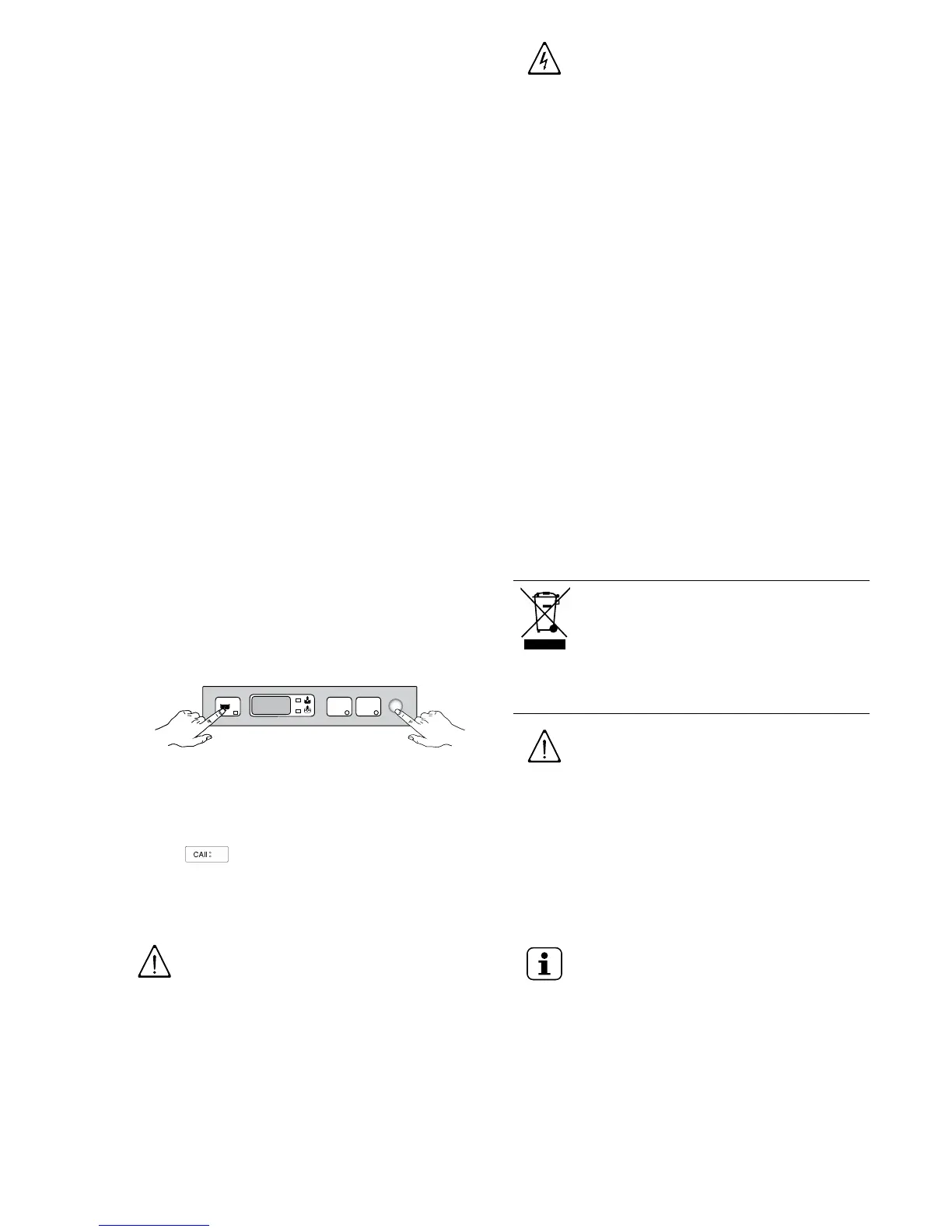
• Press simultaneously the buttons as shown in the figure.
• A buzzer indicates completion of drainage.
KK..55 PPrreevveennttiivvee mmaaiinntteennaannccee
The preventive maintenance call may be activated (see
service manuals). Upon reaching the set number of cycles (e.
g. 20000), appears on the display.
This message advises calling a qualified technician fora
general check-up of the state of the appliance.
KK..66 IInnttrroodduuccttiioonn
WWAARRNNIINNGG
Dismantling operations must
be carried out by qualified
personnel.
WWAARRNNIINNGG
Work on the electrical
equipment must only be
carried out by a qualified
electrician, with the power
supply disconnected.
KK..77 WWaassttee ssttoorraaggee
At the end of the product's life-cycle, make sure it is not
dispersed in the environment. The doors must be removed
before scrapping the appliance.
SPECIAL waste materials can be stored temporarily while
awaiting treatment for disposal and/or permanent storage. In
any case, the current environmental protection laws in the
user's country must be observed.
KK..88 PPrroocceedduurree rreeggaarrddiinngg aapppplliiaannccee
ddiissmmaannttlliinngg mmaaccrroo ooppeerraattiioonnss
Before disposing of the machine, make sure to carefully
check its physical condition, and in particular any parts of the
structure that can give or break during scrapping.
The machine's parts must be disposed of in a differentiated
way, according to their different characteristics (e. g. metals,
oils, greases, plastic, rubber, etc.).
Different regulations are in force in the various countries,
therefore comply with the provisions of the laws and
competent bodies in the country where scrapping takes place.
In general, the appliance must be taken to a specialised
collection/ scrapping centre.
The symbol on the product indicates that this
product should not be treated as domestic
waste, but must be correctly disposed of in
order to prevent any negative consequences
for the environment and human health. For
further information on the recycling of this
product, contact the local dealer or agent, the
after-sales service or the local body
responsible for waste disposal.
WWAARRNNIINNGG
Make the appliance
unusable by removing the
power cable and any
compartment closing
devices, to prevent the
possibility of someone
becoming trapped inside.
NOTE!
When scrapping the machine, the “CE“ marking,
this manual and other documents concerning the
appliance must be destroyed.


 To Next Page
 Loading...