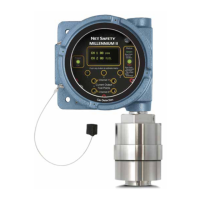
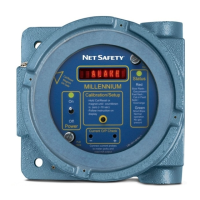
• Locate the transmitter where it will be accessible and visible.
• Mount the APM sensor so air currents allow particulate to flow into the optical path
of the sensor.
• If the particulate is expected to be moving horizontally due to air currents, orient the
sensor for maximum detection as shown in Figure 2-1.
• Exposure to excessive heat or vibration can cause premature failure of electronic
devices and should be avoided whenever possible.
• Seek advice from experts and refer to various regulatory publications that discuss
general guidelines for your industry.
• The APM works off of the principle of infrared energy being reflected off of
particulate matter passing through the optical path of the APM. Therefore, give
careful consideration when installing the APM to ensure that external infrared light
does not reach the sensing element.
Figure 2-2 illustrates a typical installation of an APM sensor and transmitter. The APM
sensor is mounted separately from the transmitter using the supplied junction box. The
transmitter is located at eye level, while the sensor is located where particles are most
likely to accumulate. The conduit then connects the two devices.
Installation
4


 To Next Page
 Loading...