5 Maintenance
5.1 Response check
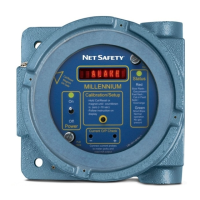
It is recommended that the APM be checked and tested at least once every three months.
Spray Smoke Detector Tester (or equivalent product) in the direction of the sensor from a
distance of two feet. Typically, a one to two second burst is adequate to initiate an alarm.
When the alarm activates, the display will read Alarm, the Status LED will flash red, and the
current output will be 20.0 mA to indicate detection of particulate matter or canned
contaminant.
After simulation, reset the alarm if latched as outlined in Section 3.4 and zero the APM as
per Section 4.3.1 in clear air free of particulates or at the accepted particulate background
level for the specific application.
Note
The overuse of artificial particulate detector testers or spraying from too close a range may impair
the operation of the APM due to the accumulation of an oily film on the internal window.
5.2
Cleaning
The APM Sensor should be routinely cleaned. The frequency of cleaning will depend on the
application and environment where the APM is installed.
When the Dirty Chamber or Clean Window Alarm message is displayed, the lens / window
and chamber will require cleaning. Follow the steps below when cleaning.
Procedure
1. Turn off power to the transmitter.
2. Unscrew bolts at the end of circular plate and connecting rods.
3. Using the included window cleaning kit (HDW-0061), clean the inner sides of the
sensor chamber and front side of the lens / window.
4. Ensure that there is no residue left on the lens or window.
5. Put the circular plate back into position, ensuring that the textured surface faces the
APM window, and screw in the bolts at the end of the connecting rods.
6. Return power to the APM and check for normal operation.
7. Complete the Zero procedure to establish new settings.
If problems develop and persist, contact Net Safety Service department or refer to
Section 1.3 (Return of material).
Maintenance
35


 To Next Page
 Loading...