The VCA has an audio input, a control and an audio output. You can externally control the amount of
reverberation by the mod input.
By default the reverberation output is connected to the third input of the mixer. That allows you to create
feedback effects.
MODULATIONS
The modulation sources unlock the expressivity of the synth. The first is an envelope, pre-patched to the
cutoff on filter pole 1.
Envelope
The envelope offers 2 modes of operation - AR and AD
In AR mode (attack/release) the trigger input acts as a gate. The envelope stays open until the gate is
released.
In AD mode (attack/decay) the envelope continues up to the end of it's cycle even if the gate is released.
If you want to play chords we suggest you to use AR mode and if you play with the sequencer the AD might
give better results, but of course experiment with both to create your own approach.
LFO
The LFO section is pre-patched to cutoff pole 2 and features seven selectable waveforms - triangle , sine,
ramp down , ramp up , and 3 different random modes. The 8th selection which is the sequencer CV out
(allowing the sequencer to be patched to the input of other compatible devices). Speed is set using the
'speed' knob. An additional square output has been included which can be useful for triggering clock resets.
The square pulse width is determined by the LFO waveform, the random mode won't give you a perfect
square.
A slew limiter (with CV signal in and out) enables you to round the waveforms coming from the LFO. By
default the main LFO output is connected to the slew in.
Noise
A noise output gives you an additional modulation source, which can also be used as an audio source
SEQUENCER
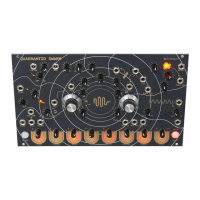
The internal sequencer offers you 8 steps. On each step you can control the CV and the gate. To active a
gate, simply press on the touch keyboard. To change the pitch use the individual potentiometers on each
step. The CV is internally connected to the VCO's frequency. And the gate output to the gate of the
envelope. It is not possible to control an external sound source from the internal sequencer except by using
the 8th preset on the LFO. In this mode you will have the sequencer output with a 0-5v range. It's speed is
controlled by the LFO and not the sequencer clock.
The sequencer clock has its individual output. To sync the sequencer to an external clock, use the clock
input. A trigger signal at the reset input reset the sequence to step 1.
The start button enables you to start and stop the sequence.
POLYPHONIC MODE
By holding shift and pressing the start button you can switch for monophonic mode to polyphonic mode.
In polyphonic mode the spread mode will have no function. Each of the 8 vcos is controlled by the 8 touch
keys. The individual frequency of each vco is controlled by the potentiometers above each key. Each VCO


 To Next Page
 Loading...