Need help?
Do you have a question about the Esatto EUF172S and is the answer not in the manual?
Defines acceptable use and restrictions for the appliance.
Covers voltage, earthing, connection, and power cord safety guidelines.
Details procedures for defrosting and cleaning the appliance.
Outlines the terms and conditions for product warranties.
This document serves as the user manual for the Esatto 162L Upright Freezer, available in models EUF172W and EUF172S. It provides comprehensive instructions for installation, operation, maintenance, and troubleshooting, ensuring optimal performance and safety.
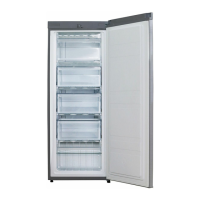
The Esatto Upright Freezer is designed for domestic household use, intended for indoor environments. Its primary function is to freeze and store food items, maintaining their quality over extended periods. The appliance features a thermostat for temperature control, transparent drawers, flip-down compartments, and adjustable feet for stability.
Upon receiving the appliance, it is crucial to unpack it carefully, removing all packaging materials from around and inside the unit. The original packaging should be kept in a safe place for future transportation or storage. Plastic wrapping, a potential suffocation hazard, must be kept away from babies and young children and disposed of safely. The power cord should be unwound and inspected for any damage; a damaged cord or appliance should not be used. Before installation, users are advised to read the manual thoroughly, paying close attention to safety instructions. The interior and exterior surfaces of the appliance should be cleaned with lukewarm water and a soft cloth to remove any dust from transit. Harsh or abrasive detergents are not recommended as they can damage the finish.
Installation requires two or more people due to the appliance's weight, to prevent back or other injuries. The freezer is designed as a freestanding unit and should not be recessed or built-in. It must be placed on a dry, sturdy, level surface capable of supporting its full weight when loaded. The ambient temperature of the room should be between 16°C and 38°C, corresponding to the climate class (T) indicated on the rating plate. Adequate air circulation is essential for the compressor and condenser to cool efficiently. A minimum of 15cm clear space at the back, 20cm at the sides, and 20cm between the top and any surface above is recommended. If placed next to a fixed wall, sufficient space on the hinge side should be left for the door to swing open.
The appliance should not be installed in moist areas, areas of high humidity, recreational vehicles, or with an inverter. Direct sunlight, heat sources (like ovens, grills, or heating appliances), open flames, or any other source of high heat should be avoided, as these can affect the acrylic coating, increase power consumption, and pose fire hazards. For optimal energy efficiency, the freezer should be installed in the coolest area of the room. It should also be protected from elements like wind, rain, water spray, or drips. Storage or use of petrol or other explosive/flammable liquids or fumes near the appliance is strictly prohibited due to the risk of fire or explosion.
For electrical connection, the appliance must be easily disconnected from the mains power supply, meaning the plug should be accessible after installation. Before plugging in, the freezer should stand upright for at least 2 hours to allow refrigerant gases to settle. The appliance must be properly earthed, and the power cord is equipped with a three-prong plug for this purpose. The plug should not be modified, and if it doesn't fit the outlet, a licensed electrician should be consulted. The unit requires a standard 220-240 V AC 50Hz electrical outlet, and the circuit should not be overloaded. The supply cord should be secured behind the unit to prevent damage or accidental disconnection. Inverters, adaptors, or extension cords are not recommended. To prevent electric shock, the unit, cord, or plug should not be immersed in water or sprayed with liquid, and the plug should not be connected or disconnected with wet hands. Always unplug the appliance from the socket when not in use, when moving, or before cleaning/servicing, by gripping the plug directly.
The door can be reversed if needed, a two-person procedure. Tools required include a Phillips head screwdriver, flat blade screwdriver, and hexagonal spanner. Before starting, the freezer must be unplugged and empty, and the levelling feet adjusted to their highest position. The freezer needs to be tilted backward and rested against something solid to prevent slipping. All removed parts must be kept safe for re-assembly. The freezer should not be laid on its back or sides as this can damage the coolant system. The process involves removing plastic covers, unscrewing hinge brackets, sliding the door off, replacing brackets on the opposite side, re-attaching the door, and finally adjusting the levelling feet.
The freezer's temperature is controlled by a thermostat located on the front, above the cavity, visible when the door is open. The temperature setting may need adjustment based on the room's ambient temperature. The dial positions offer different temperature ranges: "Min" for approximately -12°C, "Med" for normal operation at approximately -15°C, and "Max" for the coolest temperature at approximately -20°C. If the unit is unplugged, loses power, or is turned off, a 3 to 5 minute wait is necessary before restarting. When changing the thermostat setting, adjustments should be made one numerical increment at a time, allowing several hours for the temperature to stabilize. For the first use, or after a period out of use, the thermostat should be set to the maximum position (6) for 24 to 48 hours to allow the unit to cool down sufficiently before adding food. Continuous operation is recommended to prolong service life, and frequent turning on and off should be avoided.
Users may notice unusual noises from the freezer, which are typically normal and caused by the circulation of refrigerant liquid in the cooling system. These noises do not indicate a fault and will not affect performance.
To maintain food quality, food should not be stored uncovered. Good quality, freezer-proof packaging should always be used, with air removed from solid food packages and bags sealed tightly before freezing. Portions should be kept small for rapid freezing and defrosting. Fresh, unfrozen food packages should not touch already frozen food to prevent temperature rise. When freezing, food should not be pushed together too much; space should be left for air circulation, and packages should not be placed directly against the back wall. When purchasing frozen food, only buy quantities that can be stored immediately, using an insulated container for transport. For pre-packed, commercially frozen food, follow the manufacturer's storage instructions and do not exceed listed storage times. Opened frozen food packets should be re-wrapped airtight to prevent surface evaporation and freezer burn. Carbonated liquids in bottles should not be placed in the freezer as they can explode. Food should not be refrozen once it has been defrosted. Accidentally thawed frozen food should either be used immediately or discarded. If uncooked and not completely defrosted, it may be cooked and then refrozen. Caution: Do not remove items from the chilling compartment with damp or wet hands to avoid skin abrasions.
For energy efficiency, the appliance should be placed in the coolest area of the room, away from heat-producing appliances or heating ducts, and out of direct sunlight. Hot foods should be allowed to cool to room temperature before being placed in the freezer. Overloading the appliance with unfrozen food should be avoided, as it can slow freezing and risk spoilage. Foods should be wrapped properly and containers wiped dry before placing them in the appliance to reduce frost buildup. Aluminium foil, wax paper, or paper towel should not be used for wrapping items as they interfere with cold air circulation. Organizing and labelling food helps reduce door openings and extended searches; remove as many items as needed at one time, minimizing the frequency of door openings.
Defrosting is necessary when frost on the freezer walls is excessive or thicker than 5mm, for efficient operation and minimum energy consumption. It is best to defrost when the stock of frozen food is low. Boiling water should not be used as it can damage plastic parts, and sharp or metallic instruments should be avoided to prevent damage to cooling coils and voiding the warranty; a plastic scraper is recommended. The process involves removing frozen food and placing it in a cooler, unplugging the freezer, allowing ice to melt (which can be sped up by leaving the door open or pouring warm water, not boiling), cleaning the interior and removing any water, resetting the thermostat, allowing the cabinet to cool for an hour, and then returning food to the freezer.
Before cleaning, the appliance must be switched off and disconnected from the power supply to prevent electric shock or injury. The inside surfaces and interior accessories should be washed with a damp, warm cloth moistened in a solution of water and baking soda (approximately 2 tablespoons of baking soda to 1 litre of water), then rinsed and wiped dry with a soft cloth. The outside of the unit should be cleaned with a damp, well-wrung cloth, keeping the control area dry. The lid gasket (seal) should also be kept clean. Boiling water should never be used to accelerate defrosting. After cleaning/defrosting, the drain plug should be pushed in. Once dry, the appliance can be returned to service, allowing 1-2 hours for the cabinet to cool down. Abrasive, acid, oil, or solvent-based cleaning agents, or flammable fluids/sprays, should never be used, as they can create a fire hazard or explosion.
Users should not attempt to alter, modify, or repair any part of the appliance unless specifically recommended in the manual. All other servicing should be referred to a qualified technician. The after-sales support centre stocks a selection of spare parts for the Esatto 162L Upright Freezer.
Most power failures are corrected within a few hours and typically do not affect the appliance's temperature if the door is opened minimally. If the power outage is expected to be longer, proper steps should be taken to protect the contents.
The manual includes a troubleshooting guide for common issues such as the appliance not operating, not being cold enough, having an odd odour, the door not closing properly, difficulty opening the door, moisture forming on internal or external walls, and vibrations. Each problem is listed with possible causes and corresponding solutions, guiding users to resolve minor issues independently.
 General
| Brand | Esatto |
|---|---|
| Model | EUF172S |
| Category | Freezer |
| Type | Upright Freezer |
| Capacity | 172L |
| Colour | Silver |
| Defrost System | Manual |
| Noise Level | 42 dB |

 To Next Page