A Special Message from David Levy
My journey in astronomy started when I was a child attending summer camp, when I saw a meteor streaking across
the night sky. Later when attending school we were asked to create an essay on the subject of what we were to do
with our lives; I wrote that I wanted to become an astronomer who searched for comets. My teacher told me that my
essay was fine, but that it would be impossible to make a living searching for comets. I put the idea into my mind
where it grew, and finally blossomed in 1960; from that moment I knew I wanted a telescope.
Astronomical exploration and discovery is a personal quest for every astronomer, professional or amateur. And I can
tell you from experience that it is no less thrilling to see the Rings of Saturn for the first time, as it is to discover a new
comet. Although I never took a class in astronomy, over the years I have spent untold thousands of hours searching
for comets, and to date, I have discovered or co-discovered 22 of them, including Comet Shoemaker-Levy 9 that
crashed into Jupiter in 1994. My observations started with a small Newtonian reflector that I affectionately named
Echo. As my interests intensified I obtained many telescopes, all of which I use today. To me, a telescope is much
more than just a piece of equipment; it becomes an extension of me as I explore the stars.
The Comet Hunter telescope was an idea that started years ago when my friend Scott Roberts and I started a dialog
about what kind of telescope would be best for someone who was just getting started to seriously follow their passion
to explore the stars. I told Scott that in order for the telescope to be successfully used for searching for comets that it
had to have a very wide field of view or what is called “rich field”, capable of viewing two or more degrees true field of
view. But in order to be an all around telescope, it also had to work good visually at high powers, and it had to be a
good optical system for astrophotography. We wanted the telescope to be easy to use, portable, reasonably light
weight, rugged, and affordable. This telescope needed to fulfill the roles of a solid performing instrument for the
serious beginner, the public outreach enthusiast, and beginning to advanced astrophotographers… a telescope that
you could use all your life and then be passed on to future generations of would be astronomers.
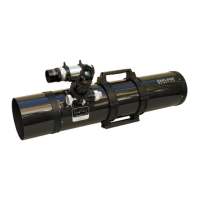
We discussed a lot of ideas, settling on a six inch (152mm) aperture f/4.8 rich field system. We then selected a rugged
Maksutov-Newtonian optical design to give high performance images across the entire field of view over a wide range
of magnifications. To obtain wide field views for scanning for comets and observing faint deep sky objects we include
a 2” O.D. 70° Series 30mm eyepiece that provides nearly 2.9° true field of view at 24x. The finder scope is a special
8x50 correct view (not upside down and backwards like most finder scopes) so that it is easy to match the view in the
finder scope to a star map. To make a worthy telescope for astrophotographers we added a ten-to-one, two-speed
focuser, and a carbon fiber tube to eliminate tube expansion problems, both of which allow precision focusing that can
hold its focus even with temperature changes at night. The dual cradle rings have a slotted handle on top to allow
easy handling and to allow attachment of camera with a standard 1/4x20 bolt. We also included a light-weight carbon
fiber dew shield, and a rugged case to protect the instrument.
I never tire of looking through telescopes, but it’s not the thrill of making a discovery that keeps me going; Exploring
the sky and sharing the experience inspires me to go on to write, lecture, and observe the stars as much as possible. I
have always made time to share the experience of stargazing with people of all ages, and these efforts have
culminated in the National Sharing the Sky Foundation where we bring the excitement of astronomical exploration to
grade schools across the country.
Through a special arrangement with Explore Scientific, sales of this Comet Hunter telescope help support the National
Sharing the Sky Foundation so that we can carry on with our outreach activities. So we encourage you to use your
Comet Hunter as often as possible and to get involved in public outreach in astronomy in your local community. And if
the time ever comes when you wish to retire this instrument, consider making a tax-deductible donation of your
telescope to our non-profit organization, where we will make sure that it will serve in educational outreach programs at
a public school or planetarium. To learn more about us go to www.sharingthesky.org.
Be sure to fill out the warranty registration of your Comet Hunter, and we will send you a certificate of authenticity with
my signature.
Wishing you many starlit nights,
David H. Levy
sharingthesky.org


 To Next Page