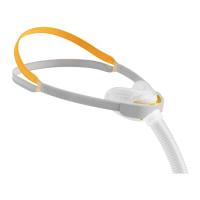
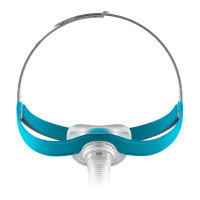
F&P Solo™ mask
Instructions for Use
English
Intended purpose
The F&P Solo mask is intended to be used as a patient interface in a non-invasive
positive airway pressure (PAP) therapy system to deliver pressurized air from the
breathing tube to the patient’s upper airway. The patients are intended to be adults
weighing ≥66 lbs (30 kg). The mask is intended to be used for single patient re-use in
the home for the treatment of a respiratory condition and in a hospital or other clinical
setting to investigate the optimal pressure required for the treatment of a respiratory
condition.
Contraindications
None.
General warnings & cautions
Any serious incident must be reported to the competent authority and your
Fisher&PaykelHealthcare representative.
Warning: Do not use the mask without supervision on patients who are unable
to remove the mask themselves as this may result in excessive carbon dioxide
inhalation if vomiting occurs.
Warning: Do not use the mask if feeling nauseous or vomiting as this may result in
excessive carbon dioxide inhalation if vomiting occurs.
Warning: Do not use the mask unless the PAP device is turned on and operating
properly as this may result in excessive carbon dioxide inhalation.
Warning: This mask is not suitable for life support ventilation as this may result
in death.
Warning: Do not administer drugs or medications into the device or breathing
tube, with the exception of supplemental oxygen, as it may impact the efficacy
of the medicine.
Warning: Do not use the mask outside of the intended purpose as this may result
in a range of harms, some of which are severe.
Caution: Therapy may be compromised if your airway is congested. Use of a
different mask may be recommended in this situation. Consult your healthcare
provider.
Caution: Discontinue use and consult your healthcare provider or physician if you
are experiencing:
• Discomfort or irritation near your eyes as this may result in an eye injury.
• Excessive leaks between the cushion seal and your face as this may result in
compromised therapy.
• An adverse reaction after using the mask, including an allergic reaction.
Possible side effects
While using the F&P Solo mask, you may experience:
•
Difficulty sleeping.
• Facial irritation (pressure sores, skin redness, skin dryness and/or abrasion).
• Oral pain (toothache and/or gum soreness).
• Dental deformation (tooth movement and/or misalignment).
• Claustrophobia and/or anxiety.
• Eye dryness, swelling and/or redness.
If you experience any of the above side effects, including any not listed in these
instructions, discontinue using the F&P Solo mask and consult your physician
immediately. Any other serious incidents must be reported to the competent authority
and your Fisher & Paykel Healthcare representative.
Mask parts & features
i
Refer to the mask diagram on the front panel of these instructions.
(A) Frame (B) Headgear (C) Tube
(D) Swivel (E) Exhaust Holes (F) Nasal Cushion
(G) Pillows Cushion
Operating instructions
Please refer to the Warnings and Cautions
within these instructions. Failure to
follow the operating instructions may compromise the performance and safety of the
mask. Only use your mask for its Intended Purpose as directed in these instructions.
Conditions of use
The operating pressure range of your mask is 4 to 20 cmH
2
O.
Warning: Only use the mask within the specified pressure range. Use outside of
this range may result in excessive carbon dioxide inhalation or excessive leak which
may result in an eye injury.
Warning: Your mask should only be used with approved PAP equipment
recommended by your physician or respiratory therapist. Using the mask with
any other medical device could decrease the safety or alter the performance of
the mask.
The operating temperature range of your mask is 5 to 40 °C (41 to 104 °F).
Store your mask dry in clean conditions. The storage temperature of your mask is
-20 to 50°C (-4 to 122 °F).
Caution: Do not store your mask in direct sunlight as this may compromise the
function of the mask.
Caution: Replace your mask/components after any of the following occur as failure
to do so may compromise the function of the mask.
•
After the expiry date printed on the external label on the mask packaging.
• Mask excluding Headgear: 12 months from date of first use of the Frame (A),
Tube (C), Swivel (D) or Cushion (F or G) Headgear: 6 months from date of first
use of the Headgear (B).
Caution: When storing or traveling with your mask ensure it is stored in such a way
to avoid bending or twisting as this may compromise the function of the mask.
Before use
Before using your mask the first time: Remove all packaging.
Before using your mask each time:
Warning: Make sure the air path through the mask is free from blockages that may
prevent or restrict airflow as this may result in excessive carbon dioxide inhalation.
Warning: Inspect the Exhaust Holes (E). Ensure air is flowing through the exhaust
and do not use if blocked as this may result in excessive carbon dioxide inhalation.
Caution: Inspect the mask for damage or deterioration. If there is any visible
deterioration (cracking, tears, etc.), do not use the mask and seek replacement
part(s) from your healthcare provider as using the mask may result in lacerations
or compromised therapy.
Caution: Inspect the mask for soiling and dust and, if present, follow the cleaning
instructions to remove the soiling or dust as this may result in a range of harms,
some of which are severe.
Fitting your mask
ii
Remove all packaging before using the mask.
Refer to the fitting images inside the front cover of these instructions.
1.
Anchor the grey strap behind your head and pull forward to stretch the Headgear
(B) over your head.
2.
Position the Cushion (F or G) under your nose and orange strap on the top of your
head.
3.
Connect the Swivel (D) to the PAP device breathing tube. Turn on the PAP device.
4.
Pull the Cushion (F or G) away from the nose to loosen the Headgear (B).
5.
Push the Cushion (F or G) into the nose to tighten Headgear (B).
Useful tips:
• Adjustment tip
iii
iv
: The Headgear (B) can be adjusted by lengthening and
shortening the side straps.
• The Cushion (F or G) should seal and feel comfortable under your nose.
• Your nose should never be inside the Nasal Cushion (F) opening.
• If you are experiencing any leaks try repositioning the Cushion (F or G) under
your nose.
Warning: Do not overtighten the mask as this may result in facial deformation.
Caution: Failure to follow fitting instructions or using the incorrect mask size may
result in pressure sores or excessive leak causing eye injury.
Disassembling your mask
v
1. Unclip the front of the Headgear (B) from the Frame (A) located in front of the
Exhaust Holes (E).
2.
Pull the Cushion (F or G) from the Frame (A).
Caution: Do not attempt to remove the swivel as this may compromise the function
of the mask.
Caution: Do not attempt to remove the tube from the frame as this may
compromise the function of the mask.
Assembling your mask
1. Push the Cushion (F or G) on to the Frame (A).
2.
Push the Headgear (B) down on to the Frame (A) in front of the Exhaust Holes (E).
Cleaning your mask at home
Mask excluding Headgear: After each use, wash the Frame (A), Tube (C), Swivel (D)
and Cushion (F or G).
Headgear: After 7 days use, wash the Headgear (B) thoroughly to minimize any
dirt and oil build up to maintain longevity and function.
1.
Disassemble for cleaning as described in the ‘Disassembling your mask’ section
above.
2. Hand-wash the mask parts in soap dissolved in lukewarm water. Do not soak for
more than 10 minutes. Do not extend headgear while wet.
3. Rinse thoroughly in fresh water. Ensure that all soap residue has been removed.
4. Inspect all parts to ensure they are visually clean. If necessary, repeat the cleaning
steps until all parts are visually clean.
5.
Leave all parts to dry out of direct sunlight before reassembling.
Warning: Do not share your mask with another person when using it at home as it
may result in the transfer of biological agents such as viruses or bacteria.
Caution: Only clean the mask with cleaning products specified in the cleaning
guidelines of these instructions, as any other products may result in an adverse
reaction if cleaning residue is left behind.
Caution: Failure to follow the cleaning instructions may compromise the function
of the mask.
Caution: Do not clean the mask with products containing alcohol, antiseptic,
bleach, chlorine or moisturizer as these may compromise the function of the mask.
Caution: Do not clean the mask in a dishwasher as this may compromise the
function of the mask.
Caution: Failure to fully disassemble the mask may compromise the effectiveness
of cleaning and may result in a range of harms, some of which are severe.
Oxygen/pressure port connector
If pressure readings and/or additional oxygen are required, an F&P Oxygen/Pressure
Port Connector is available (REF 900HC452). Please contact your healthcare provider.
Warning: Mask use with supplemental oxygen will create a risk of fire. Do not
smoke, or be in the vicinity of someone smoking, or any other ignition source
while using supplemental oxygen with your mask. This may result in ignition of the
oxygen, leading to serious burns or death.
Use with other PAP devices
Warning: When using the F&P Solo mask with other 22 mm connector (ISO-5356-1)
compatible PAP devices (including an F&P Oxygen/Pressure Port Connector REF
900HC452): Refer to the Instructions for Use for that device as there may be
additional warnings and cautions that if not followed may result in a range of
harms, some of which are severe.
Technical specifications
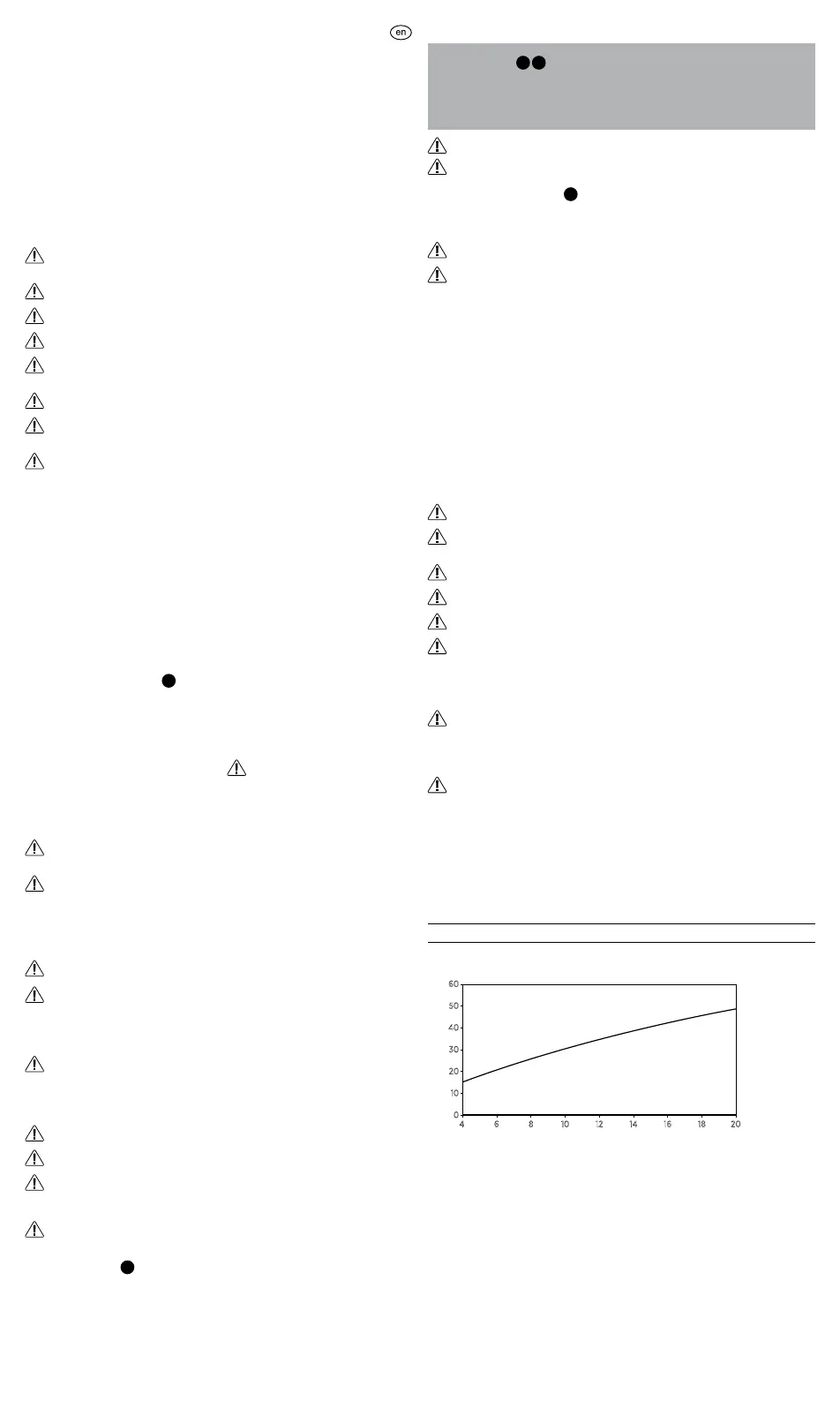
Exhaust flow information
The F&P Solo mask has exhaust holes to expel the air that you exhale from the mask. It
is important that these exhaust holes are not blocked by any object. This controlled leak
ensures exhaled CO
2
is expelled from the mask.
Pressure (cmH
2
O) 4 6 8 10 12 14 16 18 20
Flow (L/min) 15 20 25 29 34 38 42 46 49
Due to manufacturing variations, the exhaust flow rates may vary from the nominal
values shown above.
Exhaust Flow (L/min)
Pressure (cmH
2
O)
30
10
50
40
20
0
60
4 10 12 14 16 18 206 8
Resistance to flow
Pressure drop through the nasal mask at 50 L/min: 0.8 ± 0.5 cmHO.
Pressure drop through the nasal mask at 100 L/min: 2.9 ± 1.0 cmHO.
Pressure drop through the pillows mask at 50 L/min: 1.6 ± 1.1 cmHO.
Pressure drop through the pillows mask at 100 L/min: 6.0 ± 3.1 cmHO.
Mask dead space
Nasal:
Small = 29.6 cm Medium = 26.8 cm Large = 31.1 cm
Wide = 36.9 cm
Pillows:
Small = 25.8 cm Medium = 27.7 cm Large = 30.5 cm
Sound
The sound power level of the mask is 31.5 dBA, with uncertainty ± 2.5 dBA.
The sound pressure level of the mask is 23.6 dBA, with uncertainty ± 2.5 dBA.


 To Next Page
 Loading...