Rigging Instructions Cont.
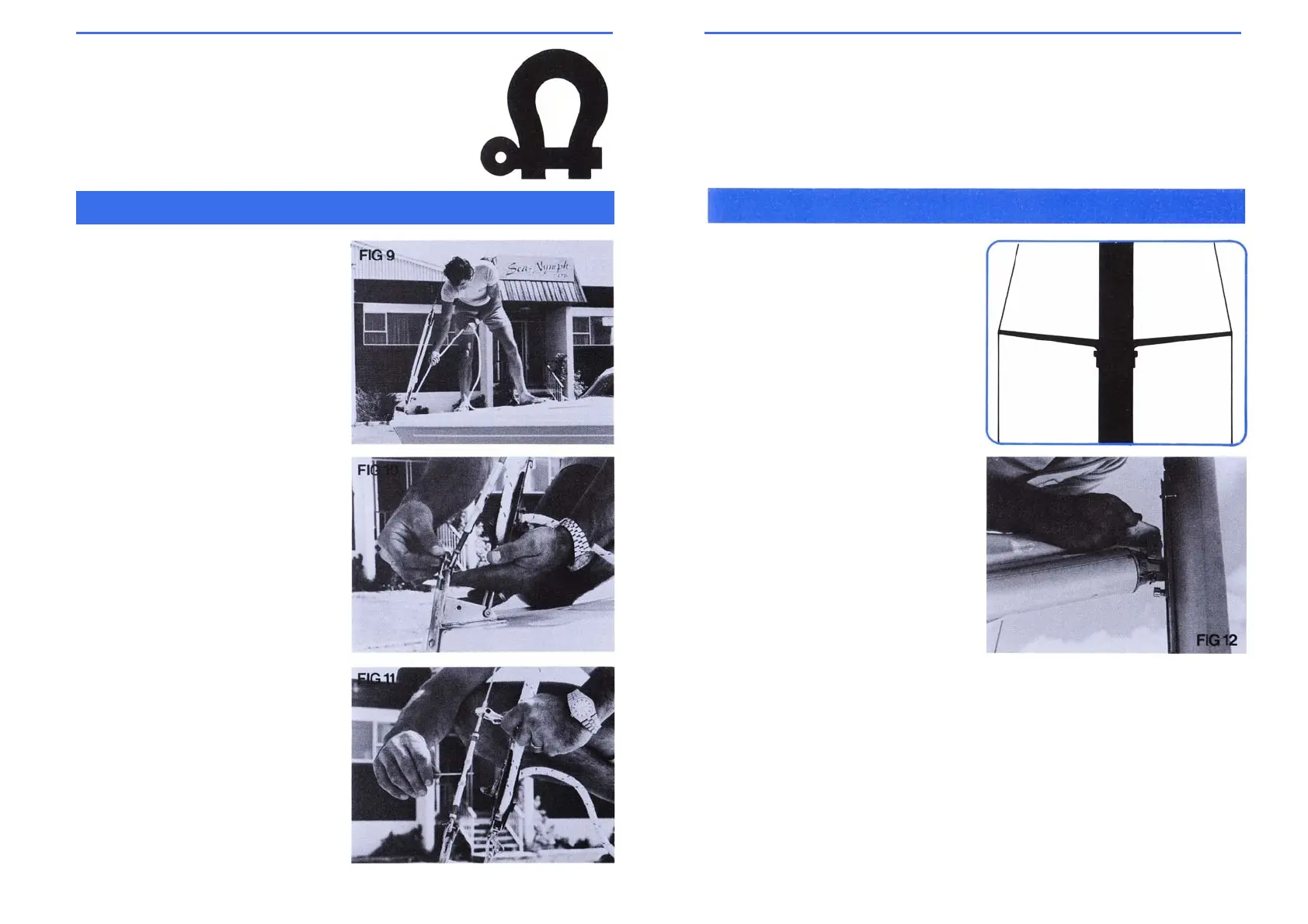
8. Take up tension on the mainsheet
(Fig. 9) and pull the mast forward
until the forestay rigging screw can be
shackled onto the forestay fitting.
(Fig. 10). Then tighten up the rigging
screw (Fig. ll) and remove the
mainsheet.
9. The mast should be set up so that
it is nearly upright, i.e. with very little
rake aft. A method of checking this
rake is to level the boat trailer with
a spirit level, and then use the spirit
level to ensure the mast is
approximately vertical.
10. Similarly, check the mast
athwartships by measuring that the
distance from the top of the mast to
the top of the chainplates is the
same on both sides, or use jib
halyard.
11. Stay Tension — When the mast is
in the correct upright position, the
forestay and upper sidestays should
be tensioned to an extent where they
are quite firm, i.e. The forestay
should be capable of sagging only
about 50 mm (2 inches) with a
reasonable load on it.
Rigging Instructions Cont.
12. Lower stays. Now that the mast
is set up correctly, attach the lower
stays to the forward hole in the
chainplates with the 6 mm stainless
steel shackles provided. The tension
on these stays can be varied, but for
normal sailing or cruising, they
should be done up so that they are
ust tight then backed off three turns.
13. At this point check that the
horizontal angle of the spreaders is
correct. lf they are not locked onto the
stay by some method, they could drop
below their correct position especially
when the mast is being raised.
The correct position is tilted upwards
at the stay as shown.
When the correct position is
obtained the spreaders should be
locked permanently onto the stays
by bending the V ends of the
spreader together. Once this is done,
the end of the spreader should be
taped to prevent wear on the sails.
14. Lay out mainsail, and thread the
boom onto the foot of the sail using
the track opening at the front of the
boom.
15. Attach the sail to the gooseneck
by screwing in pin supplied. (Fig. 12)
21 22


 To Next Page
 Loading...