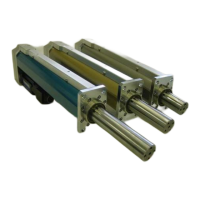
The AFC1500 Multi System is an Electric Servo Nutrunner designed for precision fastening applications. This hardware manual, identified as AFC1500E-HM2-2, provides comprehensive information for its installation, wiring, handling, and troubleshooting.
Function Description:
The AFC1500 Multi System operates as an Electric Servo Nutrunner, utilizing a servo motor for controlled and precise tightening of fasteners. It is designed to be a multi-unit system, suggesting its capability to manage multiple nutrunner tools or operations simultaneously. The system integrates various communication interfaces, allowing it to be controlled and monitored within a larger automation framework, such as a PLC-controlled manufacturing line. Its core function is to execute tightening sequences with high accuracy, providing feedback on the fastening process.
Important Technical Specifications:
While specific numerical values for torque, speed, or power are not detailed in the provided excerpts, the manual outlines several critical aspects of the system's technical design and operational requirements:
- System Components: The system includes the AFC1500 Multi Unit (also referred to as AXIS Unit or SAN Unit) and associated nutrunner tools.
- Power Requirements: The system requires a specified power supply voltage, and safety measures like breakers and circuit protectors are mandatory.
- Environmental Conditions:
- Operation: Ambient temperature range of 0°C to +45°C (avoid freezing), ambient humidity of 90% RH or lower (avoid moisture). It must be operated indoors, free from corrosive gases, flammable gases, oil mist, dust, water, salt, and iron powder. Direct vibration or shocks should be avoided.
- Transportation/Storage: Ambient temperature range of -5°C to +55°C (avoid freezing), ambient humidity of 50% RH or lower for transportation (tight seal package, rust prevention measures required for tools), and 90% RH or lower for storage. Similar atmospheric conditions (indoors, no corrosive/flammable gases, no oil mist/dust/water/salt/iron powder, avoid vibration/shocks) apply to storage.
- Communication Interfaces: The system supports a wide range of industrial communication protocols, indicating its versatility in integration:
- RS485 Connection
- User Console Ethernet Connection (with an optional Ethernet Port for Data Communication)
- Serial Communication Ports (PC Port, Display Port, Data-Out (1) Port, Data-Out (2) Port, Data-In Port)
- PLC Interface Communication (I/O) with Control Interfaces, Input Signals, Output Signals, and Signal Timing Chart.
- Dedicated industrial fieldbus interfaces: Interbus S, DeviceNet, Profibus, Modbus Plus, CC-Link (Version 1 and 2), Allen-Bradley Remote I/O, Ethernet-I/P, and Profinet.
- Physical Dimensions: Unit dimensions are covered in Chapter 2.2.
- Firmware: The system includes a Firmware Flash Connector for updates.
- Safety Features: The manual emphasizes numerous safety precautions, including warnings against electric shock, fire, pinch points, high temperatures, and improper operation. It mandates the use of specified tools, proper grounding (type-3 for FG terminals), and the installation of power shutdown and emergency stop devices.
Usage Features:
- Multi-System Capability: The "Multi System" designation implies the ability to manage and coordinate multiple nutrunner operations, potentially enhancing productivity in complex assembly tasks.
- Extensive Connectivity: The broad array of communication interfaces (Ethernet, RS485, Interbus S, DeviceNet, Profibus, Modbus Plus, CC-Link, Allen-Bradley Remote I/O, Ethernet-I/P, Profinet) allows for seamless integration into diverse industrial automation environments and PLCs. This enables remote control, data exchange, and system monitoring.
- User Console: The presence of a "User Console Ethernet Connection" and "User Console Software Settings" across various interface descriptions suggests a dedicated interface for configuration, monitoring, and diagnostics. The ability to set a default TCP/IP address for the User Console Port further supports network-based management.
- Input/Output Signals: Detailed sections on Input Signals and Output Signals for each communication interface, along with Signal Timing Charts, indicate comprehensive control and feedback capabilities for precise operation and process validation.
- Data Output: The "Data-Out" ports and "Available Output Data" and "Output Data Format" sections suggest that the system provides detailed fastening results and operational data, crucial for quality control and process optimization.
- Tool Compatibility: The system is designed to operate exclusively with FEC-supplied controllers, tools, and cables, ensuring optimal performance and safety.
Maintenance Features:
- Troubleshooting Guide: Chapter 6 is dedicated to "Troubleshooting" and "Abnormals," providing guidance for diagnosing and resolving operational issues.
- Wiring and Parameter Settings: Emphasizes that wiring and parameter settings should only be conducted by qualified professionals, ensuring correct setup and preventing malfunctions.
- Regular Checks: Instructions for checking for abnormal odor, noise, or operation errors, and stopping operation immediately if detected.
- Firmware Updates: The "Firmware Flash Connector" allows for system software updates, which can include bug fixes, performance enhancements, or new features.
- Warranty: A 12-month warranty on material and workmanship (or 18 months from shipment, or 500,000 machine cycles, whichever comes first) is provided, with provisions for repair or replacement. Extended warranties are also available.
- Preventive Measures: Guidelines for proper transportation, storage, and environmental conditions are provided to prevent damage and ensure longevity of the equipment. This includes rust prevention measures for tools during transport.
- Component Integrity: Warnings against disassembling, repairing, or modifying individual components, and against using damaged tools or units, highlight the importance of maintaining the system's original integrity for safe and reliable operation.
- Parameter Adjustment: Caution against conducting extreme adjustments or setting changes that may cause instability, advising to confirm and adjust all parameters before operation.

 Need help?
 General

 To Next Page