Need help?
Do you have a question about the FIBARO Smart Implant and is the answer not in the manual?
Product name and SKU of the Z-Wave device.
Explains the Z-Wave wireless protocol for Smart Home communication.
Details the functionality and capabilities of the FIBARO Smart Implant.
Instructions on preparing the device for installation and factory reset procedures.
Step-by-step guide to reset the device to its original factory settings.
Critical safety precautions for working with mains voltage and powered devices.
Wiring diagrams and instructions for connecting alarm system components.
Instructions for connecting DS18B20 temperature sensors to the device.
Instructions for connecting DHT22 humidity and temperature sensors.
Guide for connecting 0-10V analog sensors using a pull-up resistor.
Instructions for connecting binary sensors or buttons to inputs.
Specific wiring and configuration for controlling a gate opener.
Step-by-step process to add the device to an existing Z-Wave network.
Step-by-step process to remove the device from a Z-Wave network.
Recommendations for positioning the antenna for best signal reception.
Explanation of different visual indicators during range testing.
LED status meanings during firmware or software updates.
LED status meanings when navigating through the device's menu.
Configures the operational mode for the first input terminal (IN1).
Configures the operational mode for the second input terminal (IN2).
Allows reversing the input logic for IN1 and IN2 without rewiring.
Allows reversing the output logic for OUT1 and OUT2 without rewiring.
Defines actions on IN1 that trigger sending specific scene IDs and attributes.
Defines actions on IN2 that trigger sending specific scene IDs and attributes.
Sets the value sent to association group 2 upon IN1 activation.
Sets the value sent to association group 2 upon IN1 deactivation.
Sets the value sent to association group 3 upon IN2 activation.
Sets the value sent to association group 3 upon IN2 deactivation.
Sets threshold for reporting analog input value changes.
Configures the interval for periodic analog input value reports.
Sets threshold for reporting internal temperature sensor changes.
Configures the interval for periodic internal temperature sensor reports.
Sets threshold for reporting external sensor value changes.
Configures the interval for periodic external sensor reports.
Adjusts sensitivity for IN1 input to prevent false triggers.
Adjusts sensitivity for IN2 input to prevent false triggers.
Sets delay for alarm cancellation on IN1 input.
Sets delay for alarm cancellation on IN2 input.
Defines the operational logic for the OUT1 terminal.
Defines the operational logic for the OUT2 terminal.
Sets the auto-off time for the OUT1 terminal.
Sets the auto-off time for the OUT2 terminal.
Explanation of the Basic command class in Z-Wave communication.
Definition of a Z-Wave controller and its role in the network.
Definition of a Z-Wave slave device and its functions.
Definition and role of the primary controller in a Z-Wave network.
Definition of the Z-Wave device inclusion process.
Definition of device-to-device control relationships in Z-Wave.
Explanation of the wakeup notification mechanism for battery-powered devices.
Definition of the Node Information Frame used for device communication.
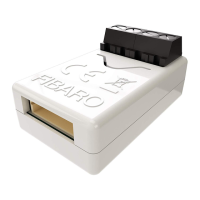
The FIBARO Smart Implant (SKU: FIBEFGBS-222) is a Z-Wave compatible device designed to enhance the functionality of wired sensors and other devices by integrating them into a Z-Wave network. It acts as a bridge, allowing traditional wired sensors to communicate with a Z-Wave controller, thereby expanding the capabilities of a smart home system. This device is a secure alarm sensor for Europe and requires connection to a mains power supply to operate.
The Smart Implant enables various types of wired sensors to report their readings to a Z-Wave controller. It supports:
Beyond just reporting sensor data, the Smart Implant can also control devices by opening or closing output contacts (OUT1 and OUT2), independently of the inputs. This allows for automation scenarios where sensor input triggers an action on a connected device. For example, it can be connected to a gate opener with an impulse input, where each impulse starts and stops the gate motor, alternating between opening and closing.
The device supports Z-Wave network Security Modes, including S0 with AES-128 encryption and S2 with PRNG-based encryption, ensuring secure communication within the network. It also functions as a Z-Wave signal repeater, extending the range and reliability of the Z-Wave network. A built-in temperature sensor provides additional environmental monitoring.
To integrate the Smart Implant into a Z-Wave network, it must first be in its factory default state. The inclusion process involves setting the main controller to "Security S2 Authenticated add mode," scanning the DSK QR code or inputting the 5-digit PIN code, and then powering the device. A blinking yellow LED indicates the adding process, and a successful addition is confirmed by the Z-Wave controller's message.
The Smart Implant offers extensive configuration parameters to adapt its function to specific user needs. These parameters allow users to:
The device also features a built-in Z-Wave network range tester. This allows users to check the communication range with the main controller, indicated by different LED pulsing patterns (green for direct communication, yellow for routed communication, violet for maximum distance, red for no connection).
For maintenance and troubleshooting, the Smart Implant provides several features:
The Smart Implant is designed for continuous operation as it is powered by a DC power supply unit, meaning it is always awake and does not have a deep sleep state like battery-operated devices. This ensures consistent communication and responsiveness within the Z-Wave network.
 General
| Power Supply | 9-30V DC ±10% |
|---|---|
| Radio Protocol | Z-Wave |
| Maximum Current at Outputs | 150mA |
| Maximum Voltage at Outputs | 30V DC / 20V AC |
| Radio Frequency | 868.4 or 869.8 MHz EU; 908.4 or 916.0 MHz US; 921.4 or 919.8 MHz ANZ; 869.0 MHz RU |
| Range | Up to 50m outdoors; Up to 40m indoors (depending on terrain and building structure) |
| Inputs | 2x Digital/Analog |
| Outputs | 2x potential-free outputs |
| Certification | RoHS 2011/65/EU, RED 2014/53/EU |
| Measuring Range of the Temperature Sensor | -55°C to 126°C (-67°F to 259°F) |

 To Next Page