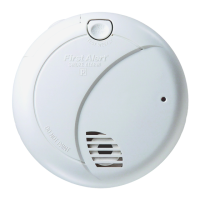
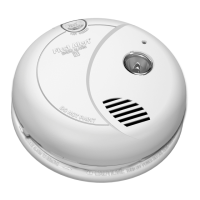
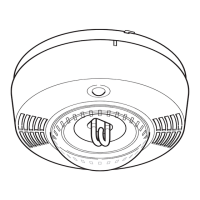
IMPORTANT! PLEASE READ CAREFULLY AND SAVE.
This user’s manual contains important information about your Smoke
Alarm’s operation. If you are installing this Smoke Alarm for use by
others, you must leave this manual—or a copy of it—with the end user.
Printed in Mexico
M08-0099-172430 K1 03/2020
Model
SA303A
Conforms to ULC
STD S531
© 2020 BRK Brands, Inc. All rights reserved. Distributed by BRK Brands, Inc.
BRK Brands, Inc. is a subsidiary of Newell Brands Inc. (NASDAQ: NWL). 3901
Liberty Street, Aurora, IL 60504-8122. To obtain warranty service, contact the
Customer Service Team at 1-800-323-9005. • www.firstalert.ca
All First Alert
®
Smoke Alarms conform to regulatory requirements,
and are designed to detect particles of combustion.
Smoke particles
of varying number and size are produced in all fires.
Ionization technology is generally more sensitive than photoelectric
technology at detecting small particles, which tend to be produced
in greater amounts by flaming fires, which consume combustible
materials rapidly and spread quickly. Sources of these fires may
include paper burning in a wastebasket, or a grease fire in the kitchen.
Photoelectric technology is generally more sensitive than ionization
technology at detecting large particles, which tend to be produced
in greater amounts by smoldering fires, which may smolder for hours
before bursting into flame. Sources of these fires may include
cigarettes burning in couches or bedding.
For maximum protection, use both types of Smoke Alarms on each
level and in every bedroom of your home.
FIRE SAFETY TIPS
Follow safety rules and prevent hazardous situations: 1) Use smoking
materials properly. Never smoke in bed; 2) Keep matches or lighters
away from children; 3) Store flammable materials in proper containers;
4) Keep electrical appliances in good condition and don’t overload elec-
trical circuits; 5) Keep stoves, barbecue grills, fireplaces and chimneys
grease- and debris-free; 6) Never leave anything cooking on the stove
unattended; 7) Keep portable heaters and open flames, like candles,
away from flammable materials; 8) Don’t let rubbish accumulate.
Keep alarms clean, and test them weekly. Replace alarms immediately if
they are not working properly. Smoke Alarms that do not work cannot alert
you to a fire. Keep at least one working fire extinguisher on every floor, and
an additional one in the kitchen. Have fire escape ladders or other reliable
means of escape from an upper floor in case stairs are blocked.
BEFORE YOU INSTALL THIS SMOKE ALARM
IMPORTANT! Read “Recommended Locations for Smoke Alarms” and
“Locations to Avoid for Smoke Alarms” before beginning. This unit mon-
itors the air, and when smoke reaches its sensing chamber, it alarms. It
can give you more time to escape before fire spreads. This unit can
ONLY give an early warning of developing fires if it is installed, main-
tained and located where smoke can reach it, and where all residents
can hear it, as described in this manual. This unit will not sense gas,
heat, or flame. It cannot prevent or extinguish fires.
Understand The Different Type of Smoke Alarms
Battery powered or electrical? Different Smoke Alarms provide
different types of protection. See “About Smoke Alarms” for details.
Know Where To Install Your Smoke Alarms
Fire Safety Professionals recommend at least one Smoke Alarm on
every level of your home, in every bedroom, and in every bedroom
hallway or separate sleeping area. See “Recommended Locations
For Smoke Alarms” and “Locations To Avoid For Smoke Alarms”
for details.
Know What Smoke Alarms Can and Can’t Do
A Smoke Alarm can help alert you to fire, giving you precious time to
escape. It can only sound an alarm once smoke reaches the sensor.
See “Limitations of Smoke Alarms” for details.
Check Your Local Building Codes
This Smoke Alarm is designed to be used in a typical single-family
home. It alone will not meet requirements for boarding houses,
apartment buildings, hotels or motels. See “Special Compliance
Considerations” for details.
WEEKLY TESTING
• NEVER use an open flame of any kind to test this unit. You
might accidentally damage or set fire to the unit or to your
home. The built-in test switch accurately tests the unit’s
operation as required by Underwriters’ Laboratories of Canada
(ULC).
• If the Alarm ever fails to test properly, replace it immediately.
Products under warranty may be returned to the manufacturer
for
replacement. See “Limited Warranty”.
• DO NOT stand close to the Alarm when the horn is sounding.
Exposure at close range may be harmful to your hearing. When
testing, step away when horn starts sounding.
It is important to test this unit every week to make sure it is working
properly. Using the test button is the recommended way to test this
Smoke Alarm. Press and hold the test button on the cover of the unit
until the alarm sounds (the unit may continue to alarm for a few seconds
after you release the button). If it does not alarm, make sure the unit is
receiving power and test it again. If it still does not alarm, replace it imme-
diately. During testing you will hear 3 beeps, pause, 3 beeps.
HOW TO INSTALL THIS SMOKE ALARM
THE PARTS OF THIS SMOKE ALARM
FOLLOW THESE SIMPLE STEPS
Tools you will need:
• Pencil
• Drill with 5 mm (3/16”) drill bit
• Standard Flathead screwdriver
• Hammer
1. Remove the mounting bracket from the Smoke Alarm base. Hold
the mounting bracket against the ceiling (or wall) and make a mark
at the center of each of the mounting slots with a pencil.
2. Put the unit where it won’t get covered with dust when you drill the
mounting holes.
3. Using a 5 mm (3/16”) drill bit, drill a hole through each pencil mark.
4. Insert the plastic screw anchors (in the plastic bag with screws)
into the holes. Tap the screw anchors gently with a hammer, if
necessary, until they are flush with the ceiling or wall.
5. Tighten the screws (provided) into the screw anchors.
• This unit will not alert hearing impaired residents. It is recom-
mended that you install special units which use devices like
flashing strobe lights to alert the hearing impaired residents.
• Do not connect this unit to any other alarm or auxiliary
device. It is a single-station unit that cannot be linked to
other devices. Connecting anything else to this unit may
prevent it from working properly.
• Unit will not operate without battery power. The Smoke
Alarm cannot work until you install the battery in the correct
position (Match “+” to “+” and “-” to “-”).
• This Smoke Alarm has a battery drawer which resists closing
unless a battery is installed. This warns you the unit will not
operate without a battery.
• Do not install this unit over an electrical junction box.
Air currents around junction boxes can prevent smoke from
reaching the sensing chamber and prevent the unit from
alarming. Only AC powered units are intended for installation
over junction boxes.
• Do not stand too close to the unit when the alarm is sounding.
It is loud to wake you in an emergency. Exposure to the horn
at close range may harm your hearing.
• Do not paint over the unit. Paint may clog the openings to the
sensing chamber and prevent the unit from operating properly.
1 2 3
6. Activate the battery. With the
battery compartment open,
install the battery so the
terminals on the battery match
the terminals on the Smoke
Alarm. Match “+” to “+” and
“-” to “-.” Push the battery in
until it snaps in securely and
cannot be shaken loose.
If the battery is not snapped in completely, the unit cannot receive
battery power. The Smoke Alarm may beep briefly when you install
the battery—this is normal.
7.
Position the base of the Smoke Alarm over the mounting bracket and
turn. The Alarm can be positioned over the bracket every 60°. Turn
the Smoke Alarm clockwise (right) until the unit is in place.
8. Test the Smoke Alarm. See “Weekly Testing.”
REGULAR MAINTENANCE
This unit has been designed to be as maintenance free as possible, but
there are a few simple things you must do to keep it working properly.
Use only the replacement batteries listed below. The unit may not
operate properly with other batteries. Never use rechargeable
batteries since they may not provide a constant charge.
• Test it at least once a week.
• Clean the Smoke Alarm at least once a month; gently vacuum the
outside of the Smoke Alarm using your household vacuum’s soft
brush attachment. A can of clean compressed air (sold at computer
or office supply stores) may also be used. Follow manufacturer
instructions for use. Test the Smoke Alarm. Never use water, cleaners
or solvents since they may damage the unit.
• If the Smoke Alarm becomes contaminated by excessive dirt, dust
and/or grime, and cannot be cleaned to avoid unwanted alarms,
replace the unit immediately.
• Relocate the unit if it sounds frequent unwanted alarms. See
“Locations to Avoid for Smoke Alarms” for details.
• When the battery becomes weak, the Smoke Alarm unit will “chirp”
about once a minute (the low battery warning). This low battery warn-
ing should last for 30 days, but you should replace the battery imme-
diately to continue your protection.
Choosing a replacement battery:
Your Smoke Alarm requires one standard 9V battery. The following
batteries are acceptable as replacements: Eveready #1222, Duracell
#MN1604, (Ultra) #MX1604; Eveready (Energizer) #522. You may also
use a Lithium battery like the Ultralife U9VL-J for longer service life
between battery changes. These batteries are available at many local
retail stores.
Continued...
The Parts of This Unit
1. Mounting Bracket
2. Mounting Slots and Screws
3. Locking Pins (break out of bracket)
4. Latch to Open Battery Compartment
5. Swing-Out Battery Compartment
To remove the mounting bracket
from the Smoke Alarm base, hold the
Smoke Alarm base firmly and twist the
mounting bracket counterclockwise.
LIMITED WARRANTY
BRK Brands, Inc., ("BRK") the maker of First Alert
®
brand products
warrants that for a period of ten years from the date of purchase, this
product will be free from defects in material and workmanship. BRK, at
its option, will repair or replace this product or any component of the
product found to be defective during the warranty period. Replacement
will be made with a new or remanufactured product or component. If
the product is no longer available, replacement may be made with a
similar product of equal or greater value. This is your exclusive warranty.
This warranty is valid for the original retail purchaser from the date of
initial retail purchase and is not transferable. Keep the original sales
receipt. Proof of purchase is required to obtain warranty performance.
BRK dealers, service centers, or retail stores selling BRK products do
not have the right to alter, modify or any way change the terms and
conditions of this warranty.
This warranty does not cover normal wear of parts or damage resulting
from any of the following: negligent use or misuse of the product, use
on improper voltage or current, use contrary to the operating instruc-
tions, disassembly, repair or alteration by anyone other than BRK or an
authorized service center. Further, the warranty does not cover Acts of
God, such as fire, flood, hurricanes and tornadoes or any batteries that
are included with this unit.
BRK shall not be liable for any incidental or consequential damages
caused by the breach of any express or implied warranty. Except to
the extent prohibited by applicable law, any implied warranty of mer-
chantability or fitness for a particular purpose is limited in duration to
the duration of the above warranty. Some states, provinces or jurisdic-
tions do not allow the exclusion or limitation of incidental or conse-
quential damages or limitations on how long an implied warranty lasts,
so the above limitations or exclusion may not apply to you. This warran-
ty gives you specific legal rights, and you may also have other rights
that vary from state to state or province to province.
How to Obtain Warranty Service
Service: If service is required, do not return the product to your retailer.
In order to obtain warranty service, contact the Customer Service Team
at 1-800-323-9005. To assist us in serving you, please have the model
number and date of purchase available when calling.
1301 Joe Battle, El Paso, TX 79936.
Battery: BRK Brands, Inc. make no warranty, express or implied,
written or oral, including that of merchantability or fitness for any
particular purpose with respect to battery.
Model SA305A with Lithium Battery: BRK Brands, Inc. warrants the
enclosed battery to be free from defects in materials and workmanship
under normal use and service for a period of ten years from the date of
purchase. Warranty does not cover length of actual service life.
IF YOU SUSPECT A PROBLEM
Smoke Alarms may not operate properly because of dead, missing or
weak batteries, a build-up of dirt, dust or grease on the Smoke Alarm
cover, or installation in an improper location. Clean the Smoke Alarm as
described in “Regular Maintenance,” and install a fresh battery, then test
the Smoke Alarm again. If it fails to test properly when you use the test
button, or if the problem persists, replace the Smoke Alarm immediately.
• If you hear a “chirp” once a minute, replace the battery.
• If you experience frequent non-emergency alarms (like those
caused by cooking smoke), try relocating the Smoke Alarm.
• If the alarm sounds when no smoke is visible, try cleaning or
relocating the Smoke Alarm. The cover may be dirty.
• If the alarm does not sound during testing, try installing a new
battery, and make sure it is snapped in securely.
Do not try fixing the alarm yourself – this will void your warranty!
If the Smoke Alarm is still not operating properly, and it is still under
warranty, please see “How to Obtain Warranty Service” in the Limited
Warranty.
RECOMMENDED LOCATIONS FOR SMOKE ALARMS
Installing Smoke Alarms in Single-Family Residences
The National Fire Protection Association (NFPA) recommends one Smoke
Alarm on every floor, in every sleeping area, and in every bedroom. In
new construction, the Smoke Alarms must be AC powered and intercon-
nected. See “Agency Placement Recommendations” for details. For addi-
tional coverage, it is recommended that you install a Smoke Alarm in all
rooms, halls, storage areas, finished attics, and basements, where tem-
peratures normally remain between 4˚ C (40˚ F) and 38˚ C (100˚ F). Make
sure no door or other obstruction could keep smoke from reaching the
Smoke Alarms.
More specifically, install Smoke Alarms:
•
On every level of your home, including finished attics and basements.
• Inside every bedroom, especially if people sleep with the door partly
or completely closed.
• In the hall near every sleeping area. If your home has multiple
sleeping areas, install a unit in each. If a hall is over 12 meters
(40 feet) long, install an alarm at each end.
• At the top of the first-to-second floor stairway, and at bottom of
basement stairway.
Specific requirements for Smoke Alarm installation vary by municipality
and province. Check with your local Fire Department for current
requirements in your area. It is recommended AC or AC/DC units
be interconnected for added protection.
SPECIAL COMPLIANCE CONSIDERATIONS
This Smoke Alarm alone is not a suitable substitute for complete fire
detection systems in places housing many people—like apartment build-
ings, condominiums, hotels, motels, dormitories, hospitals, long-term
health care facilities, nursing homes, day care facilities, or group homes
of any kind—even if they were once single-family homes. It is not a suit-
able substitute for complete fire detection systems in warehouses, indus-
trial facilities, commercial buildings, and special-purpose non-residential
buildings which require special fire detection and alarm systems.
Depending on the building codes in your area, this Smoke Alarm may be
used to provide additional protection in these facilities.
The following information applies to all four building types below:
In new construction, most building codes require the use of AC or AC/DC
powered Smoke Alarms only. In existing construction, AC, AC/DC, or DC
powered Smoke Alarms can be used as specified by local building
codes. Refer to NFPA 101 (Life Safety Code) or NFPA 72 (National Fire
Alarm Code), local building codes, or consult your Fire Department for
detailed fire protection requirements in buildings not defined as “house-
holds.”
1. Single-Family Residence:
Single family home, townhouse. It is recommended Smoke Alarms be
installed on every level of the home, in every bedroom, and in each
bedroom hallway.
2. Multi-Family or Mixed Occupant Residence:
Apartment building, condominium. This Smoke Alarm is suitable for use
in individual apartments or condos, provided a primary fire detection sys-
tem already exists to meet fire detection requirements in common areas
like lobbies, hallways, or porches. Using this Smoke Alarm in common
areas may not provide sufficient warning to all residents or meet local fire
protection ordinances/regulations.
3. Institutions:
Hospitals, day care facilities, long-term health care facilities. This
Smoke Alarm is suitable for use in individual patient sleeping/resident
rooms, provided a primary fire detection system already exists to meet
fire detection requirements in common areas like lobbies, hallways, or
porches. Using this Smoke Alarm in common areas may not provide suf-
ficient warning to all residents or meet local fire protection
ordinances/regulations.
4. Hotels and Motels:
Also boarding houses and dormitories. This Smoke Alarm is suitable
for use inside individual sleeping/resident rooms, provided a primary
fire detection system already exists to meet fire detection requirements in
common areas like lobbies, hallways, or porches. Using this Smoke
Alarm in common areas may not provide sufficient warning to all
residents or meet local fire protection ordinances/regulations.
LIMITATIONS OF SMOKE ALARMS
Smoke Alarms have played a key role in reducing deaths resulting from
home fires worldwide. However, like any warning device, Smoke Alarms
can only work if they are properly located, installed, and maintained, and
if smoke reaches them. They are not foolproof.
Smoke Alarms may not waken all individuals. Practice the escape
plan at least twice a year, making sure that everyone is involved – from
kids to grandparents. Allow children to master fire escape planning and
practice before holding a fire drill at night when they are sleeping.
If children or others do not readily waken to the sound of the Smoke
Alarm, or if there are infants or family members with mobility limitations,
make sure that someone is assigned to assist them in fire drill and in the
event of an emergency. It is recommended that you hold a fire drill while
family members are sleeping in order to determine their response to the
sound of the Smoke Alarm while sleeping and to determine whether they
may need assistance in the event of an emergency.
Smoke Alarms cannot work without power. Battery operated units
cannot work if the batteries are missing, disconnected or dead, if the
wrong type of batteries are used, or if the batteries are not installed
correctly. AC units cannot work if the AC power is cut off for any reason
(open fuse or circuit breaker, failure along a power line or at a power
station, electrical fire that burns the electrical wires, etc.). If you are
concerned about the limitations of battery or AC power, install both types
of units.
Smoke Alarms cannot detect fires if the smoke does not reach
them. Smoke from fires in chimneys or walls, on roofs, or on the other
side of closed doors may not reach the sensing chamber and set off the
alarm. That is why one unit should be installed inside each bedroom or
sleeping area—especially if bedroom or sleeping area doors are closed
at night—and in the hallway between them.
Smoke Alarms may not detect fire on another floor or area of the
home. For example, a stand-alone unit on the second floor may not
detect smoke from a basement fire until the fire spreads. This may not
give you enough time to escape safely. That is why recommended
minimum protection is at least one unit in every sleeping area, and every
bedroom on every level of your home. Even with a unit on every floor,
stand-alone units may not provide as much protection as interconnected
units, especially if the fire starts in a remote area. Some safety experts
recommend installing interconnected AC powered units with battery
back-up (see “About Smoke Alarms”) or professional fire
detection systems, so if one unit senses smoke, all units alarm.
Interconnected units may provide earlier warning than stand-alone units
since all units alarm when one detects smoke.
Smoke Alarms may not be heard. Though the alarm horn in this unit
meets or exceeds current standards, it may not be heard if: 1) the unit is
located outside a closed or partially closed door, 2) residents recently
consumed alcohol or drugs, 3) the alarm is drowned out by noise from
stereo, TV, traffic, air conditioner or other appliances, 4) residents are
hearing impaired or sound sleepers. Special purpose units, like those
with visual and audible alarms, should be installed for hearing impaired
residents.
Smoke Alarms may not have time to alarm before the fire itself
causes damage, injury, or death, since smoke from some fires may
not reach the unit immediately. Examples of this include persons
smoking in bed, children playing with matches, or fires caused by
violent explosions resulting from escaping gas.
Smoke Alarms are not foolproof. Like any electronic device, Smoke
Alarms are made of components that can wear out or fail at any time.
You must test the unit weekly to ensure your continued protection.
Smoke Alarms cannot prevent or extinguish fires. They are not a
substitute for property or life insurance.
Smoke Alarms have a limited life. The unit should be replaced imme-
diately if it is not operating properly. You should always replace a Smoke
Alarm after 10 years from date of purchase. Write the purchase date on
the space provided on back of unit.
4 5 6
INSTALLING SMOKE ALARMS IN MOBILE HOMES & RVS
For minimum security install one Smoke Alarm as close to each sleeping
area as possible. For more security, put one unit in each room. Many
older mobile homes (especially those built before 1978) have little or no
insulation. If your mobile home is not well insulated, or if you are unsure
of the amount of insulation, it is important to install units on inside walls
only. Smoke Alarms should be installed where temperatures normally
remain between 4˚ C (40˚ F) and 38˚ C (100˚ F). WARNING: Test units
used in RVs after the vehicle has been in storage, before every trip,
and once a week while in use. Failure to test units used in RVs as
described may remove your protection.
This equipment should be installed in accordance with NFPA (National Fire
Protection Association) 72 and
101. National Fire Protection Association, One
Batterymarch Park, Quincy, MA 02269-9101
U.S.A
. Additional local build-
ing and regulatory codes may apply in your area. Always check com-
pliance requirements before beginning any installation.
This model is
not RV listed with Underwriters’ Laboratories of Canada (ULC).
AGENCY PLACEMENT RECOMMENDATIONS
NFPA 72 (National Fire Code)
Smoke Alarms shall be installed in each separate sleeping room, outside
each sleeping area in the immediate vicinity of the bedrooms and on
each additional story of the family living unit, including basements and
excluding crawl spaces and unfinished attics.
In new construction, Alarms shall be so arranged that operation of any
one Alarm shall cause the operation of all Alarms within the dwelling.
Smoke Detection-Are More Smoke Alarms Desirable? The required
number of Smoke Alarms might not provide reliable early warning
protection for those areas separated by a door from the areas protected
by the required Smoke Alarms. For this reason, it is recommended that
the householder consider the use of additional Smoke Alarms for those
areas for increased protection. The additional areas include the base-
ment, bedrooms, dining room, furnace room, utility room, and hallways
not protected by the required Smoke Alarms. The installation of Smoke
Alarms in kitchens, attics (finished or unfinished), or garages is not
normally recommended, as these locations occasionally experience con-
ditions that can result in improper operation.
LOCATIONS TO AVOID FOR SMOKE ALARMS
For best performance, it is recommended you AVOID installing
Smoke Alarms in these areas:
• Where combustion particles are produced. Combustion particles
form when something burns. Areas to avoid include poorly ventilated
kitchens, garages, and furnace rooms. Keep units at least 6 meters
(20 feet) from the sources of combustion particles (stove, furnace,
water heater, space heater) if possible. In areas where a 6 meter
(20-foot) distance is not possible – in modular, mobile, or smaller
homes, for example – it is recommended the Smoke Alarm be
placed as far from these fuel-burning sources as possible. The
placement recommendations are intended to keep these Alarms at
a reasonable distance from a fuel-burning source, and thus reduce
“unwanted” alarms. Unwanted alarms can occur if a Smoke Alarm
is placed directly next to a fuel-burning source. Ventilate these areas
as much as possible.
• In air streams near kitchens. Air currents can draw cooking smoke
into the sensing chamber of a Smoke Alarm near the kitchen.
• In very damp, humid or steamy areas, or directly near bathrooms with
showers. Keep units at least 3 meters (10 feet) away from showers,
saunas, dishwashers, etc.
• Where the temperatures are regularly below 4˚ C (40˚ F) or above
38˚C (100˚ F), including unheated buildings, outdoor rooms, porches,
or unfinished attics or basements.
• In very dusty, dirty, or greasy areas. Do not install a Smoke Alarm directly
over the stove or range. Keep laundry room Smoke Alarms free of dust
or lint.
• Near fresh air vents, ceiling fans, or in very drafty areas. Drafts can blow
smoke away from the unit, preventing it from reaching the sensing
chamber.
• In insect infested areas. Insects can clog openings to the sensing
chamber and cause unwanted alarms.
• Less than 305 mm (12 inches) away from fluorescent lights. Electrical
“noise” can interfere with the sensor.
• In “dead air” spaces. “Dead air” spaces may prevent smoke from
reaching the Smoke Alarm.
AVOIDING DEAD AIR SPACES
“Dead air” spaces may prevent smoke from reaching the Smoke Alarm.
To avoid dead air spaces, follow the installation recommendations below.
On ceilings, install Smoke Alarms as close to the center of the ceiling as
possible. If this is not possible, install the Smoke Alarm at least
102 mm (4 inches) from the wall or corner.
For wall mounting (if allowed by building codes), the top edge of Smoke
Alarms should be placed between 102 mm (4 inches) and 305 mm (12 inch-
es) from the wall/ceiling line, below typical “dead air” spaces.
On a peaked, gabled, or cathedral ceiling, install the first Smoke
Alarm within 0.9 meters (3 feet) of the peak of the ceiling, measured
horizontally. Additional Smoke Alarms may be required depending on the
length, angle, etc. of the ceiling's slope. Refer to NFPA 72 for details on
requirements for sloped or peaked ceilings.
ABOUT SMOKE ALARMS
Battery (DC) operated Smoke Alarms: Provide protection even when
electricity fails, provided the batteries are fresh and correctly installed.
Units are easy to install, and do not require professional installation.
AC powered Smoke Alarms: Can be interconnected so if one unit
senses smoke, all units alarm. They do not operate if electricity fails.
AC with battery (DC) back-up: will operate if electricity fails, provided
the batteries are fresh and correctly installed. AC and AC/DC units must
be installed by a qualified electrician.
Smoke Alarms for Solar or Wind Energy users and battery backup
power systems: AC powered Smoke Alarms should only be operated
with true or pure sine wave inverters. Operating this Smoke Alarm with
most battery-powered UPS (uninterruptible power supply) products or
square wave or “quasi sine wave” inverters will damage the Alarm.
If you are not sure about your inverter or UPS type, please consult with
the manufacturer to verify.
Smoke Alarms for the hearing impaired: Special purpose Smoke
Alarms should be installed for the hearing impaired. They include a
visual alarm and an audible alarm horn, and meet the requirements of the
Americans With Disabilities Act. Can be interconnected so if one
unit senses smoke, all units alarm.
All these Smoke Alarms are designed to provide early warning of fires
if located, installed and cared for as described in the user’s manual, and
if smoke reaches them. If you are unsure which type of Smoke Alarm
to install, refer to Chapter 2 of the National Fire Protection Association
(NFPA) Standard 72 (National Fire Alarm Code) and NFPA 101 (Life Safety
Code). National Fire Protection Association, One Batterymarch Park,
Quincy, MA 02269-9101 U.S.A. Local building codes may also require
specific units in new construction or in different areas of the home.


 To Next Page
 Need help?
 General