40 Rev. 03
• check that there is no gas in the delivering fluid, if there is stop the pump
STOP
To stop the pump, operate exclusively on the air supply closing the 3-way valve, discharging in this way residual pressure from the
pneumatic system of the pump.
WARNING never stop the pump by totally closing the suction and/or delivery valves of the hydraulic circuit
WARNING is prohibited to stop the pump by means of the complete closure of the valves in the suction and / or discharge of the
hydraulic circuit
MAINTENANCE
- all the operation must be carried out by qualified personnel
- do not carry out maintenance and/or repairs with the air circuit under pressure
- carry out periodic inspections (2 ÷ 30 days in accordance with the fluid pumped) to check the filtering elements cleaning
- carry out periodic inspections (3 ÷ 5 months in accordance with the fluid pumped and with the environment conditions)
to ensure the correct operation of the system start/stop units
- the presence of fluid under the pump casing may indicate failures to the pump
- damaged parts must be replaced with complete original parts and not with repaired parts
- the replacement of damaged parts must be carried out in a clean and dry place
RECOMMENDATIONS
WARNING: before performing any maintenance or repair work on the pump, disconnect the pump from the air supply line.
Disconnect the hydraulic connections and discharge the product that is being pumped
- all the operation must be carried out by qualified personnel
- use gloves, goggles and acid-resistant clothing when disconnecting from the system and washing the pump
- wash the pump before carrying out maintenance operations
- do not disperse the washing waste into the environment
DISASSEMBLY
- Bolts are the type with right thread
- Clean all the pump external surfaces using a damp cloth Ball seats removal (for all models)
- Remove the delivery and intake manifolds removing the tightening bolts
- Pull off the seats, the balls and the related cages
- Check the condition of the gasket
Diaphragms removal
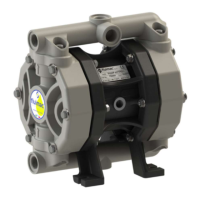
PHOENIX 07-18-30-50-65-100-101-160-250-500-700-1000
- Remove the delivery and intake manifolds removing the tightening bolts
- Remove the deposits from the internal surfaces
- Remove the two pump casings
- Remove the plates that lock the diaphragms
- Remove the diaphragms and the related backing plates
- If it would be necessary to disassemble the shaft, remove one of the two diaphragms on air side and then pull off the shaft
Pneumatic distributor removal
- slip off the pneumatic exchanger cap and the spool (if necessary use a M6 screw for slip off the spool)
PHOENIX 07-18-30-50
- remove the manifolds, pump casing and diaphragms
- remove the bolts (pos.22) and divide the semi-central casing
PHOENIX 65-100-101-160-250-500-700-1000
- Remove the Seeger ring of the transverse sleeve of the central casing
- Overturn the pump and with the aid of a Ø6 mm punch and a press, pull off the distributor (this operation may be carried out with
pump casings assembled, check that the tightening bolts of the pump casings located on the upper area of the distributor to not
obstacle the distributor removal)
- WARNING the pneumatic distributor shall not be opened to prevent an incorrect reassembling that may cause the pump
malfunctioning
INSPECTION
Check the absence of:
• excessive abrasion of the thermoplastic parts
• clots and/or agglomerates due to the pumped fluid
• deformations and/or surface lesions of the diaphragms
• deformations and/or breakages on the valve seats
Replace the parts: broken, cracked, deformed.
Reopen all the clogged ducts and eliminate any chemical agglomerates.
Clean all the surfaces before reassembly, particularly the OR gaskets seats (risk of leaks for dripping).
CLEANING AND REPLACING THE DIAPHRAGMS
control and internal cleaning every 500.000 cycles
diaphragm check every 5.000.000 cycles
diaphragm replacement every 20.000.000 cycles
SAFETY RISKS
WARNING! CHEMICAL RISK. Pumps are intended for operation with different types of fluids and chemical solutions. Follow the
specific internal instructions for decontamination during the inspection or maintenance operations.
WARNING! ELECTRICAL RISK. The pump must always be earthed independently to other members connected to it. Safety
requirements and explosion risk prevention are not fulfilled if the pump is not earthed or is incorrectly earthed
WARNING: the diaphragms (into contact with the product and external) are components extremely subject to wear.
Their duration is strongly affected by the conditions of employments and by chemical and physical stresses. By tests
carried out on thousands of pumps installed with head value from 0° to 18°C, the ordinary life exceeds one hundred
million cycles. For safety reasons, in environments with explosion risk it is necessary to disassemble and check the
diaphragms every five million cycles and to replace them every twenty mil- lion cycles.
WARNING! In the case of diaphragms total breaking, the fluid may enter in the pneumatic circuit, da- mage it and
come out from the discharge port. Therefore, it is necessary to convey the air discharge in a piping up to a safe area.


 To Next Page
 Loading...