Next Number - This two- or three-digit number is the
tire’s load index. It is a measurement of how much
weight each tire can support. You may find this informa-
tion in your Owner’s Manual. If not, contact a local tire
dealer.
NOTE:
You may not find this information on all tires because it is
not required by law.
M+S - The "M+S" or "M/S" indicates that the tire has
some mud and snow capability. Most radial tires have
these markings.
Speed Rating - The speed rating denotes the speed at
which a tire is designed to be driven for extended periods
of time. The ratings range from 65 miles per hour (mph)
to 186 mph. These ratings are listed below.
NOTE:
You may not find this information on all tires because it is
not required by law.
Letter Rating Speed Rating
ST 65 mph
Q 99 mph
R 106 mph
S 112 mph
T 118 mph
U 124 mph
H 130 mph
V 149 mph
W 168* mph
Y 186* mph
* For tires with a maximum speed capability over
149 mph, tire manufacturers sometimes use the letters
ZR. For those with a maximum speed capability over
186 mph, tire manufacturers always use the letters ZR.
U.S. DOT Tire Identification Number - This begins with
the letters "DOT" and indicates that the tire meets all
federal standards. The next two numbers or letters are
the plant code where it was manufactured, and the last
four numbers represent the week and year the tire was
built. For example, the numbers 3197 means the 31
st
week of 1997. The other numbers are marketing codes
used at the manufacturer’s discretion. The information is
used to contact consumers if a tire defect requires a
recall.
Tire Ply Composition on Materials Used-The number
of plies indicates the number of layers of rubber-coated
fabric in the tire. In general, the greater the number of
plies, the more weight a tire can support. Tire manufac-
turers also must indicate the materials in the tire, which
include steel, nylon, polyester, and others.
Maximum Load Rating - This number indicates the
maximum load in kilograms and pounds that can be car-
ried by the tire.
Maximum Permissible Inflation Pressure - This num-
ber is the greatest amount of air pressure that should
ever be put in the tire under normal driving conditions.
Additional Information on Light Truck Tires
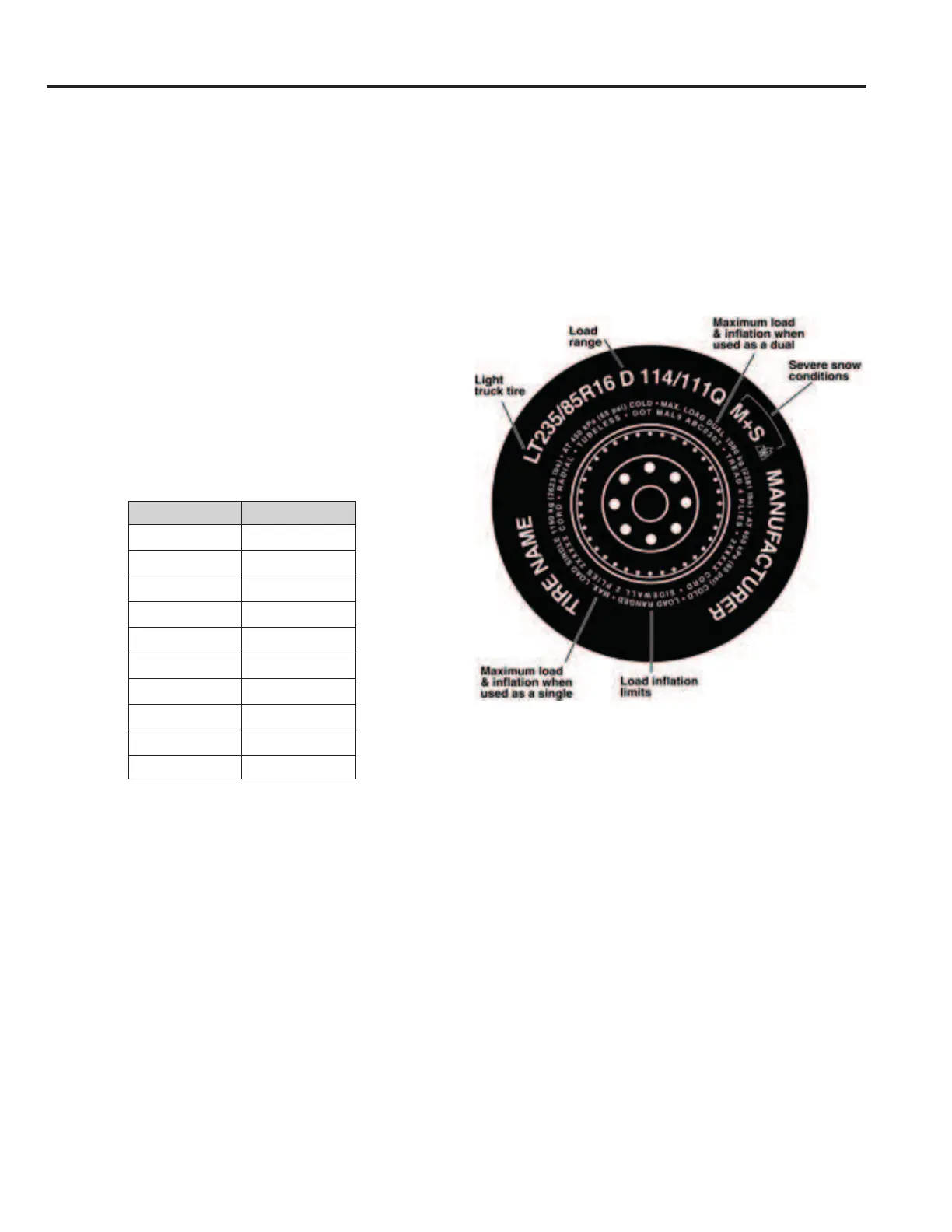
Please refer to the following diagram.
Tires for light trucks have other markings besides those
found on the sidewalls of passenger tires.
LT - The "LT" indicates the tire is for light trucks or
trailers.
ST - An "ST" is an indication the tire is for trailer use only.
Max. Load Dual kg (lbs.) at kPa (psi) Cold - This infor-
mation indicates the maximum load and tire pressure
when the tire is used as a dual, that is, when four tires
are put on each rear axle (a total of six or more tires on
the vehicle).
Max. Load Single kg (lbs.) at kPa (psi) Cold - This
information indicates the maximum load and tire pres-
sure when the tire is used as a single.
Load Range - This information identifies the tire’s load-
carrying capabilities and its inflation limits.
Vehicle Load Limits
Determining the load limits of a vehicle includes more
than understanding the load limits of the tires alone.
On a trailer, there is a federal certification label that is
located on the forward half of the left (road) side of the
RV.
Identification And Safety
14



 To Next Page