Tire Safety Tips
Preventing Tire Damage
• Slow down if you have to go over a pothole or other
object in the road.
• Do not run over curbs or other foreign objects in the
roadway, and try not to strike the curb when parking.
Tire Safety Checklist
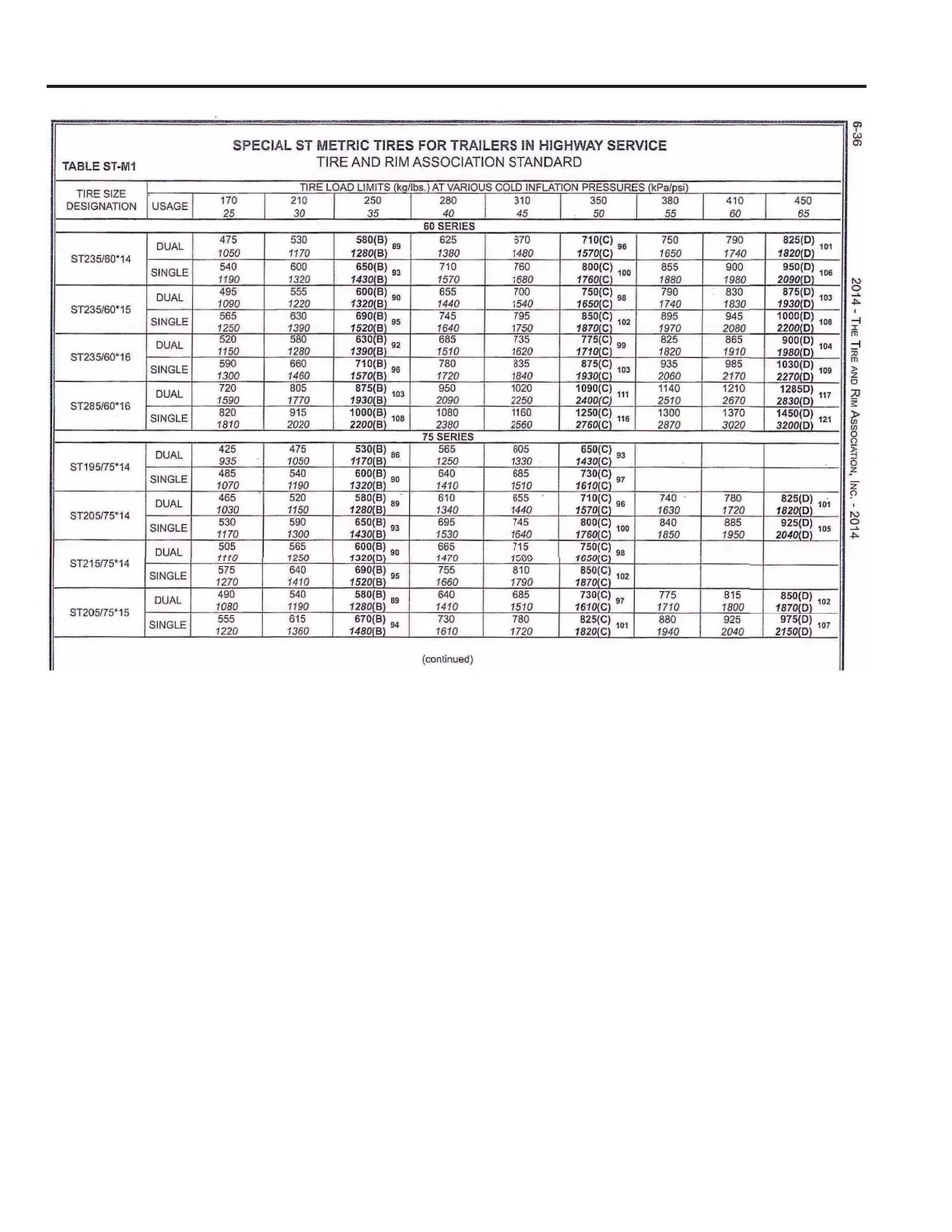
• Check tire pressure regularly (at least once a
month), including the spare.
• Inspect tires for uneven wear patterns on the tread,
cracks, foreign objects, or other signs of wear or
trauma.
• Remove bits of glass and foreign objects wedged in
the tread.
• Make sure all of your tire valves have valve caps
• Check tire pressure before going on a long trip.
• Do not overload your vehicle. Check the Tire Infor-
mation and Loading Placard or Owner’s Manual for
the maximum recommended load for the vehicle.
Steps For Determining Correct Load Limit
1. Locate the statement "The combined weight of
occupants and cargo should never exceed XXX
lbs." on your vehicle placard.
2. Determine the combined weight of the driver and
passengers that will be riding in your vehicle.
3. Subtract the combined weight of the driver and pas-
sengers from XXX kilograms or XXX pounds.
4. The resulting figure equals the available amount of
cargo and luggage capacity.
For example, if the "XXX" amount equals 1400 lbs.
and there will be five 150 lb. passengers in your
vehicle, the amount of available cargo and luggage
capacity is 650 lbs. (1400-750 (5 x 150) = 650 lbs.)
5. Determine the combined weight of luggage and
cargo being loaded on the vehicle. That weight may
not safely exceed the available cargo and luggage
capacity calculated in Step 4.
6. If your vehicle will be towing a trailer, load from your
trailer will be transferred to your vehicle. Consult
this Manual to determine how this reduces the
available cargo and luggage capacity of your
vehicle.
Identification And Safety
16



 To Next Page