Connector Type Speed Protocol Description
Internal RJ-45 10/100 Base-T Ethernet Connection to the internal network.
External RJ-45 10/100 Base-T Ethernet Connection to the internet.
DMZ RJ-45 10/100 Base-T Ethernet Optional connection to a DMZ network, or to other
FortiGate-200 units for high availability. For details,
see the Documentation CD-ROM.
Console DB-9 9600 Bps RS-232 Optional connection to the management computer.
Provides access to the command line interface
(CLI).
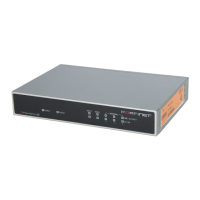
Place the unit on a stable surface. It requires 1.5 inches (3.75 cm) clearance above and
on each side to allow for cooling.
Plug in power cable to unit before connecting power.
The Status light ashes while the unit is starting up and turns off when the system is up
and running.
•
•
•
Connect the FortiGate unit to a power outlet and to the internal and external networks.
Before beginning to congure the FortiGate unit, you need to plan how to integrate the unit into your network. Your conguration plan depends on the operating mode you select: NAT/Route
mode (the default) or Transparent mode.
NAT/Route mode
In NAT/Route mode, each FortiGate unit is visible to the network that it is connected to. All of
its interfaces are on different subnets. Each interface that is connected to a network must be
congured with an IP
address that is valid for
that network.
You would typically use
NAT/Route mode when
the FortiGate unit is
deployed as a gateway
between private and
public networks. In its
default NAT/Route mode
conguration, the unit
functions as a rewall.
Firewall policies control
communications through
the FortiGate unit. No trafc can pass through the FortiGate unit until you add rewall poli-
cies. In NAT/Route mode, rewall policies can operate in NAT mode or in Route mode. In
NAT mode, the FortiGate unit performs network address translation before IP packets are
sent to the destination network. In Route mode, no translation takes place.
Transparent mode
In Transparent mode, the FortiGate unit is invisible to the network. All of its interfaces are on
the same subnet. You only have to congure a management IP address so that you can make
conguration changes.
You would typically use the
FortiGate unit in Transparent
mode on a private network
behind an existing rewall or
behind a router. In its default
Transparent mode conguration,
the unit functions as a rewall.
No trafc can pass through the
FortiGate unit until you add
rewall policies.
You can connect up to four network segments to the FortiGate unit to control trafc between
these network segments.
Refer to the Documentation CD-ROM for information on how to control trafc, and how to congure HA, antivirus protection, FortiGuard, Web content ltering, Spam ltering,
intrusion prevention (IPS), and virtual private networking (VPN).
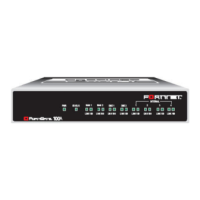
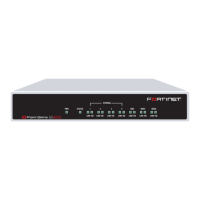
FortiGate-200
01-30002-0034-20060705
LED State Description
Power
Green The FortiGate unit is on.
Off The FortiGate unit is off.
Status
Flashing Green The FortiGate unit is starting up.
Green The FortiGate unit is running normally.
Off The FortiGate unit is powered off.
Internal,
External
DMZ
Green The correct cable is in use and the connected
equipment has power.
Flashing Green Network activity at this interface.
Flashing Amber Network activity at this interface.
Off No link established.
Straight-through Ethernet cable connects to Internet (public switch, router or modem)
Straight-through Ethernet cable connects to LAN or switch on internal network
Crossover Ethernet cable connects to management computer on internal network
or
Optional null modem cable connects to serial port on management computer
Power cable connects to power outlet
Optional straight-through Ethernet cable connects to DMZ network
DMZ
CONSOLE
INTERNAL
EXTERNAL
INTERNALPOWER STATUS
EXTERNAL
DMZ


 To Next Page
 Need help?



 General