EasyManua.ls Logo

Fostex B-16 - Page 21

Fostex B-16
118 pages
Print Icon
To Next Page IconTo Next Page
To Previous Page IconTo Previous Page
Loading...
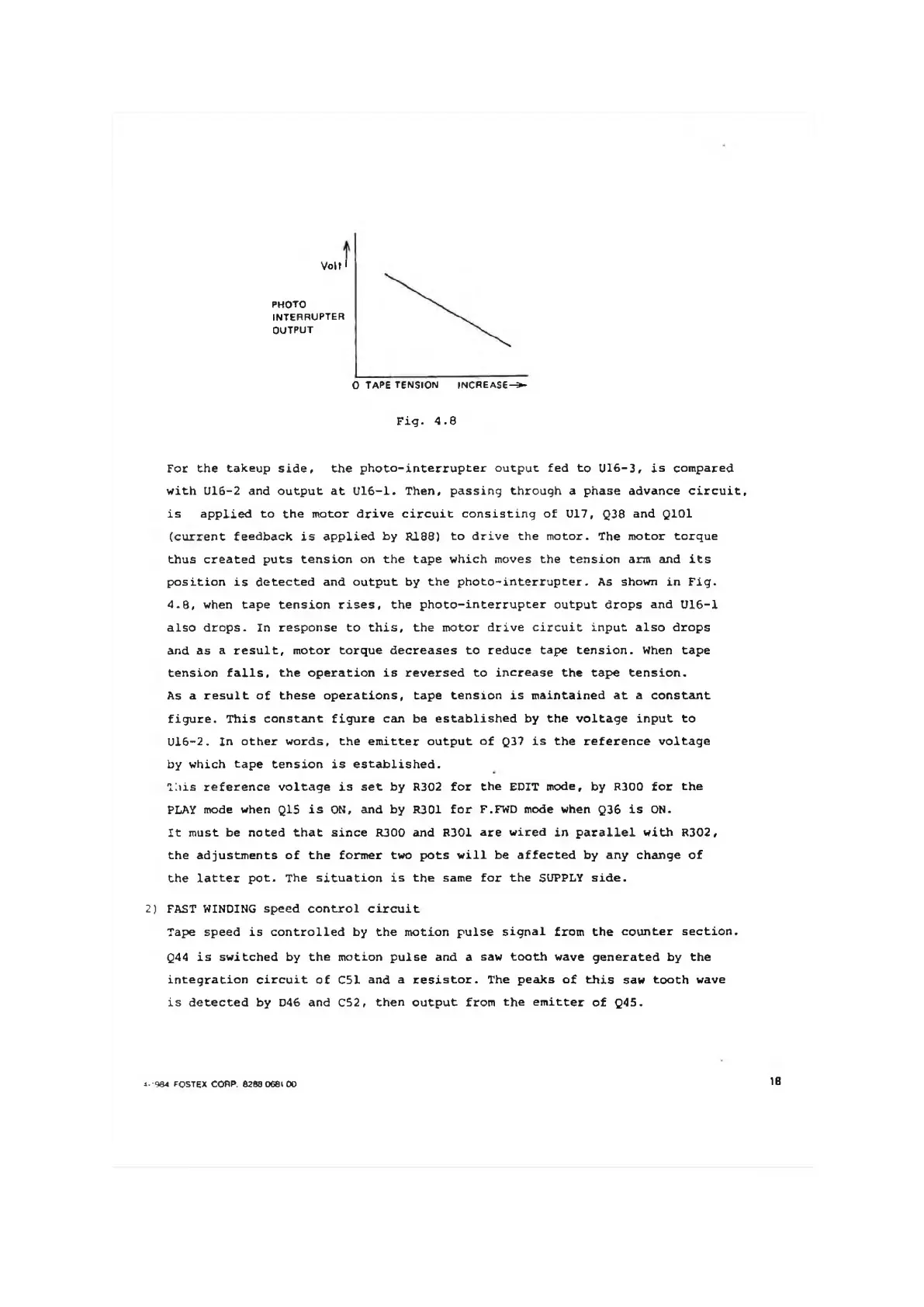
Volt
PHOTO
INTERRUPTER
OUTPUT
0
TAPE
TENSION
INCREASE-*-
Fig.
4.0
For
the
takeup
side,
the
photo-interrupter
output
fed
to
U16-3,
is
compared
with
U16-2
and
output
at
U16-1.
Then,
passing
through
a
phase
advance
circuit,
is
applied
to
the
motor
drive
circuit
consisting
of
U17,
Q38
and
Q101
(current
feedback
is
applied
by
R1S8)
to
drive
the
motor.
The
motor
torque
thus
created
puts
tension
on
the
tape
which
moves
the
tension
arm
and
its
position
is
detected
and
output
by
the
photo-interrupter.
As
shown
in
Fig.
4.8,
when
tape
tension
rises,
the
photo-interrupter
output
drops
and
U16-1
also
drops.
In
response
to
this,
the
motor
drive
circuit
input
also
drops
and
as
a
result,
motor
torque
decreases
to
reduce
tape
tension.
When
tape
tension
falls,
the
operation
is
reversed
to
increase
the
tape
tension.
As
a
result
of
these
operations,
tape
tension
is
maintained
at
a
constant
figure.
This
constant
figure
can
be
established
by
the
voltage
input
to
U16-2.
In
other
words,
the
emitter
output
of
Q37
is
the
reference
voltage
by
which
tape
tension
is
established.
This
reference
voltage
is
set
by
R3O2
for
the
EDIT
mode,
by
R300
for
the
PLAY
mode
when
Q15
is
ON,
and
by
R301
for
F.FWD
mode
when
Q36
is
ON.
It
must
be
noted
that
since
R300
and
R301
are
wired
in
parallel
with
R3O2,
the
adjustments
of
the
former
two
pots
will
be
affected
by
any
change
of
the
latter
pot.
The
situation
is
the
same
for
the
SUPPLY
side.
2)
FAST
WINDING
speed
control
circuit
Tape
speed
is
controlled
by
the
motion
pulse
signal
from
the
counter
section.
Q44
is
switched
by
the
motion
pulse
and
a
saw
tooth
wave
generated
by
the
integration
circuit
of
C51
and
a
resistor.
The
peaks
of
this
saw
tooth
wave
is
detected
by
D46
and
C52,
then
output
from
the
emitter
of
Q45.
i-
964
FOSTEX
CORP.
8268
066100
18

Other manuals for Fostex B-16