EasyManua.ls Logo

Fostex G16 - Page 29

Fostex G16
124 pages
Print Icon
To Next Page IconTo Next Page
To Previous Page IconTo Previous Page
Loading...
The
FG
output
of
the
capstan
motor
is
shaped
into
a
square
wave
by
UI
and
applied
to
the
F/V
converter
and
P/D.
After
setting
the
reference
frequency
to
position
3
or
2,
or
the
ex
ternal
reference
frequency
of
position
1
by
the
PITCH
CONT
switch
which
activates
SW1
(UI
1),
it
is
applied
to
the
F/V
converter
and
P/D.
The
F/V
converter
output
will
drop
when
the
input
frequency
rises.
The
output
of
the
P/D
is
a
voltage
related
to
phase
difference
between
the
FG
output
and
reference
frequency.
Its
output
voltage
rises
when
phase
of
the
FG
output
lags
from
the
reference
frequency.
By
action
of
the
P/D,
the
FG
output
frequency
from
the
motor
and
the
reference
frequency
will
be
the
same.
Now,
if
SW1
is
set
to
position
3
and
the
reference
frequency
is
changed,
output
of
the
F/V
converter
A
will
change
to
dis
turb
the
amplifier
input
offset
voltage,
thus
exceeding
the
lock
range
of
the
P/D
and
the
lock
will
be
released.
F/V
converter
B
is
provided
to
prevent
this
and
acts
to
compensate
the
input
offset
voltage.
3.4.2
Circuit
details
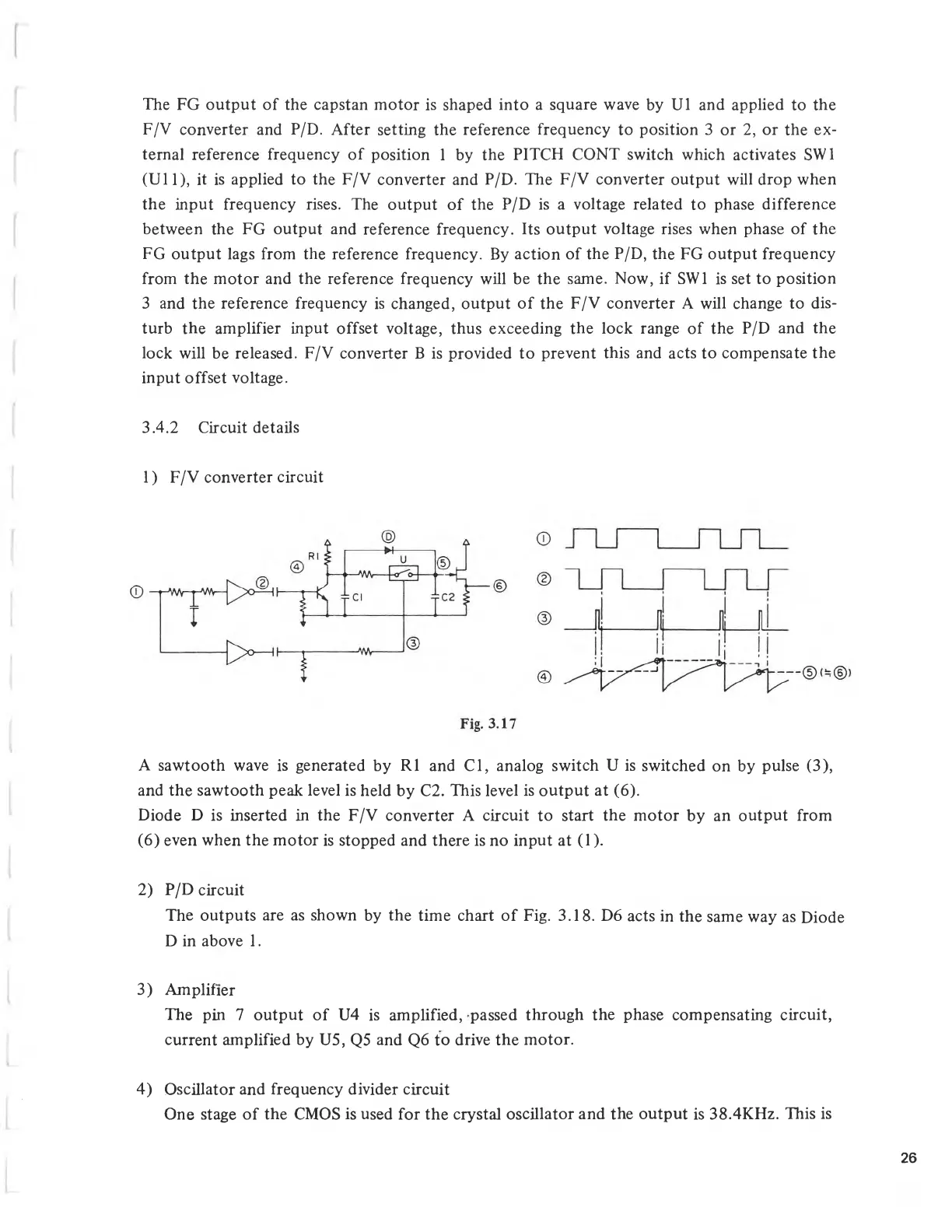
1)
F/V
converter
circuit
A
sawtooth
wave
is
generated
by
RI
and
Cl,
analog
switch
U
is
switched
on
by
pulse
(3),
and
the
sawtooth
peak
level
is
held
by
C2.
This
level
is
output
at
(6).
Diode
D
is
inserted
in
the
F/V
converter
A
circuit
to
start
the
motor
by
an
output
from
(6)
even
when
the
motor
is
stopped
and
there
is
no
input
at
(1).
2)
P/D
circuit
The
outputs
are
as
shown
by
the
time
chart
of
Fig.
3.18.
D6
acts
in
the
same
way
as
Diode
D
in
above
1.
3)
Amplifier
The
pin
7
output
of
U4
is
amplified,
passed
through
the
phase
compensating
circuit,
current
amplified
by
U5,
Q5
and
Q6
to
drive
the
motor.
4)
Oscillator
and
frequency
divider
circuit
One
stage
of
the
CMOS
is
used
for
the
crystal
oscillator
and
the
output
is
38.4KHz.
This
is
26

Related product manuals