4-2. Power supply cable
RELATED LINKS
"Electrical characteristics
" in Chapter 3. OUTDOOR UNITS on page 03-21
"Electrical characteristics" in Chapter 4. INDOOR UNITS on page 04-26
¢
S
pecifications
Use a separate power supply for the outdoor unit and indoor unit.
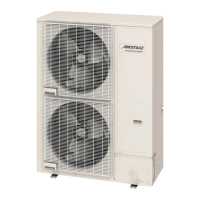
Outdoor unit
Model MCA (A) MAX. CKT. BKR (A) GFEB
AOU72RLAVL 38
40
100 mA, 0.1 sec or lessAOU96RLAVL 39
AOU120RLAVL 47 50
• MCA: Minimum Circuit Ampacity
•
MAX. CKT. BKR: Maximum Circuit Breaker
• GFEB: Ground Fault Equipment Breaker
• Select the power cable type and size in accordance with local regulations.
• Select a wire length (maximum wire length) so that the voltage drop is less than 2%.
• When the wire length is long and voltage drop exceeds this value, increase the wire diameter to
stay within design limits.
I
ndoor unit
Model
Recommended
cable size (
AWG)
MAX. CKT. BKR (A)
Breaker for leakage
current
Remarks
All models 16 to 10 15 Refer to Table B
208/230 V ~ 60 Hz
2 wire + ground
Refer to the table for the breaker specifications of each installation condition.
Perform the power crossover wiring within the range of the same refrigerant system. When the pow-
er crossover wiring is done, make a connection for indoor units to satisfy conditions of Table A and B
below.
•
Select the power cable type and size in accordance with local regulations.
• Include at least one breaker and one disconnect per refrigerant circuit.
• Power supply circuits should only be connected to units and the same refrigerant circuit.
• Design the power supply circuit to keep the voltage drop within 2%.
4-2. Power supply cable - (06-50) - 4. Wiring design
SYSTEM
DESIGN
SYSTEM
DESIGN


 To Next Page
 Loading...