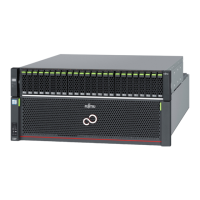
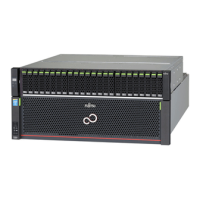
• ETERNUS DX600 S5
Figure 151 Rear View of a Controller Enclosure (ETERNUS DX600 S5)
8 8
1 1
9 9
CPSU#0
CPSU#1
CA#0
CA#1
CA#0
CA#1
CA#2
CA#3CA#2
CA#3
2 2
CM#0
CM#1
BUD#1
BUD#0
BUD#1
BUD#0
543 76
1 Controller (CM#0, CM#1)
(Refer to "Controllers" (page 257
).)
2 Host interface (CA#0, CA#1, CA#2, CA#3)
(Refer to "■ Host Interfaces" (page 259).)
3 RMT (LAN) port
This port is used for connecting a LAN cable. Use this port to separate the network (such as for the
remote support) from the MNT port for operation management. This port uses an RJ-45 connector.
(Refer to "■ MNT Ports/RMT Ports/FST Ports" (page 263).)
4 MNT (LAN) port
This port is used for connecting a LAN cable and used for operation management. This port uses an
RJ-45 connector.
(Refer to "■ MNT Ports/RMT Ports/FST Ports" (page 263).)
5 FST (LAN) port
A port that is dedicated for maintenance engineers. Customers must not use this port.
(Refer to "■ MNT Ports/RMT Ports/FST Ports" (page 263).)
6 Drive interface (OUT) port
This port is used to connect a controller enclosure to a drive enclosure with a mini SAS HD cable
between enclosures.
(Refer to "■ Drive Interface Ports" (page 263).)
7 PWC port
This port is used to connect a power synchronized unit with an RS232C cable.
(Refer to "■ PWC Ports" (page 263).)
8 Power supply unit (CPSU#0, CPSU#1)
(Refer to "■ Power Supply Units" (page 264).)
9 BUD (BUD#0, BUD#1)
(Refer to "■ BUD" (page 258).)
6. Hardware Configurations
Controller Enclosure
254 Design Guide


 To Next Page
 Loading...