A
CAUTION:
Driving in
Mud,
Sand, Snow
or
Ice
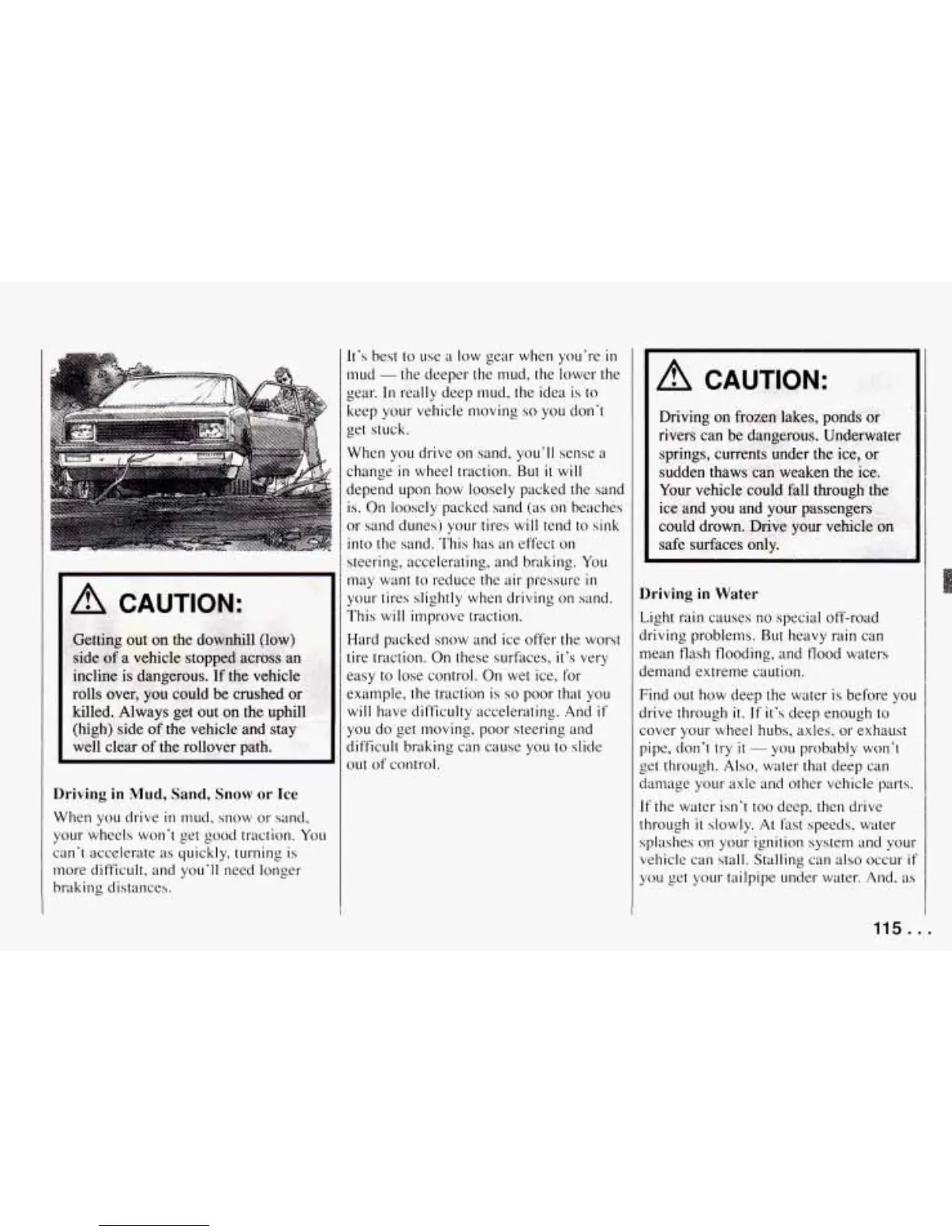
When you drive
in
mud, snow
or
sand,
your wheels won't get good traction. You
can't
accelerate as quickly, turning
is
more difficult, and
you'll
need longer
braking distances.
It's
best to use
a
low gear when you're
in
mud -the deeper
the
mud, the lower the
gear.
In
really deep mud, the idea is
to
keep your vehicle moving
so
you
don't
get stuck.
When
you
drive
on
sand, you'll sense a
change
in
wheel traction.
But
it
will
depend upon how loosely packed the sand
is.
On loosely packed sand (as
on
beaches
or sand dunes) your tires will tend
to
sink
into the sand. This has an effect on
steering. accelerating, and braking. You
may want to reduce the air pressure
in
your tires slightly
when
driving on sand.
This will improve traction.
Hard packed snow and ice offer the worst
tire
traction. On these surfaces, it's very
easy
to
lose control. On wet ice, for
example, the traction is
so
poor that you
will have difficulty accelerating. .4nd
if
you do get moving, poor steering and
difficult braking can cause
you
to
slide
out of control.
A
CAUTION:
Driving in Water
Light rain causes no special off-road
driving problems. But heavy rain can
mean tlash flooding, and tlood
waters
demand extreme caution.
Find out how deep the water is before you
drive through it.
If
it's deep enough to
cover your wheel hubs, axles, or exhaust
pipe, don't
try
il
-
you probably won't
get through.
Also,
water that deep can
damage your axle and other vehicle parts.
If the water
isn't
too
deep, then drive
through
it
slowly.
At
fast
speeds. water
splashes on your ignition system and
your
vehicle can stall. Stalling can also occur
if
you
get
your
tailpipe under water. ,4nd, as
115
...


 To Next Page