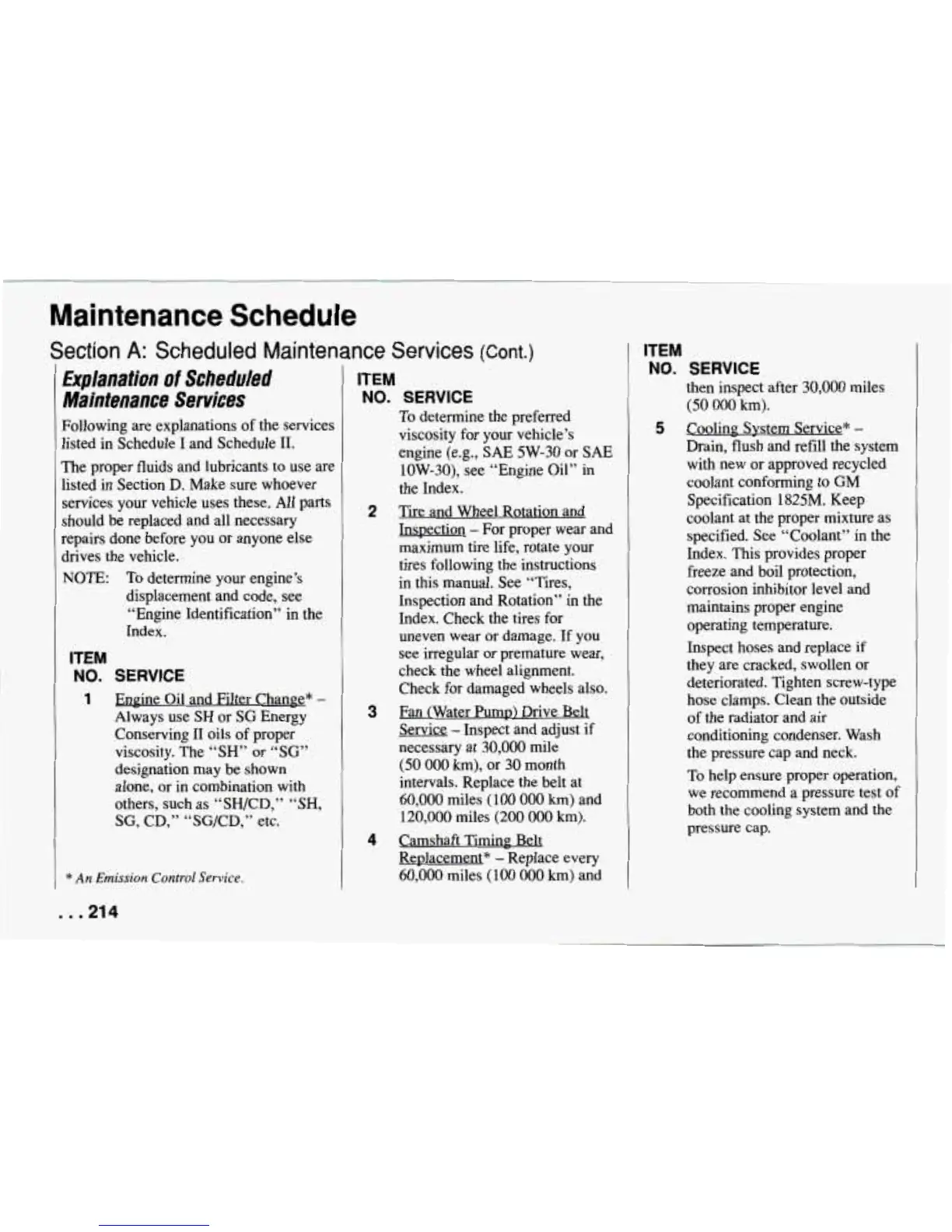
Maintenance
Schedule
Section
A:
Scheduled Maintenance
Services
(Cont.)
&planation
of
Scheduled
Maintenance Services
?allowing
are explanations
of
the services
isted in Schedule
I
and Schedule
II.
he proper fluids and lubricants to use are
.isted
in
Section
D.
Make sure whoever
rervices your vehicle uses these. All parts
should be replaced and all necessary
repairs done before you or anyone else
~ives the vehicle.
NOTE:
To
determine your engine’s
displacement and code, see
“Engine Identification” in the
Index.
ITEM
NO.
SERVICE
1
-e Oil and Filter Change*
-
Always use
SH
or
SG
Energy
Conserving
II
oils of proper
viscosity. The
“SH”
or
“SG”
designation may be shown
alone, or in combination with
others, such as “SHKD,”
“SH,
SG,
CD,”
“SG/CD,”
etc.
*
An
Emission
Control
Service.
ITEM
NO.
SERVICE
2
3
4
To
determine the preferred
viscosity for your vehicle’s
engine (e.g.,
SAE
5W-30
or
SAE
10W-30),
see “Engine Oil” in
the Index.
Tire Wheel Rotation and
Jnspectioq
-
For proper wear and
maximum tire life, rotate your
tires following the instructions
in this manual. See
“Ties,
Inspection and Rotation’’ in
the
Index. Check the tires for
uneven wear or damage.
If
you
see irregular or premature wear,
check the wheel alignment.
Check for damaged wheels also.
Fan (Water Pump) Drive Belt
Servk
-
Inspect and adjust if
necessary at
30,000
mile
(50
000
km),
or
30
month
intervals. Replace the belt at
60,000
miles
(100
000
km) and
120,000
miles
(200
000
km).
-shaft Timin? Belt
Replacemeat”
-
Replace every
60,000
miles
(100
000
km)
and
ITEM
NO.
SERVICE
then inspect after
30,000
miles
(50
000
km).
Drain, flush and refill the system
with new or approved recycled
coolant conforming to
GM
Specification
182SM.
Keep
coolant at the proper mixture
as
specified. See “Coolant” in the
Index. This provides proper
freeze and boil protection,
corrosion inhibitor level and
maintains proper engine
operating temperature.
Inspect hoses and replace
if
they are cracked, swollen or
deteriorated. Tighten screw-type
hose clamps. Clean the outside
of
the radiator and air
conditioning condenser. Wash
the pressure cap and neck.
To
help ensure proper operation,
we recommend a pressure test
of
both the cooling system and the
nressure cap.
5
Coolin? Sys&nSemice*
-
. .
,214


 To Next Page