We recommend initially adjusting the distance of the chest strap according to the table. Then if
necessary, make slight adjustments. In general, the carabiner distance should not be set too narrow!
For flight comfort and safety it is very important that you fly with a suitable, properly adjusted
harness. In practice, it turns out that few pilots have a harness that suits their flying style and
paraglider. If you have any questions or doubts regarding the use of your harness with the Evora,
please contact a GIN dealer or Gin Gliders directly.
NOTE: Don’t adjust your leg and shoulder straps too tightly. If you do, you may have
di
ffi
culty sitting back into your harness after take-o
ff
.
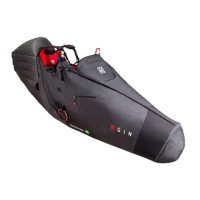
Reclined harnesses
Reclined harnesses are generally completely enclosed and often have a very low main attachment
point. Active flying is very di
ff
erent with them than with an upright harness. To achieve the same level
of e
ffi
ciency and safety in flight with a reclined harness which you are accustomed to with an upright
harness, you must systematically learn the appropriate techniques and gain a good deal of
experience.
If any problems or disturbances are encountered when flying with a reclined harness, the pilot must
immediately assume an upright seating position. Extreme flight manoeuvres flown in a reclined
position drastically increase the risk of twist. In addition, pilots often underestimate the reduction in
control travel caused by flying an extreme flight manoeuvre.
There is an increased risk of twist when using a reclined harness if a large section of the canopy
collapses. If there is an asymmetric collapse and the pilot tips sideways, the resulting twist around the
vertical axis with a poorly positioned harness leads to a reduction in control travel. This quickly causes
an unintended stall on the open side.
Reserve
It is a mandatory requirement to carry an approved reserve for use in emergency situations where the
paraglider fails and recovery is not possible, for example after colliding with another aerial sports craft.
In choosing a reserve, you should be careful that you remain within the specified take-o
ff
weight. The
reserve is fitted according to the manufacturer’s instructions.
Weight range
Be sure to fly your glider within the certified weight range given in the Technical Specification section.
The weight refers to take-o
ff
weight: pilot, incl. clothing, glider, harness and equipment.
The reactions are quite di
ff
erent at the upper- or lower weight range. If you fly at a high wing-
loading, the glider shows dynamic flight behaviour with fast reactions. This may be an advantage in
strong wind conditions, but considerable pilot skill is required.
The dynamics are reduced somewhat in the middle and lower part of the weight range.
Note: Check your total flying weight by standing on weighing scales with all your equipment
packed into your rucksack.
Remember that ballast can also be used to adjust wing loading to the conditions.


 To Next Page
 Loading...