Canopy Collapses
Asymmetric collapses
Asymmetric collapses are caused by the stagnation point moving to the trailing edge of the glider. A
negative angle of attack makes part of the canopy collapse and tuck under, and the glider may plunge
down, turn away or spin.
Use active flying techniques to virtually eliminate collapses in normal flying conditions.
Nevertheless, if you do get a collapse, stabilize your weight in your harness and do not allow yourself
to fall to the collapsed side. Control your course with weight-shift and a little outside brake. The
deflation should re-inflate spontaneously.
If the deflation does not re-inflate spontaneously, apply brake on the closed side in a smooth,
progressive pumping action. Be sure not to apply too much brake too slowly as this may risk a stall.
Remember that a partly collapsed wing has a reduced surface area and thus a higher stall speed.
If you get a collapse while in accelerated flight, release the speed bar immediately. Then apply the
normal procedure for unaccelerated asymmetric collapses.
WARNING: After a large collapse, an instinctive reaction to the body falling is to attempt to
hold something. This can result in the pilot unintentionally applying brake, which prevents
proper recovery. Always make sure you have fully released the brakes (including any wraps
taken) after any incident. Let the glider fly.
Cravat / glider wrapped around lines
A cravatte occurs when a wing tip becomes stuck between the glider lines, for example, following a
bad take-o
ff
preparation. On the Evora, a cravatte is unlikely to occur. If you do get a cravatte, first
control your direction. Do this by using weight-shift and enough counter-brake to stop the turn, but
not too much to risk a stall of the opposite side.
A cravat can generally be opened by a short, fast pull on the brake line of the cravatted side. If not,
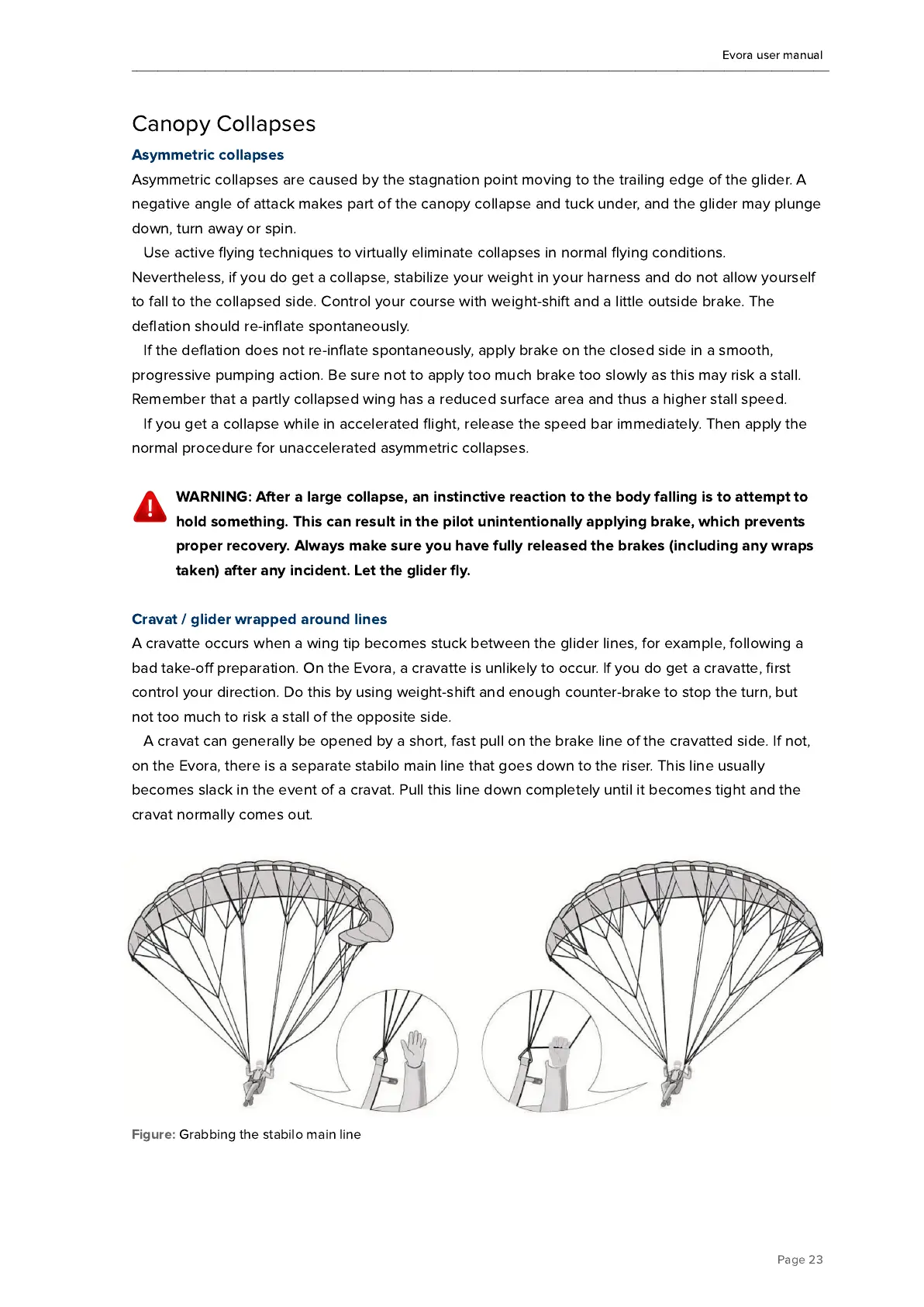
on the Evora, there is a separate stabilo main line that goes down to the riser. This line usually
becomes slack in the event of a cravat. Pull this line down completely until it becomes tight and the
cravat normally comes out.
Figure:
Grabbing the stabilo main line


 To Next Page
 Loading...