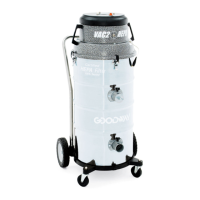
This document provides operating and maintenance instructions for Goodway Vacuums, including models VAC-2, VAC-2Q, VAC-3A, VAC-3QA, AV-1200, SOOT-VAC™ Soot Recovery System, CHIP-MASTER Metal Chip Recovery System, Transfer Lids, and Adapter Rings. The manual is effective as of April 1, 2004, and states that the products are made in the U.S.A.
Function Description:
The Goodway Vacuums are designed for both dry and wet recovery applications, offering solutions for general cleaning, soot recovery, and metal chip recovery. The product line includes both electrical and air-operated vacuum models, catering to various industrial and commercial cleaning needs. The SOOT-VAC™ system is specifically engineered for efficient soot recovery, while the CHIP-MASTER system is dedicated to metal chip recovery, highlighting the versatility and specialized applications of these vacuums.
Important Technical Specifications (General for Electrical Vacuums):
- Power Supply: Vacuums are supplied with a three-conductor cord and a ground plug, requiring use with a grounding receptacle to prevent electrical shock.
- Extension Cords: If an extension cord is used, it must be sufficiently heavy and of a three-conductor type, and must not remove the grounding pin.
- Motor Lubrication: No lubrication of the motor is required for electrical models.
- Carbon Brushes: Carbon brushes should be checked periodically and replaced when worn down to approximately 1/2" (13mm).
- Voltage: Models with a suffix 'A' (e.g., VAC-2A, VAC-3A, GTC-540A) denote 220 Volt operation. VAC-3A and VAC-3QA models specifically include a third motor (M3).
- Safety Features: Electrical schematics show components like radio interference suppression capacitors (F1), switches (S1), pressure differential switches (S2, for VAC-2A-HEPA only), diodes (D, for VAC-2A-HEPA only), red lamps (L, for VAC-2A-HEPA only), and thermal overload fuses (T).
Important Technical Specifications (General for Air Vacuums):
- Air Supply: Requires a clean, dry air supply at a minimum of 50 PSI (3.5 BAR) and 35 CFM (1 m³/min).
- Optimal Performance: Maximum performance is obtained at 70-80 PSI (4.8-5.5 BAR) and 45 CFM (1.3 m³/min).
- Air Line: A minimum 1/2" (13mm) air line is required.
- Grounding: For maximum safety, grounded air lines and vacuum hoses must be used with air-operated equipment to prevent static electricity buildup and arcing, which could lead to fire or explosion near flammable materials.
- Hose Connection: Connects a grounded 1 1/2" or 2" (38mm or 51mm) vacuum hose to the vacuum intake.
Usage Features:
- Safety Precautions (All Models):
- Read all instructions before use.
- Do not vacuum hot, burning, or smoking materials (cigarettes, matches, hot ash).
- Do not vacuum combustible liquids or use in areas where they may be present without proper safety measures.
- Keep loose clothing, hair, and body parts away from openings and moving parts.
- Keep openings free of lint, dust, or anything that impedes airflow.
- Exercise extra care when cleaning stairs.
- Use only Goodway-recommended attachments and filters.
- Strict supervision is required when operating near children.
- Electrical Vacuums Specific Usage:
- Plug into an outlet of the proper voltage.
- Turn off all controls before unplugging the power cord.
- Grasp the plug, not the cord, when unplugging.
- Do not use if the cord or plug is damaged.
- Do not handle with wet hands.
- Avoid rolling the vacuum over the power cord, pulling the cord, closing a door on the cord, or pulling it around sharp corners. Keep the cord away from hot surfaces.
- Air Vacuums Specific Usage:
- Connect a grounded air supply line to the barbed fitting at the intake on the vacuum lid, ensuring the valve is in the off position.
- Open the valve on the vacuum lid to begin vacuuming.
- When finished, shut off the main air supply and open the valve at the vacuum to relieve pressure in the air line.
- Warning: Unrestricted compressed air hoses can whip, causing personal injury and equipment damage.
Maintenance Features:
- Filter Cleaning: For top performance, filters should be cleaned regularly.
- Dry Recovery: Ensure filter bags (GTC-175 and GTC-176) are in place.
- Wet Recovery: Remove GTC-175 and GTC-176 filter bags, but leave the VACP-51 Filter Guard in place on VAC-2, VAC-2Q, VAC-3A, and VAC-3QA models.
- Carbon Brush Replacement (Electrical Vacuums):
- For all VAC models except GTC-540: Pry off the spring clip on each brush holder, lift the plastic motor cap, unclip field wires, remove the hex-head screw, and twist/pull out the carbon brush assembly. Reverse the procedure for replacement.
- For GTC-540: Pry off the motor cover, remove two screws holding each brush assembly, replace the assembly, and reassemble.
- Troubleshooting (Loss of Power - Electrical): Check power cord, fuse/circuit breaker, cord for breaks/loose contacts, switch, and carbon brushes.
- Troubleshooting (Loss of Suction - All Models): Check for clogged filters, obstructions/holes in hose/tools, clogged vacuum intake, overfilled tank, smooth/even drum top for proper seal, vacuum lid/drum adapter sealing ring, and drum for holes/leaks.
- Troubleshooting (Loss of Suction - Air Vacuums Specific): Ensure air supply is fully turned on, check air supply for obstructions/restrictions (undersized air line/regulator), ensure vacuum lid valve is fully open, and check venturi nozzle for clogging.
- Grounding (Air Vacuums): On anodized aluminum and painted accessories, sand coatings off the part of the tube that goes into the hose. Check continuity from the wand to the ground pin on the plug. The connecting wire to ground should be long enough to allow removal of the head and adapters.

 Need help?
 General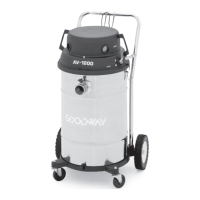

 To Next Page