10
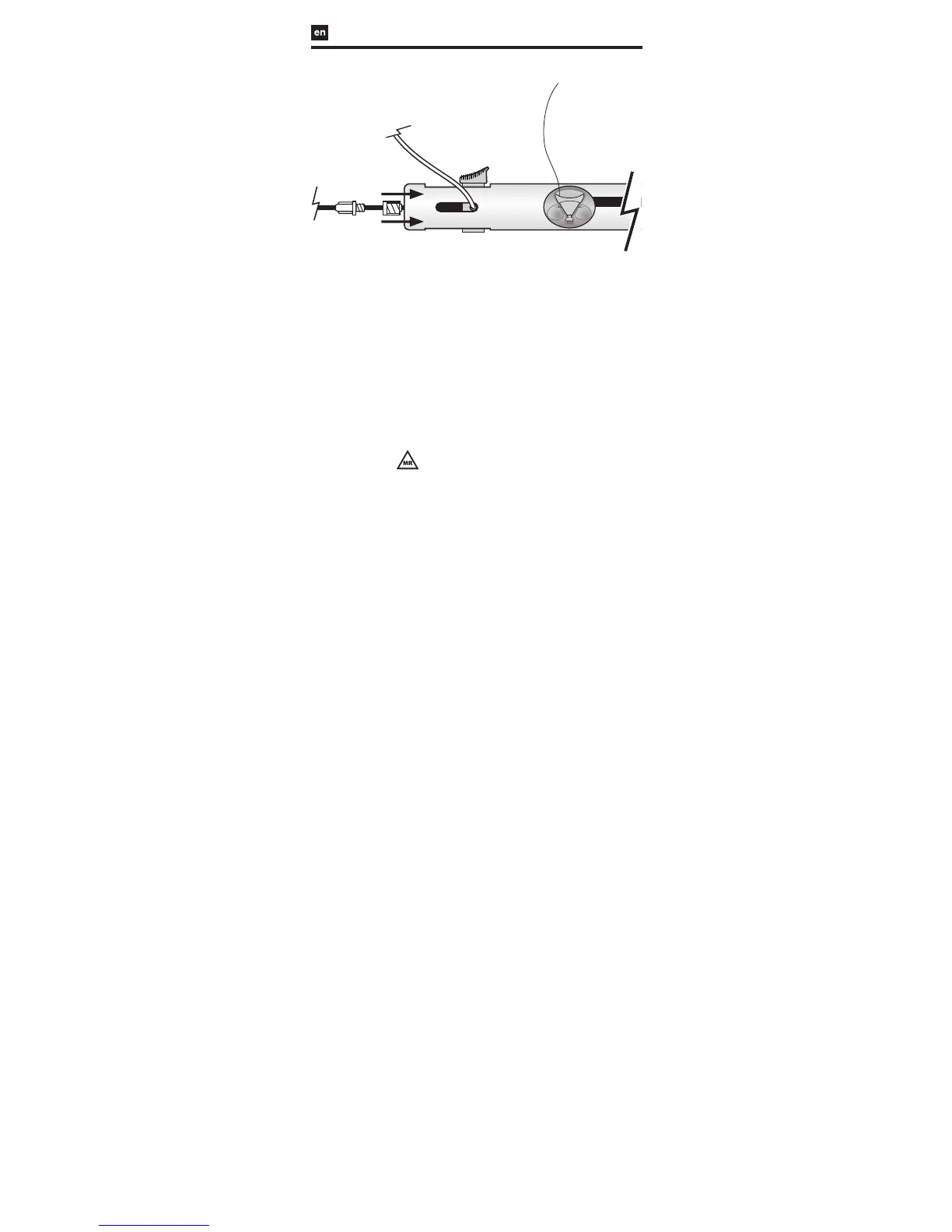
FIGURE 9: Occluder Retrieval
I. Recapture
1. In the event that the Occluder is malpositioned, embolized, or otherwise
requires removal, it may be recaptured with the aid of a loop snare or other
suitable means. A long sheath (11 Fr or greater) positioned close to the
device is recommended for recapture.
2. Attempt to recapture the device by first snaring the left or right atrial eyelet
to facilitate Occluder retraction into the sheath. If necessary, the loop snare
may be placed around any portion of the Occluder frame.
3. Pull the Occluder into the long sheath using the snare. If a portion of
the Occluder frame cannot be retracted into the long sheath, it may be
necessary to remove the Occluder, loop snare, and long sheath as one unit.
Do not use excessive force in an attempt to withdraw all of the Occluder
into the long sheath. Doing so could result in Occluder damage.
4. Bring the recaptured Occluder into the sheath to avoid pulling the unlocked
device across valve tissue.
MR CONDITIONAL
MR Conditional
J. MRI Information
The GORE® CARDIOFORM Septal Occluder has been determined to be
MR-conditional.
Non-clinical testing demonstrated that the GORE® CARDIOFORM Septal Occluder
is MR Conditional. A patient with this device can be scanned safely immediately
after placement under the following conditions:
Static Magnetic Field
-Static magnetic field of 3-Tesla or 1.5 Tesla
-Maximum spatial gradient magnetic field of 720-Gauss/cm or less
-Maximum scanner displayed whole body averaged specific absorption rate
(WB-SAR) of 3.0W/kg for 15 minutes of scanning.
MRI-Related Heating
In non-clinical testing, the GORE® CARDIOFORM Septal Occluder produced the
following temperature rise during MRI performed for 15 minutes of scanning
(i.e., per pulse sequence) in 1.5-Tesla/64-MHz (Magnetom, Siemens Medical
Solutions, Malvern, PA. Software Numaris/4, Version Syngo MR 2002B DHHS
Active-shielded, horizontal field scanner) and 3-Tesla/128-MHz (Excite, HDx,
Software 14X.M5, General Electric Healthcare, Milwaukee, WI) MR systems:
Highest temperature change +1.8°C
The MRI-related heating experiments for the GORE® CARDIOFORM Septal
Occluder at 1.5-Tesla using a transmit / receive RF body coil at an MR system
reported whole body averaged SAR of 2.9-W/kg (i.e., associated with a calorimetry
measured whole body averaged value of 2.1-W/kg) indicated that the greatest
amount of heating that occurred in association with these specific conditions was
equal to or less than +1.8°C.
The MRI-related heating experiments for the GORE® CARDIOFORM Septal
Occluder at 3- Tesla using a transmit / receive RF body coil at an MR system
reported whole body averaged SAR of 3.0 -W/kg (i.e., associated with a
calorimetry measured whole body averaged value of 2.8-W/kg) indicated that
the greatest amount of heating that occurred in association with these specific
conditions was equal to or less than +1.6ºC.
Multiple overlapping implants
MRI- related heating effects with multiple overlapping GORE® CARDIOFORM
Septal Occluder implants is unknown.
Artifact Information
MR image quality may be compromised if the area of interest is in the exact
same area or relatively close to the position of the GORE® CARDIOFORM Septal
Occluder. Therefore, optimization of MR imaging parameters to compensate for
the presence of this device may be necessary.
Pulse Sequence T1-SE T1-SE GRE GRE
Signal Void Size 981-mm
2
483-mm
2
1,308-mm
2
724-mm
2
Plane Orientation Parallel Perpendicular Parallel Perpendicular



 To Next Page
 Loading...