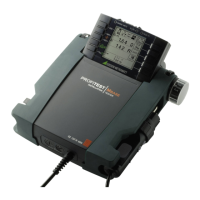
SECUTEST ST BASE(10) / PRO and SECULIFE ST BASE(25)
16 Gossen Metrawatt GmbH
potentially dangerous voltage is also
present at the accessible earthing
contacts of the standard socket (test
socket). Immediately disconnect the
test instrument from the mains and
arrange to have the fault eliminated
at the mains connection.
Voltage at the electrical system’s protective
conductor PE
may result in distorted mea-
surement values during testing for the
absence of voltage, or during leakage
voltage measurements.
Finger Contact
During this test for correct mains con-
nection, a voltage measurement is
performed between the finger contact
and PE at the test instrument’s mains
connection, and its reference poten-
tial is acquired via the user’s body
resistance to the conductive start key.
In order to obtain reliable measure-
ment results, this resistance value
must be less than 1 M. If the user is
wearing insulating shoes or gloves, or
is standing on an insulating floor cov-
ering, erroneous measurements may
result and the following message may
appear at the display “Interference
voltage at mains connection PE”. Try
to reduce resistance in this case, for
example by touching ground potential
with the other hand (e.g. a radiator,
but not an insulating wall etc.).
7.3 Connecting Test Probe P1 or P2
Insert the double plug from test probe P1 or
P2 into socket 1 or 2 respectively such that
the plug with the white ring makes contact
with the socket with the vertical bar.
The white ring identifies the terminal for the
high current conductor which is safeguarded
by the neighboring fuse link.
Test probe with coil cord (SK2W):
Grip the tip of the test probe firmly,
for example if it has been inserted
into a jack socket. Tensioning at the
coil cord may otherwise cause the
test probe to snap back resulting in
possible injury.
Probe Check
Conduct a probe check after com-
pleting each test.
If the fuse at test probe P1 is defec-
tive after testing has been started, all
subsequent measurements con-
ducted using this measuring path will
be incorrectly evaluated as good!
Difficultly in contacting exposed conduc-
tive parts when using the standard probe
with test tip
In order to assure good contact, sur-
face coatings must be removed from
devices under test with special tools
at a suitable location.
The tip of test probe P1 isn’t suitable for
scratching away paint, because this
may impair its coating and/or mechani-
cal strength. Brush probe Z745G may
be more suitable than the test probe in
certain individual cases.
7.4 International Use
The test instrument can be used internation-
ally. Refer to the operating instructions in this
regard.



 To Next Page
 Loading...