Gossen Metrawatt GmbH 23
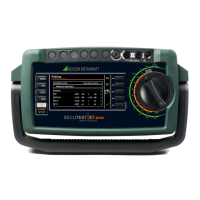
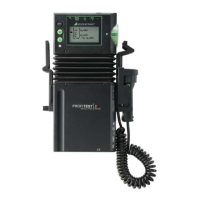
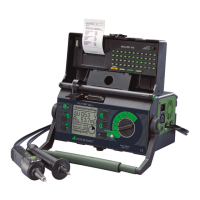
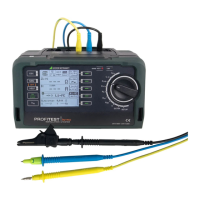
SECUTEST ST BASE(10) / PRO and SECULIFE ST BASE(25)
12 Important Basic Information on
Tests and Measurements
12.1 Important Safety Information
Observe and comply with the following safety
information when performing individual mea-
surements and test sequences.
12.1.1 Switching Loads – Maximum Starting
Current
The test instruments permit active testing of
DUTs with a nominal current (load current) of
up to 16 A.
The test socket on the respective test instru-
ment is equipped with 16 A fuses to this
end, and the switching capacity of the inter-
nal relays is also 16 A. Starting current of up
to 30 A is permissible.
Despite extensive protective measures
targeted at preventing overloading, the
relay contacts may be fused together if
starting current exceeds 30 A
.
Follow the procedure described below
and observe information concerning
defective relays.
Procedure
Be absolutely sure to adhere to the
sequence specified below when switching
the live device under test. This prevents
excessive wear of the mains relays at the
test instrument.
Before measurement:
1 Device under test: Turn the DUT off via its
own switch.
2 Test instrument: Switch line voltage to the
test socket.
3 Device under test: Turn the DUT on via its
own switch.
Perform the measurement.
After measurement:
4 Device under test: Turn the DUT off via its
own switch.
5 Test instrument: Deactivate line voltage to
the test socket.
Safer Testing with Test Adapter
In the case of test objects for which a start-
ing current of greater than 30 A can be
expected, we urgently recommend the use
of a test adapter for larger starting currents:
for example test adapters from the AT3
series (AT3- IIIE, AT3- IIS, AT3-IIS32, AT16DI
or AT32DI).
Alternative: Passive Test
If necessary on the basis of the hazard
assessment, testing can be conducted as a
passive test (equivalent leakage current
method), i.e. without switching line voltage
to the test socket.
12.2 Measurement with DUT Connected to Line
Voltage
Dangerous Touch Voltage!
Exposed parts may conduct danger-
ous touch voltage during testing.
Do not touch under any circum-
stances!
Use a special cover in order to avoid
touch contact.
Mains power is disconnected by the test
instrument if leakage current exceeds
approximately 10 mA (can also be set to
30 mA) (see “Residual Current Monitoring” in
the operating instructions). However, this
does not fulfill the requirements specified for
a PRCD.
If the “PROCEED in case of limit viola-
tion” setting is used (see operating in-
structions), enhanced safeguarding
against touch contact and a 30 mA
RCD must be used, and personal
protective equipment (PPE) must be
worn (secure workstation).
The function test may only be per-
formed after the DUT has success-
fully passed the safety test!



 To Next Page
 Loading...