GMC-I Messtechnik GmbH 23
8 Testing of Breaking Requirements Overcurrent
Protective Devices, Measurement of Loop
Impedance and Determination of Short-Circuit
Current (functions Z
L-PE
and I
K
)
Testing of overcurrent protective devices includes visual
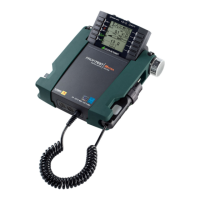
inspection and measurement. The PROFITEST M
ASTER is used to to
perform measurements.
Measuring Method
Loop impedance Z
L-PE
is measured and short-circuit current I
K
is
ascertained in order to determine whether or not breaking
requirements for protective devices have been fulfilled.
Loop impedance is the resistance within the current loop (utility
company plant – phase conductor – protective conductor) when
a short-circuit to an exposed conductive part occurs (conductive
connection between phase conductor and protective conductor).
Short-circuit current magnitude is determined by the loop
impedance value. Short-circuit current I
K
may not fall below a
predetermined value set forth by DIN VDE 0100, so that reliable
breaking of the protective device (fuse, automatic circuit breaker)
is assured.
Thus the measured loop impedance value must be less than the
maximum allowable value.
Tables containing allowable display values for loop impedance, as
well as minimum short-circuit current display values for ampere
ratings for various fuses and circuit breakers can be found in
the help texts, as well as in section 20 beginning on page 57.
Maximum device error in accordance with VDE 0413 has been
taken into consideration in these tables (see also section 8.2).
In order to measure loop impedance Z
L-PE
, the instrument uses a
test current of 0.65 A to 4 A (60 ... 550 V) dependent upon line
voltage and line frequency. The test has a duration of max.
1200 ms at 16 Hz.
If dangerous contact voltage occurs during measurement
(> 50 V), safety shutdown occurs.
The test instrument calculates short-circuit current I
K
based on
measured loop impedance
Z
L-PE
and line voltage. Short-circuit
current calculation is made with reference to nominal line voltage
for line voltages which lie within the nominal ranges for 120 V,
230 V and 400 V systems. If line voltage does not lie within these
nominal ranges, the instrument calculates short-circuit current I
K
based upon prevailing line voltage and measured loop resistance
Z
L-PE
.
Measuring Method with Suppression of RCD Tripping
PROFITEST MTECH tester provides the opportunity of measuring
loop impedance within systems which are equipped with RCCBs.
The test instru-
ment generates a
DC current to this
end, which satu-
rates the RCCB’s
magnetic circuit.
The test instru-
ment then super-
imposes a measur-
ing current which
only demonstrates
half-waves of like
polarity. The RCCB
is no longer capa-
ble of detecting this
measuring current,
and is consequently not tripped during measurement.
A four conductor measuring cable is used between the
instrument and the test plug. Cable and measuring adapter
resistance is automatically compensated for during measurement
and does not effect measurement results.
Select the Measuring Function
Connection



 To Next Page
 Loading...