28
Contents
Chapter Page
1. Introduction 28
2. Warnings and safety notes, please read and observe! 29
3. General notes on using the charger 30
4. Recommended charge leads, polarity 31
5. Controls, using the charger, starting the charge process 31
6. Charge and discharge programs 32
7. Program flowchart 32
8. Selecting the charge program group 33
9. Using the charger for the first time 33
10. Starting the charge / discharge process 34
11. Nickel-Cadmium (Ni-Cd) charge programs 36
12. Nickel-Metal-Hydride (Ni-MH) charge programs 38
13. Lithium-Ion / Lithium-Polymer / Li-Mn / LiFePO
4
- charge programs 41
14. Lead-acid (Pb) charge programs 44
15. Screen displays, cycle data display 46
16. Monitor displays 46
17. Error messages, warnings 48
18. PC interface 49
19. Cleaning and maintenance 50
20. Notes on handling rechargeable batteries 50
21. Specification, Environnemental Protection Notes 51
22. Environnemental Protection Notes, 52
1. Introduction
Please study these instructions, reading them completely and attentively, before using
the unit for the first time. This will guarantee that you will be able to exploit all the
facilities of your new battery charger. The warnings and safety notes are particularly
important. Please store these instructions in a safe place, and be sure to pass them on
to the new owner if you ever dispose of the charger.
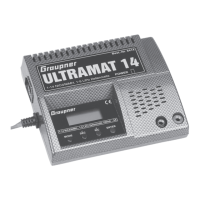
In the ULTRA TRIO PLUS 14 you have acquired a mature product with an excellent
performance. It incorporates the latest semi-conductor technology, controlled by a high-
performance RISC micro-processor, to provide superior charging characteristics combined with
simple operation and optimum reliability. These features can normally be expected only from
much more expensive units. The ULTRA TRIO PLUS 14 represents a reliable method of
charging sintered Nickel-Cadmium (NC, Ni-Cd) packs, Nickel-Metal-Hydride (Ni-MH) batteries,
Lithium-Polymer (Li-Po), Lithium-Manganese (Li-Mn), Lithium-Ion (Li-Io) and LiFePO
4
(LiFe)
batteries, and also lead-gel and lead-acid (Plumbum: Pb) batteries These sealed, gas-tight
batteries have proved excellent for our purposes in RC models. They are mechanically robust,
can be used in any attitude and are generally highly reliable. They require no special measures
for storage apart from protecting the cells from becoming deep-discharged. The ULTRA TRIO
PLUS 14 can also be used to discharge your batteries and balance the cells in a pack.
Note
It is important always to observe the charging instructions supplied by the battery manufacturer,
and to keep to the recommended charge currents and times Do not fast-charge batteries unless
the manufacturer states expressly that they are suitable for the high currents which flow during
these processes. When charging new batteries you may also encounter problems with
premature charge termination. Whenever you wish to use a new battery it therefore makes
sense to carry out a series of monitored test charges, so that you can check that the automatic
charge termination circuit works correctly and reliably with your packs, and charges them to full
capacity.


 To Next Page
 Loading...