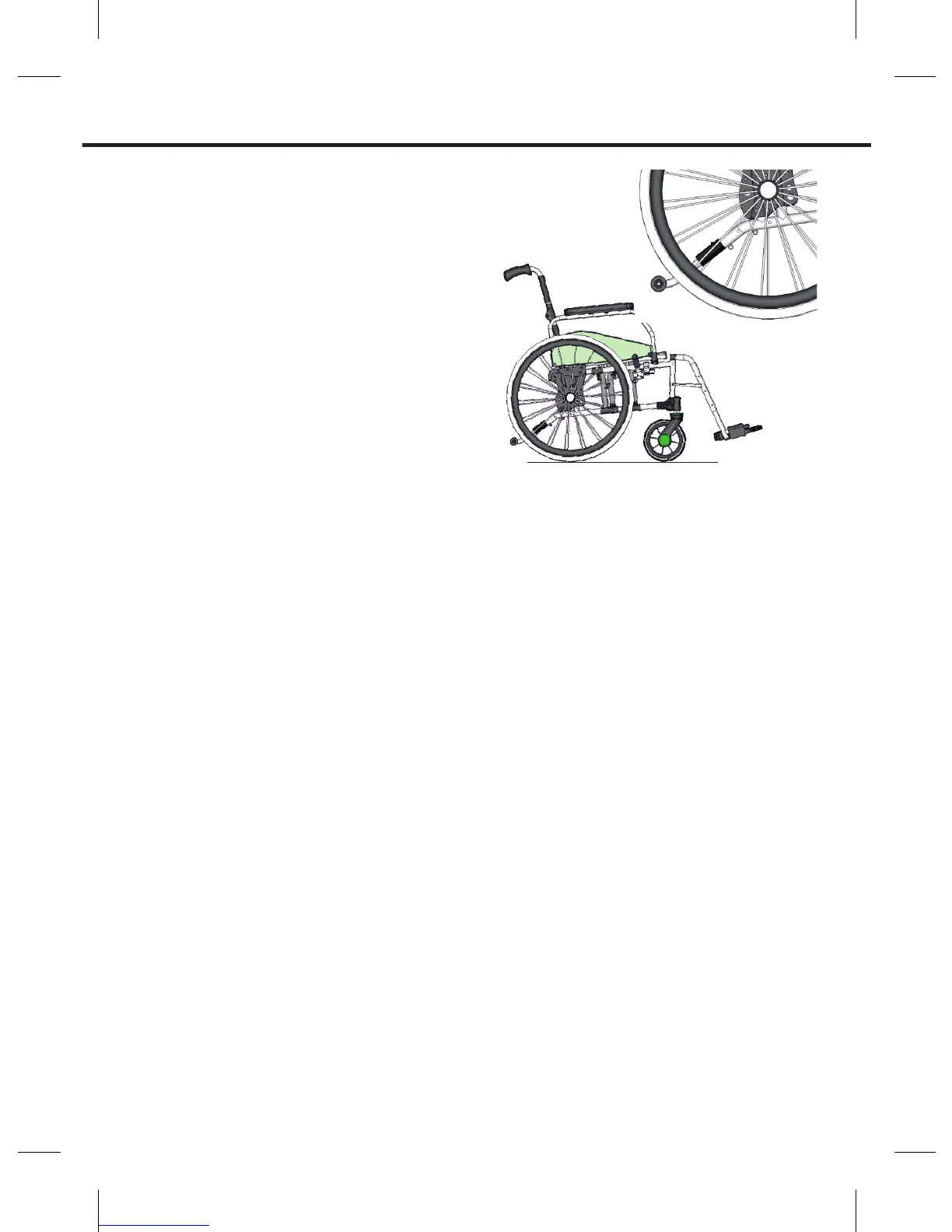
Use of Anti tippers
Anti tippers are available for all Greencare
DB1 models, both occupant and attendant
carer controlled configurations. Attendant
controlled wheelchairs should not need anti
tippers when the chair is being pushed, but
they may be fitted where the occupant spends
long periods in the wheelchair, in a static
situation, or where the occupant is likely to
move about frequently in the chair
Anti tippers fit into the lower rear frame. They
can be set to allow a degree of rearwards
pivotal movement for manouevre. Anti tippers
are not substitutes for safe and responsible
use. It is possible to remove anti tips for
storage, or to allow a skilled occupant much
more freedom, however, for normal use they
should be replaced in the required position.
With a manual wheelchair, an important factor
in considering what is a safe slope is the effort
demanded from the occupant or attendant
using the chair. Pushing up a steep slope over
a long distance may demand a need to stop
and rest, which in turn demands more effort to
start back upwards again from a stopped
position. Attendant operated hub brakes may
be fitted to assist in such circumstances.
Manouevre, which demands over exertion,
may create risk of injury to both occupant and
or carer, and should be avoided
Users should be aware that anti-tippers
become less effective when the wheelchair is
on an upward facing slope. We recommend
that wheelchairs are not used on slopes
greater than 8 degrees. Before taking a
wheelchair outside, routine user safety
checks on the main components, and
occupant security, should be carried out.
Wheelchair skills training under the
supervision of a knowledgeable person or
professional is recommended for all new
users. Users who are in doubt about safety
and stability should contact their local
wheelchair service for advice.
It is most important that the Assessment
Teams are fully satisfied with user skills
before allowing finely tuned balance
settings, and removal or adjustment of anti
tippers. In some instances a helmet may be
advisable for head protection in the event of
rearward tip-out.
Fire Precautions
Carelessness causes Fire. DB1 wheelchair
uses FR material. This is not a solution.
Prevention and safety is key. Smoking can
cause fires, and is bad for you, A wheelchair
occupant who smokes increases fire risk.
Never underestimate the speed at which a
fire can take hold .Disabled persons are at
greater risk than others in the event of a fire.
The environment in which wheelchairs are
used should incorporate safety precautions
to minimise fire related risks. In buildings
check that fire exits and emergency
evacuation procedures are understood. The
local fire brigade are available for advice on
fire prevention. Do not park the chair against
an open fire or intense heat source. When
parking, the carer should position the chair
so that the occupant can see and
communicate as well as possible.
GETTING AROUND SAFELY AND ENVIRONMENTAL FEATURES
21


 To Next Page
 Loading...