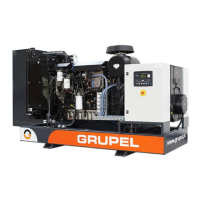
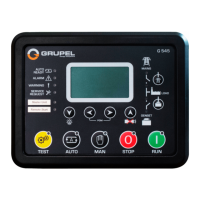
This document serves as a user manual for Deepsea controllers, specifically focusing on their application with Grupel generators. It provides essential information for the safe and efficient operation, maintenance, and troubleshooting of these generator sets. The manual is structured to guide users through various aspects, from initial setup and operation to detailed maintenance schedules and technical support.
Function Description
The Grupel generator sets, equipped with Deepsea controllers, are designed to provide reliable electrical power. These systems are suitable for a wide range of applications, including emergency power, prime power, and continuous power generation. The Deepsea controllers act as the central control unit, managing the generator's functions, monitoring its performance, and ensuring its safe operation. They facilitate automatic and manual control, allowing for flexible deployment based on specific power requirements. The controllers are capable of handling various operational modes, including automatic start/stop, manual start/stop, and test modes, and can manage load transfers, synchronization, and protection against various faults.
Important Technical Specifications
The manual covers several Deepsea controller models, including DSE 3110, DSE 4520, DSE 7310, DSE 7320, DSE 7420, DSE 8610, and DSE 8620. While specific technical specifications for each model are not detailed in a consolidated table, the operational descriptions imply their capabilities.
- DSE 3110: This controller is a basic model, offering fundamental control and monitoring functions. It supports manual and automatic operation, with features for starting, stopping, and resetting the generator. It includes indicators for alarms and operational status.
- DSE 4520: A more advanced controller, the DSE 4520 provides enhanced monitoring and protection features. It supports automatic and manual modes, with capabilities for managing load transfer and detecting various fault conditions, such as low voltage battery or loss of voltage. It also includes scheduled event programming.
- DSE 7310/7320/7420: These controllers represent a higher tier, offering comprehensive control over generator sets, including synchronization and load sharing capabilities. They feature directional navigation keys for accessing various instrumentation values, control screens, and operational settings. They support multiple operating modes (manual, automatic, test) and advanced load transfer functions. The 7320 and 7420 models specifically detail load transfer to the network (Manual) and load transfer to the generator (Manual), indicating their suitability for applications requiring precise power management.
- DSE 8610/8620: These are top-tier controllers designed for complex applications, including parallel operation of multiple generators and synchronization with the mains. They offer extensive control over circuit breakers, load transfer, and advanced protection features. The 8620 model, in particular, highlights its ability to manage synchronization with the grid and load sharing, making it ideal for large-scale power generation and distribution systems.
All controllers feature a display screen for instrumentation and control, along with various buttons for navigation, mode selection, and alarm management. They are designed to monitor critical parameters such as oil levels, coolant levels, fuel levels, and battery status, providing warnings and shutdowns in case of anomalies.
Usage Features
The manual provides detailed instructions for operating the generator sets with Deepsea controllers, emphasizing safety and proper procedure.
- Initial Setup and Placement: Before operation, it is crucial to ensure adequate installation. This includes proper ventilation, sufficient clearance for cooling, appropriate protections, presence of fire extinguishers, and a sandpit. The generator must be installed in a dust-free and humidity-free environment, protected from chemical agents. Electrical connections, including earthing and battery connections, must be correctly established and comply with local regulations.
- Starting and Stopping:
- Manual Mode: Users can start and stop the generator manually by pressing specific buttons on the controller (e.g., button 5 for start, button 3 for stop/reset). The controller will display the operational status and any pending requests.
- Automatic Mode: In automatic mode, the generator starts automatically based on external signals or programmed events (e.g., button 4). The controller manages the start sequence, including circuit breaker closure and load transfer. If a fault occurs, the system will stop and indicate the anomaly.
- Test Mode: Specific controllers (e.g., DSE 7320, 7420, 8620) offer a test mode activated by a dedicated button (e.g., button 7 or 10). This mode allows for testing the generator's functionality and load transfer capabilities without affecting the main power supply.
- Load Transfer: The controllers facilitate load transfer between the generator and the network. Depending on the model, this can be done manually or automatically. For advanced models (e.g., DSE 7320, 7420, 8620), load transfer can involve synchronizing the generator with the grid before taking over the load or transferring the load to the generator in case of network failure.
- Alarm Management: The controllers are equipped with alarm indicators and sounders to alert operators to various fault conditions (e.g., low oil pressure, high engine temperature, overspeed). Users can silence alarms and test LED indicators.
- ATS/QTC (Automatic Transfer Switch / Quick Transfer Controller): The manual describes two types of automatic transfer switches. These systems automatically switch the power source between the main grid and the generator in case of power outages. The ATS/QTC IN is located inside the generator's electrical panel, while the ATS/QTC OUT is located externally. The connections involve specific color-coded cables for phase, neutral, and earth, ensuring correct wiring for power input and output.
Maintenance Features
Regular maintenance is critical for the longevity and reliable operation of Grupel generator sets. The manual provides a comprehensive maintenance plan, recommending specific checks and replacements at different operational intervals (daily, 250 hours, 500 hours, 1000 hours, 2000 hours, 2500 hours, 2750 hours, and annually).
- Engine Maintenance:
- Daily Checks: Verify oil level, coolant level, fuel level, and check for leaks.
- 250 Hours/Annual: Inspect battery electrolyte level and integrity of components.
- 500 Hours/Annual: Change oil and oil filter, replace fuel filter, check coolant, and clean air filter.
- 1000 Hours/Annual: Replace air filter, check fan belt, inspect injectors, and check valve clearance.
- Long-term Storage: If the generator is stored for more than five months, it is advisable to remove engine oil and filters and disconnect the battery. For storage exceeding six months, follow the engine manufacturer's guidelines.
- Alternator Maintenance:
- Daily Checks: Verify condition of the alternator and check for unusual noises.
- 250 Hours/Annual: Check battery terminals and cables.
- 500 Hours/Annual: Inspect wiring and connections, check for vibrations, and verify cooling fan condition.
- 1000 Hours/Annual: Inspect windings, armatures, and safety labels. Verify voltage sensor values and check stator and exciter resistance.
- General Maintenance:
- Environmental Protection: Proper disposal of waste, including fluids, oils, refrigerants, lubricants, electrolytes, and batteries, is emphasized to prevent environmental contamination.
- Accident Procedures: Instructions for handling fuel or electrolyte contact, electrical shocks, and fire incidents are provided, stressing immediate medical attention and safety precautions.
- Documentation and Support: The manual includes a QR code for accessing technical documentation online and contact information for Grupel's technical support, including an email address and phone number.
The manual also includes important warnings and advisories, such as the danger of splashing fluids, hot parts, moving parts, electrocution, and the importance of proper grounding. It highlights the maximum fuel tank capacity (90%) and the location of fuel and oil fill points. Emergency stop procedures are also clearly outlined.
Overall, this manual is a crucial resource for anyone operating or maintaining Grupel generator sets with Deepsea controllers, ensuring safe, efficient, and long-lasting performance.

 Need help?
 General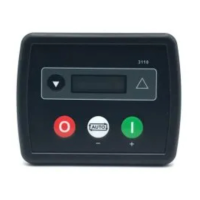

 To Next Page