
 Need help?
Do you have a question about the Ham radio HK5A and is the answer not in the manual?
Describes the HK5A Keyer as a deluxe iambic keyer with dot/dash memory, sidetone, and versatile power options.
Instructions for opening the unit, installing 4 C cells, and reassembling.
Explains connecting a squeeze-type keyer paddle using a 3 CKT 1/4 Phone Plug for dot, dash, and common contacts.
Details fabricating a cable with RCA Phono Plug for grid block or direct keying connections to transmitters.
Removes power from the keyer, extending battery life when not in use.
Keyer is operational, but sidetone is disabled for use with external sidetone.
Activates built-in sidetone; volume and pitch adjustable via front panel controls.
Switches output plugs to ON position, enabling transmitter tuning.
Adjusts keying speed from approximately 8 to 50 WPM.
Adjusts dot/dash length for keying distinctiveness; over-advancing causes constant keying.
Controls the audible volume of the internal sidetone oscillator.
Controls the pitch (frequency) of the internal sidetone oscillator.
Connects a 6V battery eliminator; automatically disconnects internal batteries.
Allows manual operation and use as a code practice oscillator with sidetone.
Describes sending alternate dots/dashes by squeezing paddles; lists 'squeezable' letters.
Troubleshooting for erratic keying due to dirty contacts or RF interference.
Using shielded cables and positioning the HK5A away from RF sources.
Installing ferrite beads on leads to mitigate severe RF problems.
Details warranty coverage, exclusions, and purchaser responsibilities.
Instructions for furnishing model number, date, place, and proof of purchase for warranty.
Schematic diagram of the Curtis 8044 based HK5A Electronic Keyer circuit.
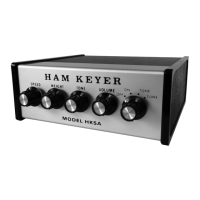
The HAM KEYER HK5A DELUXE ELECTRONIC KEYER is a sophisticated iambic keyer designed for amateur radio enthusiasts. It is capable of keying grid block, cathode, or solid-state transmitters, offering versatility for various radio setups. A key feature of the HK5A is its dot and dash memory and insertion circuits, which contribute to smoother and more accurate Morse code transmission.
The HK5A features a four-position function switch on the front panel, offering different operational modes:
For optimal use of the HK5A's features, a squeeze-type keyer paddle, such as the Ham-Key HK-1, is recommended. The key should be connected using the provided 3 CKT 1/4 Phone Plug. The tip of the plug connects to the dot contact, the ring to the dash contact, and the sleeve to the common contact.
A shielded cable is required to connect the HK5A to the transmitter. An RCA Phono Plug should be installed on one end of this cable, and a connector compatible with the transmitter's key jack on the other end.
The hand key jack accepts a standard 2CKT 1/4 inch phone plug (not provided). This allows for manual operation of the transmitter while still utilizing the HK5A's sidetone monitor feature. The HK5A can also function as a code practice oscillator in this mode.
Iambic or squeeze keying allows the keyer to send alternate dots and dashes when both keyer paddles are pressed simultaneously. This technique can be used for seven specific letters (C, F, K, L, Q, R, and Y), enabling them to be sent with a single "squeeze" rather than keying each element separately. While it requires practice to master, it results in smooth and effortless keying. For example, to send the letter C, both paddles are squeezed simultaneously, leading with the dash paddle. For the letter Q, the dash paddle is held closed, and the dot is inserted at the appropriate time, with the dash paddle remaining closed until the character is complete. Learning this technique is easier at slower speeds and gradually increasing speed with persistence.
To install batteries, remove the top cover by unscrewing two screws on the rear lip, then slide the lid back to expose the battery holder. Install 4 C cells, ensuring correct polarity, and then reinstall the top cover.
Erratic keying can be caused by two main issues:
Ham Radio Center, Inc. provides a 90-day limited warranty on new products, covering defects in material and workmanship from the date of purchase by the original owner. This warranty does not cover misuse, neglect, accidents, incorrect wiring, improper installation, use in violation of instructions, units repaired or altered outside the factory, or accessories not manufactured by Ham Radio Center. Shipping damage should be reported to the carrier. The purchaser is responsible for checking contents upon receipt. The warranty does not cover transportation costs. To claim warranty service, the purchaser must provide the model number, date, place, and proof of purchase (e.g., a copy of the sales receipt) and include all pertinent details. No warranty card is furnished.
 General
| Brand | Ham radio |
|---|---|
| Model | HK5A |
| Category | Radio Communication Code Keyers & Keys |
| Language | English |

 To Next Page