Inverting
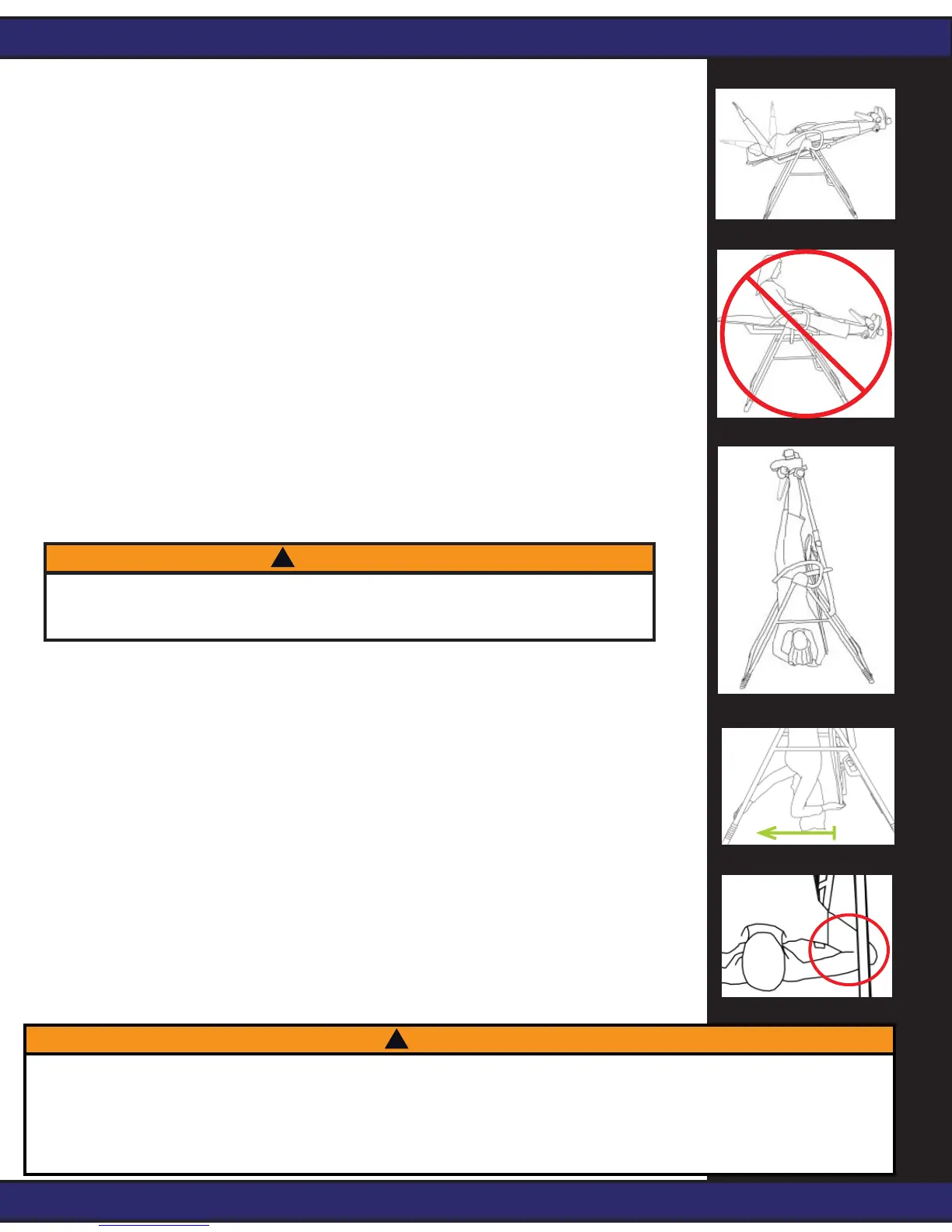
When correctly balanced, the table will rotate in response to simple arm movements. To
invert, lift your arms overhead slowly and to return upright, bring your arms back to your
sides. Your arms provide the weight needed to rotate the table. (Figure 10).
To ensure the inversion table does not rotate too far, too quickly:
• Set the Roller Hinges to Setting “C” (as explained on pg.2);
• Attach the Tether Strap to the underside of the table and test to maximum rotation;
• Raise one arm at a time, and do so very slowly (the faster you move, the faster the
inversion table will rotate).
Returning Upright
To return to the upright position, put your arms at your sides. Since your body may have
lengthened or shifted on the Table Bed during inversion, you may need to bend your
knees to shift your body weight to the foot side of the pivot point. DO NOT lift your head
or try to sit up (Figure 11).
Full Inversion
Defi nition: Hanging completely upside down by your ankles with your back free from the
table. DO NOT attempt this step until you are comfortable with partial inversion.
• Disconnect the Tether Strap.
• Set the Roller Hinges in the top hole setting “A” if you want the table to “lock” fi rmly
while inverted. If you are 220 lbs (100 kg) or more, set the Roller Hinges in the “B”
hole setting.
• From a balanced position on the table, slowly raise both hands over your head to begin
rotation. You may need to assist the last few degrees of rotation by pushing on the
fl oor or A-frame until the table pulls away from your back (Figure 12). In your correct
balance setting, your weight will keep the table “locked” in this position until you are
ready to return upright.
To Release from the Inverted “Locked” Position:
• Place one hand on the top of the Table Bed behind your head and place the other
hand on the bottom bar of the A-frame in front of you.
• Pull both hands together (Figure 13). This will rotate the table out of the “locked”
position. Slowly move your arms and elbows to your sides to complete the rotation.
USE CAUTION: Elbows protruding over the sides of the table bed could get pinched
between the A-frame and the Table Bed as you return upright (Figure 14).
4
INVERTING
Fig. 10
Fig. 11
Fig. 12
Fig. 13
Fig. 14
To reduce tipping hazard, confi ne all inverted activities to smooth movements.
Aggressive exercises that involve vigorous body movement can cause the table to tip
over, resulting in serious injury or death!
WARNING
!
It is your responsibility to familiarize yourself with the proper use of the equipment and the inherent risks of inversion, such
as falling on your head or neck, pinching, entrapment or equipment failure.
DO NOT use the inversion table until you have thoroughly and carefully read the Owner’s Manual, viewed the instructional
DVD, reviewed all accompanying documents and inspected the equipment. ALWAYS test and inspect the equipment for
smooth operation prior to each use.
WARNING
!


 To Previous Page
 Loading...