Vehicle equipment
Please note that this manual contains all
the standard equipment, country-specific
equipment and special equipment for this
model series. Thus, some eq uipment or
features described in this manual may not
be installed onto your vehicle or are only
available i n so me ma rke ts . For further
configuration information, please refer to
relevant sales information or consult with your
di s trib u to r sel li n g th e ve hic l e to yo u.
Tire maintenance
To ensure the safe operation of the vehicle, the
tire type and size must be suitable for your
vehicle model. Tire treads must be in good
condition, and the tires should be inflated to the
correct pressure.
⚠ Warning
Do not use tires that are overly worn,
damaged, under-inflated or over-inflated,
otherwise there is the risk of an accident that
may cause injury.
Follow all instructions in this manual about
inflating and caring for tires.
Burning tires release harmful gases. Take
them to an authorized service center for
disposal.
Tire check
Every time you check the tire pressures, also
check for surface damage and wear and
whether there is any foreign body that has
punctured the tire.
If you find any of the following, replace the tire
as soon as possible:
Damage or protrusion on the tire surface or
side wall.
Excessive tire wear.
Tire pressure
Keeping tires properly inflated provides the
best combination of handling, tread durability
and driving comfort.
An under-inflated tire will wear unevenly and
affect handling and driving efficiency. It is
more likely to suffer air leakage due to
overheating.
Overinflated tires are less comfortable for
passengers and are prone to damage from
uneven road surfaces and uneven wear.
We recommend regular inspection of tire
pressures, including the spare tire (if included).
Measure the tire pressures when the tires are
cool. Tire pressure measurements are most
accurate when you have parked the vehicle for
three or more hours or have driven less than 1.5
km. If you check the tire pressures when
the tires are warm (after driving several
kilometers), the pressure reading will be 30 to
40 kPa higher than when cool. This is normal.
Do not let out air to get the reading to match
the specification because this will result in
insufficient tire pressure.
Notice
Even tires that are in good condition may lose
10 to 20 kPa of pressure per month, so be sure
to check the pressure regularly.
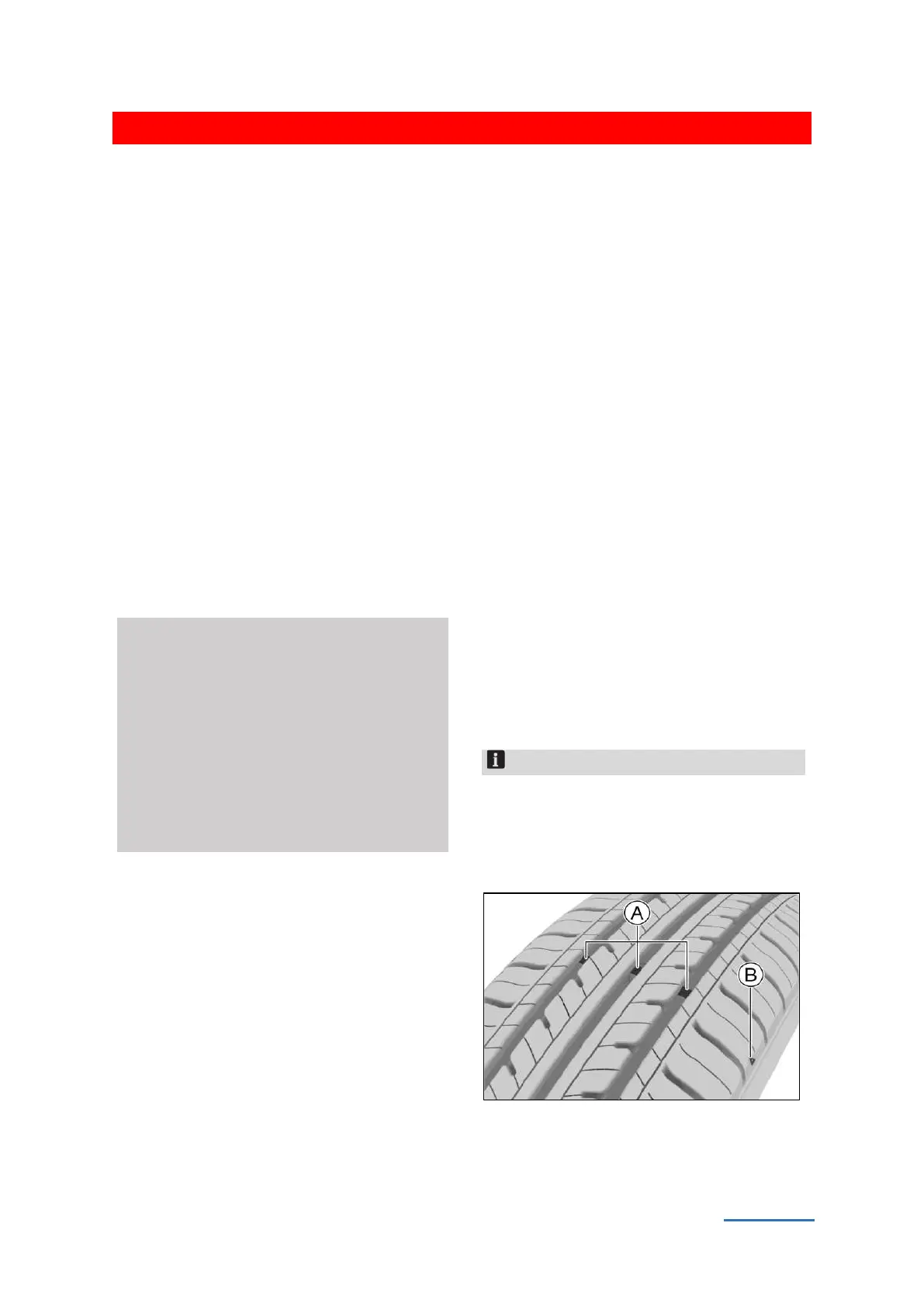
Tire wear
FF3563DBE361
Ⓐ Tire wear mark
Ⓑ Tire wear mark position figure


 To Next Page
 Loading...