There is a degree of conflicting information
from the manufacturer as to the correct
position of this slot on later engines. As a
general rule, when refitting the driveshaft, set
the slot in the same position it was in prior to
removal. If there is any doubt about the
original position, set it as shown in the
illustrations when refitting.
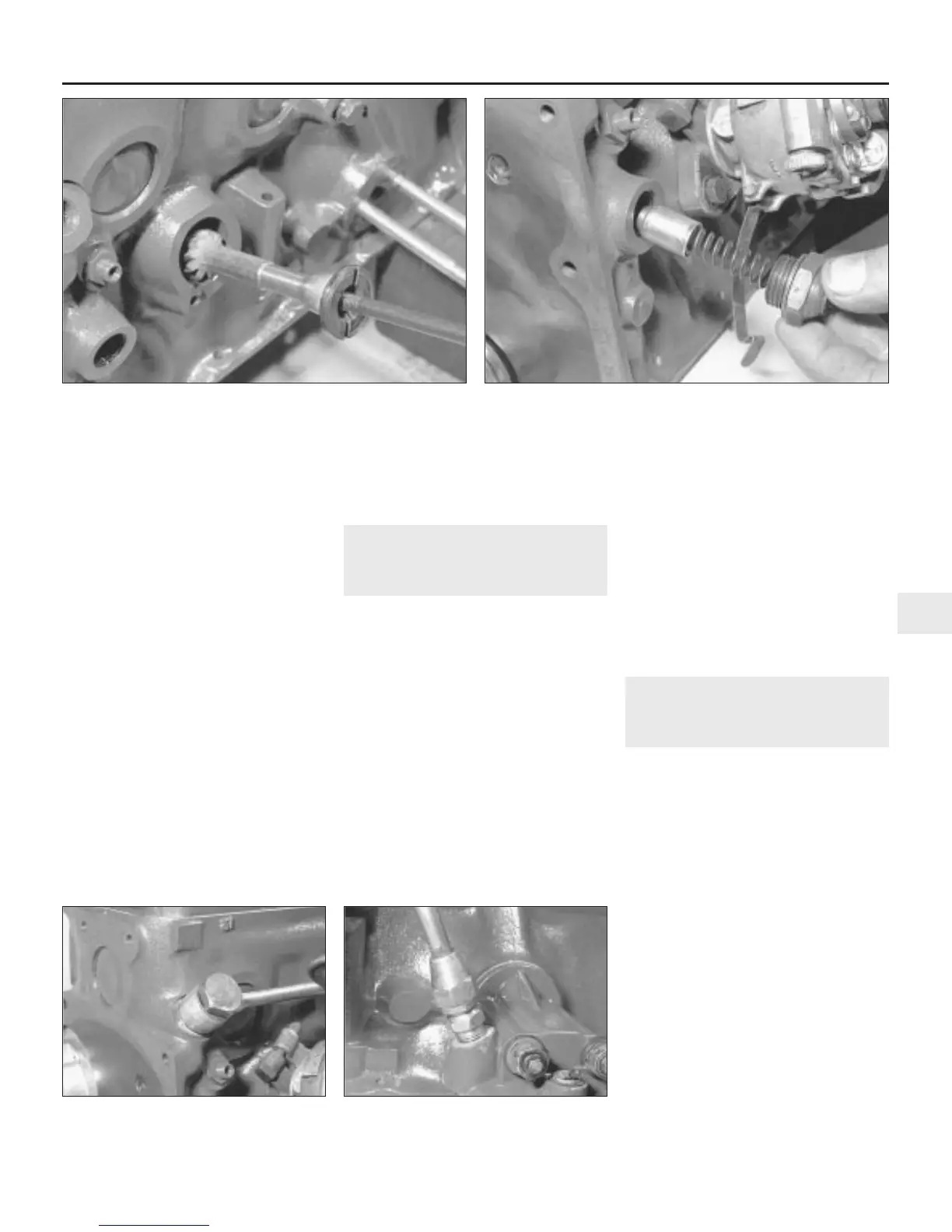
5 Screw into the end of the distributor
driveshaft a
5
⁄16 in UNF bolt. A tappet cover bolt
(where fitted) is ideal for this purpose. The
driveshaft can then be lifted out, the shaft
being turned slightly in the process to free the
shaft skew gear from the camshaft skew gear
(see illustration).
Refitting
6 With the engine still positioned with No1
piston at TDC, hold the driveshaft so that its
slot is in the correct position for refitting as
shown in the accompanying illustrations, ie so
that its larger segment is uppermost (offset
slot towards the bottom). Engage the
driveshaft gear with the camshaft skew gear,
and push the drive fully into position. As the
gear engages, the driveshaft will rotate anti-
clockwise to the final, correct fitted position. If
necessary, withdraw the driveshaft again and
adjust its position as necessary until this is so.
7 Remove the bolt from the driveshaft.
8 Where applicable, refit the distributor base
housing using a new O-ring and lock it in
position with the single bolt and lockwasher.
9 The distributor can now be refitted as
described in Chapter 5B.
14 Oil pressure relief valve -
removal, inspection and
refitting
1
Removal
1 To prevent excessive oil pressure - for
example when the engine is cold - an oil
pressure relief valve is built into the right-hand
side of the engine just below the oil delivery
pipe union.
2 The relief valve is identified externally by a
large domed hexagon nut. To remove the unit
unscrew the nut and remove it, complete with
the two fibre or copper sealing washers. The
relief spring and the relief spring cup can then
be easily extracted (see illustration).
Inspection
3 In position, the metal cup fits over the
opposite end of the relief valve spring resting
in the dome of the hexagon nut, and bears
against a machining in the block. When the oil
pressure exceeds the specified pressure the
cup is forced off its seat and the oil returns,
via a drilling, directly to the sump.
4 Check the tension of the spring by
measuring its free length. If it is shorter than
the length shown in the Specifications it
should be renewed. Check the condition of
the cup checking carefully for wear ridges
which would prevent the cup seating
effectively. Renew the cup if its condition is
suspect.
Refitting
5 Refitting is the reverse sequence to
removal.
15 Oil filter housing and delivery
pipe - removal and refitting
1
Removal
1 Drain the engine/transmission oil and
remove the oil filter as described in Chapter 1.
2 On manual transmission models, Unscrew
the banjo union bolt securing the delivery pipe
to the cylinder block. Note that on later 1275 cc
engines a tube nut and olive type fitting is used
instead of the banjo union. At the other end of
the pipe unscrew the nut securing the pipe to
the oil filter housing (see illustrations). Lift
away the pipe and collect the two copper
washers at the banjo union, or the rubber seals
at the tube nut connections, according to type.
be prepared for oil spillage.
3 On manual transmission models, unscrew
the two nuts and slide the oil filter housing off
the cylinder block studs. Recover the gasket.
4 On automatic transmission models, undo
the two bolts and remove the filter housing
from the top of the transmission casing
flange. Recover the gasket.
5 Thoroughly clean the components and
remove all traces of gasket from the mating
surfaces.
Engine in-car repair procedures 2A•13
2A
15.2a Oil feed pipe banjo union at the
engine . . .
15.2b . . . and pipe nut attachment at the
filter housing
13.5 Using a
5
⁄16 in UNF bolt to remove the distributor driveshaft 14.2 Removing the oil pressure relief valve


 To Next Page
 Loading...