This document outlines the operation, installation, and maintenance procedures for the HEATSTRIP Wall Mounted Radiant Gas Heater, available in two models: TGH34WL-2 and TGH34WN-2. This manual is crucial for ensuring safe and efficient use of the appliance.
Function Description
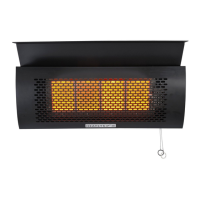
The HEATSTRIP Wall Mounted Radiant Gas Heater is designed for outdoor use, providing radiant heat in open-air environments. It operates by converting gas into radiant energy, which directly heats objects and people in its path, rather than heating the surrounding air. This makes it particularly effective in outdoor settings where convective heat would be lost to the wind. The heater is intended to be permanently mounted on a wall, offering a fixed heating solution for patios, balconies, and other outdoor living spaces. It is available in two fuel types: Liquid Propane Gas (LPG) and Natural Gas (NG), with specific models designated for each. The appliance is equipped with safety features such as a shutoff valve and a safety relief device for LPG models, and a pressure regulator for both LPG and NG models, ensuring safe gas flow and operation.
Usage Features
The heater is designed for straightforward operation, with clear instructions for connecting to a gas source and lighting. For LPG models, connection involves attaching the regulator assembly to a standard 20 lb. LP Gas tank, ensuring a secure, hand-tightened connection. It is critical to use an "OPD" gas tank with an Overfill Prevention Device for safety. Natural Gas models require connection to a home's gas supply line via a swivel nut and a 12-foot hose, with the inclusion of a shutoff valve at the gas supply source.
Before lighting, users must perform a gas leak check using a soap solution to identify and seal any leaks. This is a vital safety step that should be performed prior to first use, at the beginning of each season, and every time the LP Gas cylinder is changed. The lighting procedure involves turning on the gas source, pulling down a red cord until a "click" is heard, holding for 10 seconds to allow the heater to light, and then releasing. If the burner does not ignite, users are instructed to turn off the gas, wait 5 minutes, and retry, or conduct another leak test if necessary. To turn off the heater, a black cord is pulled down until a "click" is heard and then released, followed by turning off the gas supply.
The heater is intended for outdoor use only and must be placed on level, firm ground. Specific guidelines are provided for installation in various outdoor enclosures, emphasizing the need for natural ventilation and unrestricted open areas to disperse combustion products. The manual strictly prohibits use near automobiles, trucks, vans, or recreational vehicles, and under any unprotected combustible materials, including overhanging trees and shrubs. Users are advised to maintain a minimum clearance of 3 feet from any wall, surface, or combustible objects to prevent fire hazards. Children and adults should be aware of high surface temperatures and keep a safe distance to avoid burns or clothing ignition. Young children require careful supervision when in the vicinity of the heater.
Maintenance Features
Regular maintenance is essential for prolonging the life and ensuring the safe operation of the HEATSTRIP heater. The manual recommends periodic maintenance and an annual inspection and service by a qualified technician. Before each use, users should visually inspect the hose for any cuts, cracks, excessive wear, or other damage, and ensure all gas supply connections are securely tightened. Any damaged hose must be replaced with an authorized part from Thermofilm.
Cleaning the exterior painted surfaces involves using a mild soap and warm water solution with a washcloth or sponge. Abrasive cleaners, scrubbers, or stiff wire brushes are explicitly prohibited as they can scratch the painted surfaces. After cleaning, the appliance should be thoroughly dried to prevent rusting, and it is recommended to operate the heater on high heat to ensure complete drying. The ventilation openings of the cylinder enclosure cabinet must be kept clear of debris to ensure proper airflow.
Troubleshooting guidance is provided for common issues such as the pilot or main burner not lighting, or the flame being yellow. Solutions include purging air from the gas line, clearing blockages, repairing igniter components, ensuring the gas cylinder is full and turned on, rectifying gas control issues, and cleaning the injector, venturi, or burner ports. In cases where the appliance cannot be lit after troubleshooting, users are advised to contact the Heater Information Center for assistance. The manual also stresses the importance of never storing or using gasoline or other flammable liquids and vapors within 25 feet of the appliance, and never storing an LP-gas cylinder under or near the appliance, or indoors. LP Gas tanks must always be stored outdoors in a well-ventilated area, out of reach of children, and never filled beyond 80 percent capacity.


 To Next Page
 General