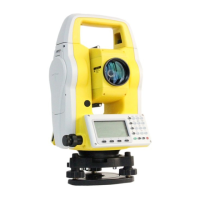
Total Station Manual
- 181 -
3.8 Instrument additive constant (K)
The instrument constant is inspected when it out, and correct it inside the
machine, make K = 0. Instrument constant change rarely, but we suggest that check it
this way for one or two times each year. The checkout should be done in the
standard baseline, or you can take the following simple method.
Checkout
1. Choose a flat field A to set up and level the instrument , mark three points A、B、
C in the same line ,their interval is 50m, and set up the reflection prism
accurately.
2. After setting the temperature and pressure data, accurately measure the
horizontal distance of AB, AC.
3. Setting up and centering the instruments accurately, measure the horizontal
distance of BC accurately.
4. You can get the instrument ranging constant:
K = AC-(AB + BC)
K should be close to 0, if | K | > 5 mm, it should be send to standard baseline
field for strict checking, then calibrate it based on the checking value.
Calibration
If it turns out the instrument constant does not close to 0 but changing after
strict inspection, you need to calibrate it, set the instrument additive constant
according to the comprehensive constant K value. Such as: the K has been measured
as -5 according to the method above, and the original instrument constant is -20,so
the new value should be set as -20-(5) =-15; Input-15 through "menu-> 6-> 3" and
then confirm .
Use the vertical line of the reticle to orientate, make A, B and C at the same line
accurately. There must be a clear mark for point B the ground to focus on.
Whether the prism center of B coincide with the instrument centers is the
guarantee of checking the accuracy, so, you had better use tripod and
all-purpose tribrach, for example, if you change the three hand type prism
connector with tribrach, keep the tripod and tribrach stable, just change the
prism and the part above tribrach of instrument, and it can reduce the error of
misalignment.
3.9 The parallelism of collimation axis and photoelectricity axis
Checkout
1. Set up the reflecting prism 50 meters long from the instrument.
2. Focus on the reflecting prism center with telescope crosshair accurately.



 To Next Page
 Loading...