7
English
*1 Existing batteries (BSL3660/3620/3626, etc.) cannot be
used with this tool.
*2 According to EPTA-Procedure 01/2014
NOTE
Due to HiKOKI’s continuing program of research and
development, the specifi cations herein are subject to
change without prior notice.
CHARGING
Before using the tool, charge the battery as follows.
1. Connect the charger’s power cord to the receptacle.
When connecting the plug of the charger to a receptacle,
the pilot lamp will blink in red (At 1- second intervals).
2. Insert the battery into the charger.
Firmly insert the battery into the charger as shown in
Fig. 3.
3. Charging
When inserting a battery in the charger, charging will
commence and the pilot lamp will light continuously in
red.
When the battery becomes fully recharged, the pilot lamp
will blink in red. (At 1-second intervals) (See Table 1)
● Pilot lamp indication
The indications of the pilot lamp will be as shown in
Table 1, according to the condition of the charger or the
rechargeable battery.
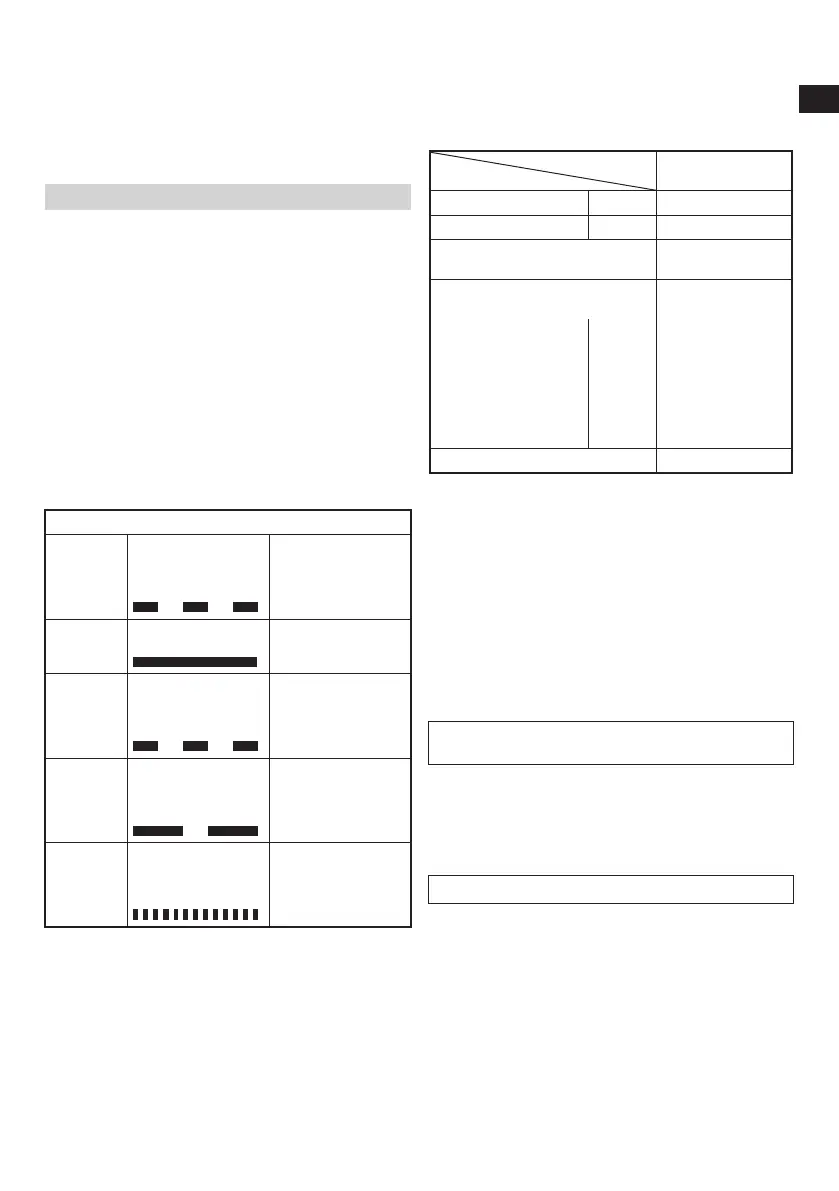
Table 1
Indications of the pilot lamp (RED)
Before
charging
Lights on for
0.5 seconds and off
for 0.5 seconds
(Blinks)
Plugged into power
source
While
charging
Lights continuously
(Lights)
—
Charging
complete
Lights on for
0.5 seconds and off
for 0.5 seconds
(Blinks)
—
Overheat
standby
Lights on for
1 second and off for
0.5 seconds
(Blinks)
Battery overheated.
Unable to charge.
(Charging will
commence when
battery cools)
Charging
impossible
Lights on for
0.1 seconds and off
for 0.1 seconds
(Flickers)
Malfunction in
the battery or the
charger
● Regarding the temperatures and charging time of the
battery.
The temperatures and charging time will become as
shown in Table 2.
Table 2
Charger
Battery
UC18YFSL
Charging voltage V 14.4–18
Weight kg 0.5
Temperatures at which the battery
can be recharged
0°C–50°C
Charging time for battery capacity,
approx. (At 20°C)
1.5 Ah
2.0 Ah
2.5 Ah
3.0 Ah
4.0 Ah
5.0 Ah
6.0 Ah
8.0 Ah
min
min
min
min
min
min
min
min
22
30
35
45
60
75
90
120
Number of battery cells 4–10
NOTE
The recharging time may vary according to temperature
and power source voltage.
CAUTION
When the battery charger has been continuously used,
the battery charger will be heated, thus constituting
the cause of the failures. Once the charging has been
completed, give 15 minutes rest until the next charging.
4. Disconnect the charger’s power cord from the
receptacle.
5. Hold the charger fi rmly and pull out the battery.
NOTE
Be sure to pull out the battery from the charger after use,
and then keep it.
Regarding electric discharge in case of new batteries,
etc.
As the internal chemical substance of new batteries and
batteries that have not been used for an extended period
is not activated, the electric discharge might be low when
using them the fi rst and second time. This is a temporary
phenomenon, and normal time required for recharging
will be restored by recharging the batteries 2–3 times.
How to make the batteries perform longer.
(1) Recharge the batteries before they become completely
exhausted.
When you feel that the power of the tool becomes
weaker, stop using the tool and recharge its battery. If
you continue to use the tool and exhaust the electric
current, the battery may be damaged and its life will
become shorter.
(2) Avoid recharging at high temperatures.
A rechargeable battery will be hot immediately after
use. If such a battery is recharged immediately after
use, its internal chemical substance will deteriorate, and
the battery life will be shortened. Leave the battery and
recharge it after it has cooled for a while.
00BookUB18DB.indb700BookUB18DB.indb7 2021/10/1911:20:542021/10/1911:20:54



 To Next Page