130-0047 Issue 8
5.6.1 Setting zero offset on instruments fitted with an L sensor
The label on the L sensor is marked with the sensor’s offset at zero
oxygen concentration. The offset figure is given in units of parts per
million (PPM) oxygen and is negative; for example (-)3.5PPM. To
set the zero offset proceed as follows:
a) Disconnect the signal leads of the old sensor from terminals 1
and 2 of the instrument’s terminal block and leave the input open
circuit, i.e. with nothing connected to terminals 1 and 2.
b) Apply power to the instrument if it has been disconnected, and
allow 2 minutes, or until the reading is steady, for the electronics to
stabilise.
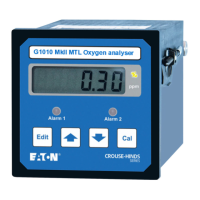
c) Press the Calibrate button for approximately 8 seconds until the
display shows “H xxxx” . Release the button and then press it for
another 8 seconds approximately until the display shows “L xxxx”.
“L” indicates that the lower concentration calibration is selected and
xxxx is an oxygen concentration figure; note it probably will have a
negative sign in front of it. Next use the up/down arrow buttons to
set the display to read the sensor oxygen concentration offset figure
Page 15 of 18
given on the new sensor - note that this a negative figure and it is
important that the display is set accordingly. When the correct
figure has been set on the display, press the Edit button once for
approximately 2 seconds and release. This puts the figure into the
instrument’s memory and the “L” will disappear and instrument will
return to ordinary measurement mode. Refer to section 5.7 for
details of how to replace and connect the sensor.
5.7 Replacing/Connecting the sensor
Read section 5.6 before proceeding
Before replacing/connecting a sensor please note:
a) SOME OF THESE PROCESSES ASSUME THAT THE
SAMPLE WILL NOT CONSTITUTE ANY SORT OF HAZARD,
ASPHYXIATION ETC., IF IT ESCAPES INTO THE
ATMOSPHERE. IT IS THE RESPONSIBILITY OF THE USER
TO ENSURE THIS. IF A HAZARD WILL RESULT THEN THE
METHOD SHOULD BE MODIFIED ACCORDINGLY.
CONSULT HITECH OR THEIR REPRESENTATIVES FOR
ADVICE IF IN DOUBT.
b) That any control loop using the outputs from the unit is
disabled.
5.7.1 General points when replacing a sensor
Disconnect the old sensor’s signal leads from terminals 1 and 2 of
the connector on the rear of the instrument. Slacken the
compression nut on the sensor sample tube and withdraw the old
sensor. See warning 5.7 a). Replacement is the reverse of
removal; refer to the following instructions for details of each type of
sensor. The instrument does not have to be turned off during this
operation, although care should be taken to ensure that any control
equipment that is attached is disabled.
5.7.2 Replacing and connecting N and L sensors - N and L
sensors are shipped with the leads shorted and the sample tube
plugged with a rubber bung. This ensures that the sensor is purged
down to low levels and ready to be applied to the measurement of
low levels of oxygen (less than 1000ppm) with the minimum of
delay. The bung should be left in place until the system is ready
Page 16 of 18
for the sensor to be fitted. If the sensor is to be immediately applied
to the measurement of low oxygen concentrations, the sample
should be left flowing during the sensor change operation. The
bung should be removed from the sensor and the sensor
coupled to the holder as quickly as possible.
5.8 Gas calibration following replacement
Refer to sections 5.3 to 5.5 for method of calibrating the sensor at
higher levels (span).
5.9 Safety and Disposal of old sensors
The sensors contain a 4-molar potassium acetate solution which is
corrosive. Normally this solution only leaks out as a result of
mechanical damage (crushing or piercing) or by electrical misuse;
e.g. by attempting to input an electrical charge. The sensors also
contain small amounts of lead, lead oxide, platinum, silver, carbon


 To Next Page
 Loading...