WARNING
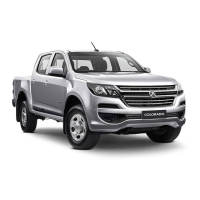
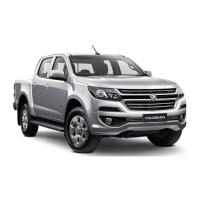
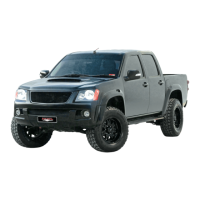
The specic design characteristics of the Colorado give it a higher centre of gravity
than ordinary vehicles. Its high ground clearance makes it capable of performing in
a wide variety of off-road applications. It is not designed for cornering at the same
speeds as conventional passenger cars. Therefore, sharp turns or abrupt manoeuvres
should be avoided at all times. As with other vehicles of this type, failure to operate
this vehicle correctly may result in loss of control and/or vehicle roll over. Always wear
your seatbelts.
Running-in
These days, there is no need to follow the formal running-in schedule. However, by
observing a few simple precautions during the rst few hundred kilometres of driving
you will greatly assist your vehicle’s future performance and economy.
For the rst 500 km, do not exceed 90 km/h. Up to 1,500 km, avoid driving at any one
speed, either slow or fast, for any length of time.
Include some higher speeds during this period. Always drive at moderate speed until
the engine has completely warmed up.
For the rst 500 km heavy braking should be avoided, except in an emergency, since
brake misuse during this period could impair future braking efciency.
It is best to drive your new vehicle for 1,500 km before towing a load. If you must tow
before this do not exceed 80 km/h on good roads. No heavy off road towing should be
attempted before 1,500 km.
Off-road
Following a period of off-road driving, particularly in wet weather, the front of the vehicle
should be hosed down to clear any accumulation of mud. In particular, pay specic
attention to both sides of the radiator.
Engine misre warning
If the engine is misring, reduce the vehicle speed and do not attempt to tow a caravan
or trailer, until the misring is corrected by the nearest Holden Dealer. Continued driving
while the engine is misring could result in the catalytic converter and exhaust system
overheating, resulting in vehicle damage.
Loose articles
Do not leave loose articles or luggage in the passenger compartment. Whenever
possible, stow articles in the tray area.
WARNING
Gas cylinders can leak, creating a risk of re or explosion. As a precaution, ensure
adequate ventilation when carrying gas cylinders. They must be restrained from rolling
around, and where possible, placed in the load area of the vehicle. It is recommended
that if gas cylinders are frequently transported that a purpose built carrying compartment
be used. Transportation of gas cylinders is regulated by legislation in some States.
DRIVING PRECAUTIONS
Chapter 4
DRIVING
4-3


 To Next Page
 Loading...