Need help?
Do you have a question about the Honda EU20i Series and is the answer not in the manual?
Crucial safety guidelines to prevent injury and property damage when operating the generator.
User's duty to understand controls, ensure proper instruction, and follow safety guidelines for safe generator operation.
Highlights key safety labels and warnings on the generator, including socket, hot, and fuel cautions.
Identifies and explains the CE mark and noise level label on the generator for compliance and user awareness.
Details the various controls and indicators on the generator's control panel for specific model types.
Details the various controls and indicators on the generator's control panel for specific model types.
Steps to inspect and ensure the engine oil level is within the recommended range before operation.
Procedure to check and refuel the generator's fuel tank, emphasizing safety precautions.
Instructions for inspecting the air cleaner elements for cleanliness and condition to ensure proper engine performance.
Guidance on inspecting, cleaning, and gapping the spark plug for optimal engine operation.
Explains modifications needed for operating the generator at high altitudes to maintain performance and emissions.
Instructions on how to properly ground the generator for electrical safety.
Guidelines for selecting and using appropriate extension cords with the generator.
Information on using RCBOs for connecting multiple appliances safely.
Explains the function and resetting of AC circuit protectors for specific generator models.
Describes the normal operation, blinks, and functions of the output indicator, including its hour meter capability.
Explains the behavior of the overload indicator when the generator is overloaded or has a connected appliance fault.
Guidelines for using Honda approved equipment to connect two generators for parallel operation.
Instructions for using the DC receptacle to charge 12-volt automotive batteries, including safety warnings.
Detailed steps for draining and refilling the engine oil, including capacity and cautions.
Procedure for checking and cleaning the air cleaner elements to maintain engine performance.
Steps for inspecting, cleaning, gapping, and replacing the spark plug for proper engine operation.
Safety precautions and procedures for transporting the generator, including securing it and preparing it for transport.
Steps for preparing the generator for extended storage, including draining fuel and protecting the engine.
A flowchart to diagnose and resolve issues when the generator engine fails to start.
A flowchart to diagnose and resolve issues when connected appliances are not operating correctly.
Technical specifications detailing the generator's physical dimensions and weight.
Detailed technical specifications for the generator's engine, including type, displacement, and capacity.
Technical specifications related to the generator's AC and DC output ratings, voltage, and frequency.
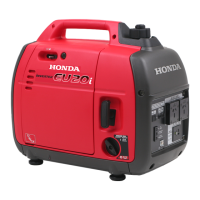
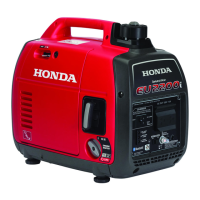
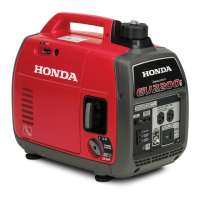
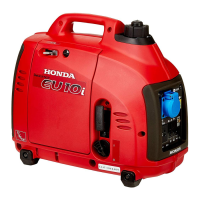
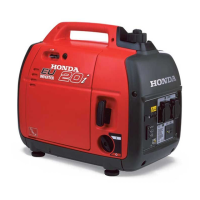
This document describes a portable generator, likely a Honda EU20i model, designed for providing electrical power. It emphasizes safe operation, maintenance, and troubleshooting to ensure reliable performance and prevent injury or damage.
The generator is designed to produce electrical power for various equipment with suitable power requirements. It features an internal combustion engine that drives an alternator to generate AC and DC electricity. The AC output is suitable for general electrical appliances, while the DC output is specifically for charging 12-volt automotive-type batteries. The generator incorporates an "Eco Throttle" system to automatically adjust engine speed based on the electrical load, minimizing fuel consumption during operation. It also includes an "Oil Alert" system that automatically shuts down the engine if the oil level falls below a safe limit, preventing engine damage. For safety, it features AC circuit protectors that automatically switch off in case of a short circuit or significant overload. The generator can be operated individually or in parallel with another identical unit using an optional receptacle box to increase total power output.
To operate the generator, users must first perform pre-operation checks, including verifying engine oil and fuel levels, and ensuring the air cleaner elements are clean. Starting the engine involves turning the fuel filler cap vent lever to the ON position, setting the engine switch to ON, moving the choke lever to the CLOSED position (if the engine is cold), and then pulling the starter grip briskly. Once the engine warms up, the choke lever should be moved to the OPEN position. When connecting appliances, it's crucial to ensure they are switched off before plugging them into the AC receptacles. The generator's output indicator (green) confirms normal operation, while the overload indicator (red) signals an overload or short circuit, prompting the user to investigate and reset the circuit protector. For DC charging, the Eco Throttle switch should be in the OFF position, and charging cables must be connected first to the generator, then to the battery, with careful attention to polarity to prevent damage or sparks. The manual strongly advises against starting an automobile engine with the generator still connected. For high-altitude operation, carburetor modifications may be necessary to maintain performance and prevent engine damage. When transporting or storing the generator, it must be secured upright, with the engine switch OFF and the fuel filler cap vent lever turned to the OFF position to prevent fuel spillage.
Regular maintenance is crucial for keeping the generator in optimal operating condition. The manual provides a detailed schedule for inspections and services. Key maintenance tasks include checking and changing the engine oil, servicing the air cleaner, and inspecting/servicing the spark plug. Engine oil should be drained when warm and refilled with recommended 4-stroke motor oil. The air cleaner elements should be cleaned regularly, especially in dusty conditions, using warm soapy water or a high flash point solvent, then oiled and squeezed dry. The spark plug needs visual inspection for cracks or fouling, cleaning with a wire brush, and adjustment of the plug gap to ensure proper engine operation. For long-term storage (more than 30 days), the fuel system should be drained to prevent fuel deterioration and engine damage. This involves emptying the fuel tank and carburetor, and then pouring a small amount of clean engine oil into the cylinder before reinstalling the spark plug. The starter grip should be pulled slowly until resistance is felt, indicating the piston is on its compression stroke, to protect against internal corrosion. The manual also advises consulting an authorized Honda dealer for disassembly and service procedures not covered in the manual, and for disposing of used parts and fluids responsibly.
 General
| Model | EU20i |
|---|---|
| Noise Level at 1/4 Load | 53 dB(A) |
| Dry Weight | 21 kg |
| Inverter | Yes |
| Maximum AC Output | 2000 VA |
| Rated AC Output | 1600 VA |
| Engine Type | 4-stroke, single cylinder |
| Fuel Tank Capacity | 3.6 litres |
| Continuous Operating Hours at Rated Load | 4.0 hours |
| Starting System | Recoil |
| AC Output | 230V |
| DC Output | 12V |
| Type | Portable Inverter Generator |

 To Next Page