EasyManua.ls Logo

HP 6296A - Page 27

HP 6296A
61 pages
Print Icon
To Next Page IconTo Next Page
To Previous Page IconTo Previous Page
Loading...
diagram.
The
firing
pulse
ls.
relatively
narT"ow
be-
cause
Q700
saturates
rapidly
causing
the
magnetic
field
surrounding T700
to
collapse.
Diode
CRSOO
damps
out
the
negative
overshoot.
4-17
Reset
of
the
control
circuit
occurs
once
every
8.33
milliseconds
when
the
rectified
ac
voltage
at
test
point
52
recedes
to
a
level
at
which
diode
CR709
becomes
forward
biased.
Summing
capacitor
C700
is
then
allowed
to
dis-
charge
through CR709.
Diodes
CR711 and CR710
become
reverse
biased
at
reset
and
transistor
Q701
reverts
to
its
"on"
state.
Consequently,
Q700
is
turned off
and
capacitor
C703
charges
up
through
R703
at
a
comparatively
slow
rate
until
the
collector
voltage
of
Q700
reaches
approximately
+17
volts.
The
above
action
causes
the
small
negative
spike
that
appears
across
the
winding
of
pulse
transfonner
T700
at
reset
time.
4-18
Capacitor
C900,
diode
CR900,
and
~stor
R900
fonn
a
long time
constant
network
which
achieves
a
slow
tum-on
characteristic.
When
the
unit
is
firSt
turned
on,
C900
provides
a
positive
voltage
to
the
cathode
of
CR71 l
to
ensure
that
lt
ls
initially
reverse
biased.
After
C900
becomes
fully
charged,
the
control
circuit
ls
permitted
to
fire
the
SCR's. Diode CR902
provides
a
discharge
path
for
C900
when
the
unit
ls
turned
off.
4-19
SERIES
REGUIATOR
4-20
The
series
regulator
(transistor
Q400
or
Q400
and Q401,
see
schematic
at
rear
Of
manual)
10
•6.ZV
ll07
CIUOZ
~TING.__-+....,.
_
__.,._
___
,.
CIRcurT
+U,4¥
ll03
RlO'
RlOI
-6.%V
R105
•6.ZV
·serves
as
the
series,
or
"pass",
element
which
provides
precise
and
rapid
control
of
the
output.
The conduction
of
the
series
translstor(s)
ls
con-
trolled
by
the feedback
signals
obtained
from
driver
Q303. Diode
CR400, connecteii
across
the
regulator
circuit,
protects
the
series
element(s)
from
reverse
voltages
that
could
develop
ac.;ross
them during
parallel
operation
if
one
supply
is
turned on before the
other.
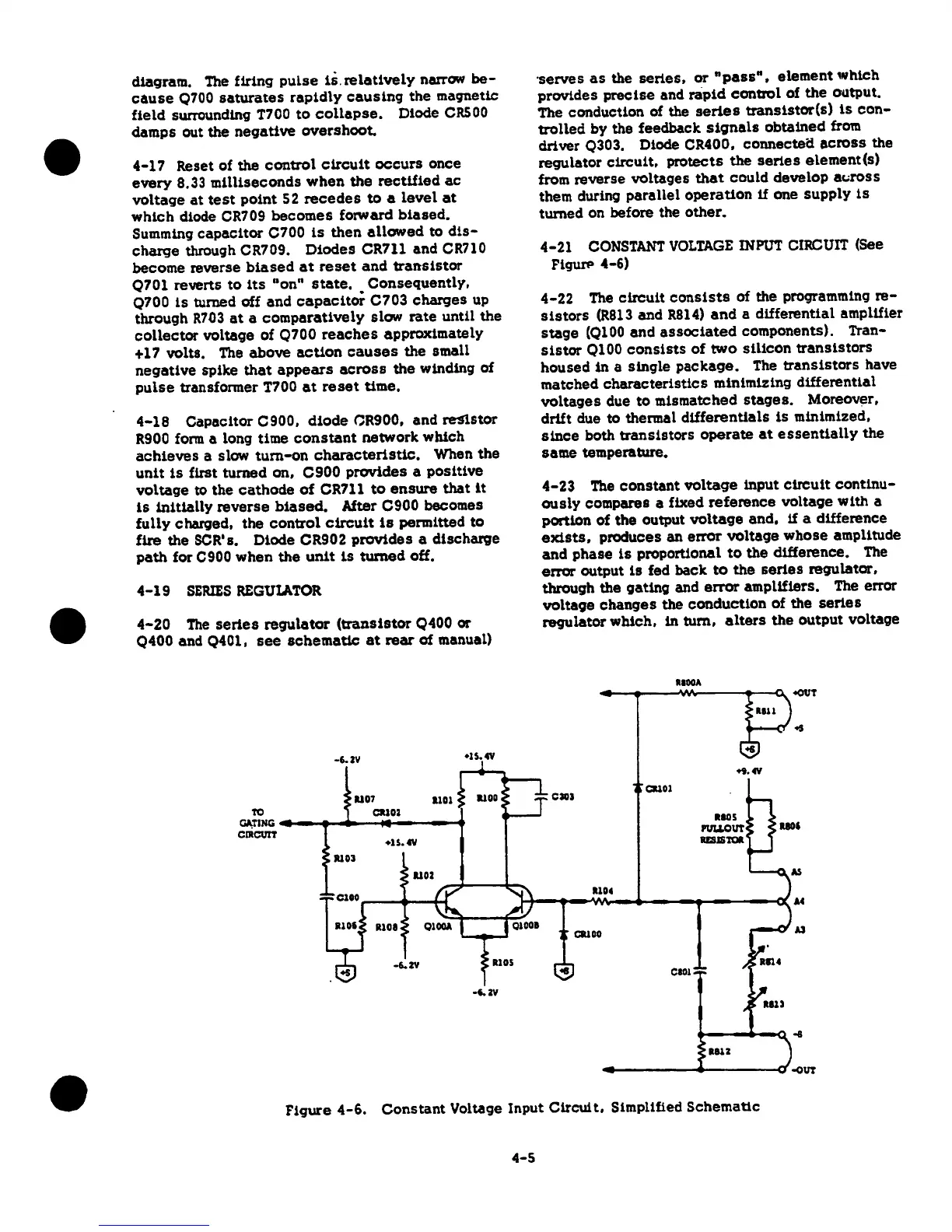
4-21
CONSTANT
VOLTAGE
INPUT
CIRCUIT (See
FigurP
4-6)
4-22
The
circuit
consists
of
the
programming
re-
sistors
(RB13
and
R814)
and
a
differential
amplifier
stage
(QlOO
and
associated
components). Tran-
sistor
QlOO
consists
of
two
silicon
transistors
housed
in
a
single
package.
The
transistors
have
matched
characteristics
minimizing
differential
voltages
due
to
mismatched
stages.
Moreover,
drift
due
to
thermal
differentials
ls
minimized,
since
both
transistors
operate
at
essentially
the
same
temperature.
4-23
The
constant
voltage
input
ctrcuit
continu-
ously
compares a fixed
reference
voltage
w
1th
a
portl.On
of
the
output
voltage
and,
if
a difference
exists,
produces
an
error
voltage
whose
amplitude
and
phase
is
proportional
to
the
difference.
The
error
output
is
fed
back
to
the
series
regulator,
through
the
gating
and
error
amplifiers.
The error
voltage
changes
the
conduction
of the
series
regulator
which,
in
tum,
alters
the
output
voltage
RIOOA
CIOl
+9.('i
llOS
PU1.LOUT
U:S.ISTCll
uo•
Figure
4-6.
Constant
Voltage Input
Circuit,
Simplified
Schematic
4-S

Related product manuals