EasyManua.ls Logo

HP 6296A - Page 43

HP 6296A
61 pages
Print Icon
To Next Page IconTo Next Page
To Previous Page IconTo Previous Page
Loading...
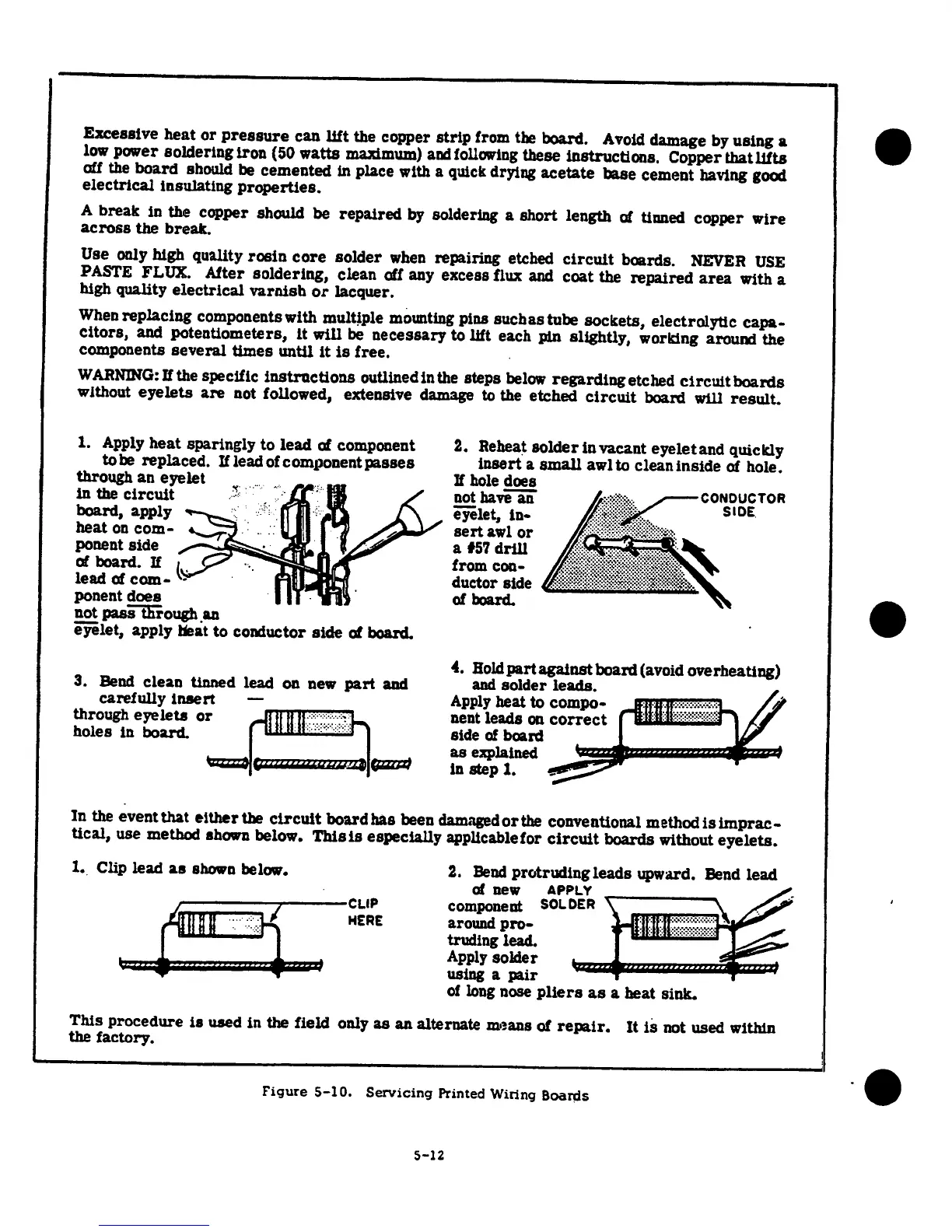
Excessive
heat
or
pressure
can
lift the copper
strip
from the
board.
Avoid damage by using
a
low power soldering
iron
( 50
watts
maximum)
and
following
these
instructions.
Copper
that
lifts
off
the
board should
be
cemented
in
place with
a
qUick
drying
acetate
base cement
bavtng
good
electrical
insulating
properties.
A break in the copper should
be
repaired
by
soldering
a short length
of
tinned
copper wire
across
the
break.
Use
only
high
quality
rosin
core
solder
when
repairing etched
circuit
boards.
NEVER USE
PASTE
FLUX.
After soldering, clean
off
any excess
flux
and
coat
the
repaired
area
With
a
high
quality
electrical
varnish
or
lacquer.
When
replacing components with multJple mowiting
pins
such
as
tube
sockets, electrolytic
capa-
citors,
and
potentiometers,
it
Will
be
necessary
to
lift
each
pin
slightly,
working around the
components
several
times
unW
it
is
free.
WARNING:
If
the
specific
instructions
outlined
in the steps
below
regarding
etched circUit
boards
wlthout
eyelets
are
not followed,
extensive
damage
to
the etched
circuit
board
will
result.
1.
Apply
heat
sparingly to
lead
of
component
to
be
replaced.
If
lead of component
passes
through
an
eyelet
in
the
circuit
~-
·
.··
board,
apply
heat
on
com-
~
ponent side
,.,,-~~~;__,
of
board.
If
I.
lead
of
com-\:;
ponent does
not
pass
--uirough
an
eyelet,
apply
beat
to conductor
side
of
board.
3.
Bend clean
tinned
lead
on
new
part
and
carefully
insert
through
eye
lets
or
holes
in
board.
C'''''''''''Up;Q!Q
~
2. Reheat
solder
in vacant eyeletand
quickly
insert
a
small
awl
to
cleaninside
of
hole.
If
hole
does
not
bavi"iii
eyelet,
in-
sert
awl
or
a
157
drill
from con-
ductor side
_______
.....,
of
board.
4.
Boldpartagainstboard(avoidoverheating)
and
solder leads.
Apply
heat
to
compa-
nent leads
on
correct
side
af
board
as
explained
in step 1.
In
the
event
that
either
the
circuit
board has
been
damagedorthe
conventional
methodisimprac-
tical, use method
shown below.
This
is
especially applicable for
circuit
boards
without
eyelets.
1
•.
Clip lead
as
shown below.
2.
Bend
prcitrudlng
leads upward. Bend lead
of
new
APPLY
component
SOLDER
around
pro-
truding
lead.
Apply
solder
using
a
pair
of
long nose
pliers
as
a heat sink.
This procedure
is
used
in
the
field only
as
an
alternate
m•?ans
of
repair.
It
is
not used
within
the
factory.
Figure
5-10.
Servicing
Printed Wiring
Boaf'!is
S-12
••

Related product manuals