Operation
Model 8642A/B
Modulation,
$M
(cont'd)
MAXIMUM
$M
DEVIATION
12.5
(Radians
INT;
B 25
Radians
per
volt
EXT)
DIVIDE BANDS
10X
0.1
4 B IB 33 66 132 2B4 528 1057 2115*
RF FREQUENCY
(MHz)
Actual band boundaries
are
listed
in
Table
3-11
[KB642B ONLY)
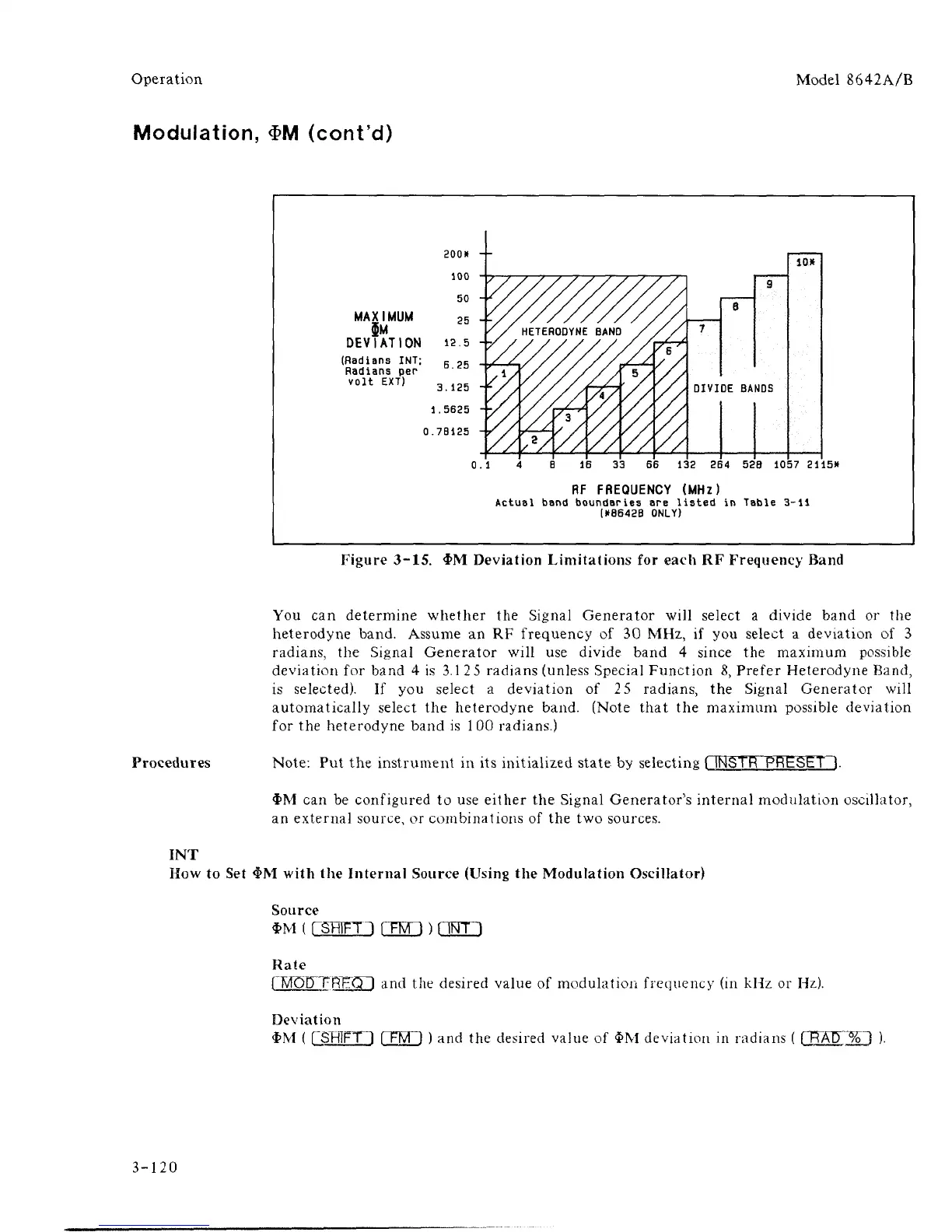
Figure
3-15. 4>M
Deviation Limitations
for
each
RF
Frequency Band
You
can
determine whether
the
Signal Generator will select
a
divide band
or the
heterodyne band. Assume
an RF
frequency
of 30
MHz,
if you
select
a
deviation
of 3
radians,
the
Signal Generator will
use
divide band
4
since
the
maximum possible
deviation
for
band
4 is
3.1
25
radians (unless Special Function
8,
Prefer Heterodyne Band,
is selected).
If you
select
a
deviation
of
2 5
radians,
the
Signal Generator will
automatically select
the
heterodyne band. (Note that
the
maximum possible deviation
for
the
heterodyne band
is
1
00
radians.)
Procedures
Note:
Put the
instrument
in its
initialized state
by
selecting
$M
can be
configured
to use
either
the
Signal Generator's internal modulation oscillator,
an external source,
or
combinations
of the two
sources.
INT
How
to Set $M
with
the
Internal Source (Using
the
Modulation Oscillator)
Source
$M
(rsHim rHvn)
rwn
Rate
{~rvfOUTRF"QTJ
and the
desired value
of
modulation frequency
(in kHz or Hz).
Deviation
*
M
(
rSHFT~) rnVD
) and the
desired value
of
<*>M deviation
in
radians
(
fTrATJ"%l
).
3-120


 To Next Page