Model 8642A/B
Operation
Modulation, Pulse (cont'd)
Example
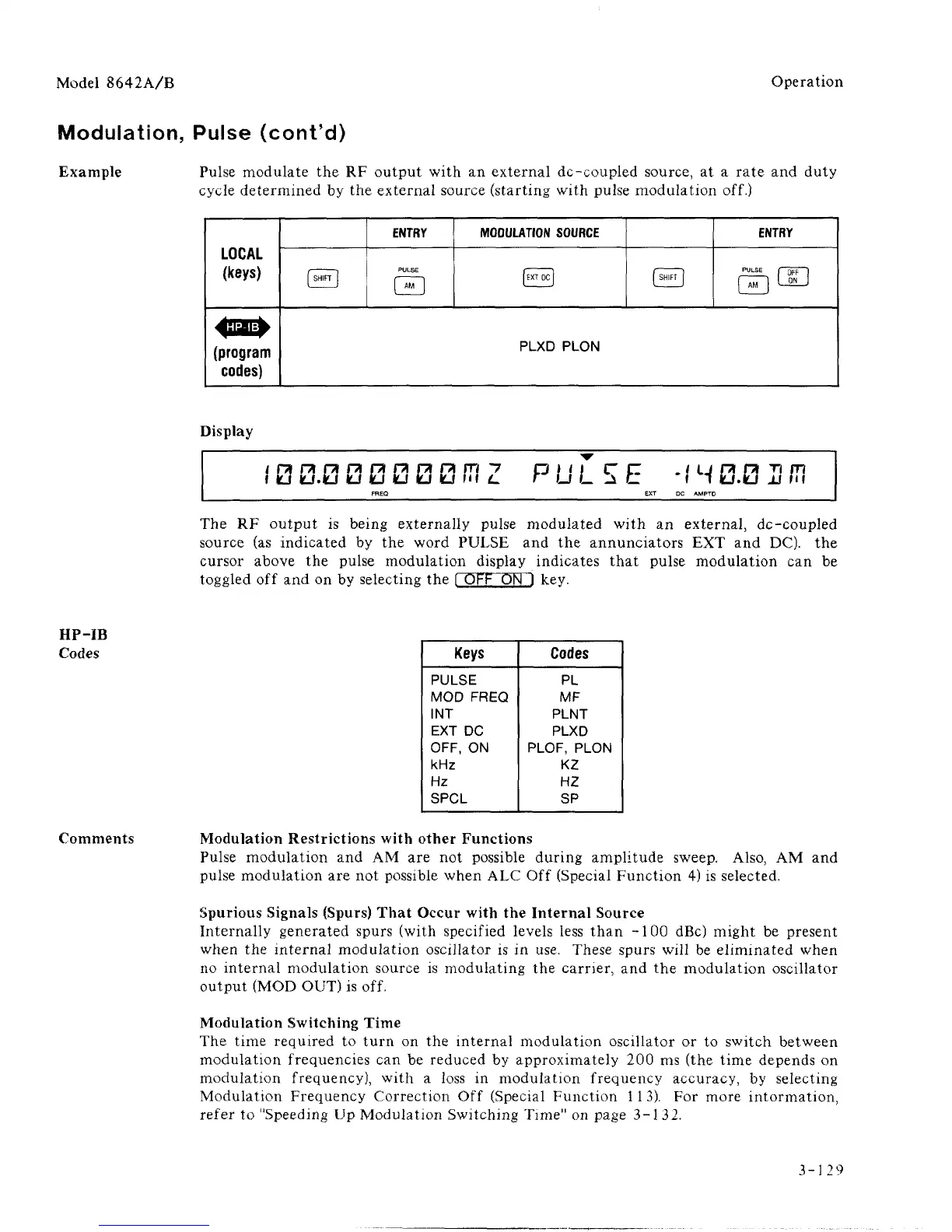
Pulse modulate the RF output with an external dc-coupled source, at a rate and duty
cycle determined by the external source (starting with pulse modulation off.)
LOCAL
(keys)
(program
codes)
(
SHIFT
1
ENTRY
PULSE
MODULATION SOURCE
[EXT DC]
1
SHIFT
1
ENTRY
.
PULSE
. I OFF |
PLXD PLON
Display
10 0.0 0 0 0 0 0
U
FREQ
<~l
~7
PULSE
EXT
-IH0.0HH?
DC AMPTD
The RF output is being externally pulse modulated with an external, dc-coupled
source (as indicated by the word PULSE and the annunciators EXT and DC), the
cursor above the pulse modulation display indicates that pulse modulation can be
toggled off and on by selecting the [ OFF ON 1 key.
HP-IB
Codes
Comments
Keys
PULSE
MOD FREQ
INT
EXT DC
OFF,
ON
kHz
Hz
SPCL
Codes
PL
MF
PLNT
PLXD
PLOF,
PLON
KZ
H2
SP
Modulation Restrictions with other Functions
Pulse modulation and AM are not possible during amplitude sweep. Also, AM and
pulse modulation are not possible when ALC Off (Special Function 4) is selected.
Spurious Signals (Spurs) That Occur with the Internal Source
Internally generated spurs (with specified levels less than -1 00 dBc) might be present
when the internal modulation oscillator is in use. These spurs will be eliminated when
no internal modulation source is modulating the carrier, and the modulation oscillator
output (MOD OUT) is off.
Modulation Switching Time
The time required to turn on the internal modulation oscillator or to switch between
modulation frequencies can be reduced by approximately 200 ms (the time depends on
modulation frequency), with a loss in modulation frequency accuracy, by selecting
Modulation Frequency Correction Off (Special Function 11 3). For more intormation,
refer to "Speeding Up Modulation Switching Time" on page 3-132.
3-129


 To Next Page