22 23
LANDING LANDEN ATTÉRISSAGE ATERRIZAJE
LAUNCHING STARTEN DÉCOLLAGE INICIO
RUSH PRO models can be very easily started backwards using the third line. When there is little wind, go in
the direction of the middle of the wind window. In strong wind, choose your position so that the kite is more at
the edge of the wind window.
1. With one hand, pull the middle line back until the kite has risen approximately to the height of the wingspan.
2. Since you are only holding the bar with one hand, the kite will start to spin in the opposite direction.
3. As soon as the leading edge points slightly upwards again, also take the bar with the other hand and steer the sail
to your desired position.
RUSH PRO-Modelle lassen sich über die dritte Leine sehr einfach rückwärts starten. Gehen Sie bei weinger
Wind in Richtung Windfenstermitte. Bei starkem Wind wählen Sie ihre Position so, dass der Drachen mehr am
Wind fensterrand liegt.
1. Ziehen Sie mit einer Hand die mittlere Leine so weit zurück, bis der Kite ca. auf die Höhe der Flügelspannweite
gestiegen ist.
2. Dadurch, dass sie die Bar nur noch mit einer Hand halten, wird der Kite anfangen sich in entgegengesetzter
Richtung zu drehen.
3. Sobald die Leitkante wieder etwas nach oben zeigt, erfassen Sie die Bar auch wieder mit der anderen Hand und
steuern Sie den Schirm an Ihre gewünschte Position.
Le décollage arrière des modèles RUSH PRO est très aisé grâce à la troisième ligne. Par vent léger, l’aile peut
être au centre de la fenêtre de vol. Par vent plus fort, choisir une position adéquate de manière à ce que l’aile
soit plus vers le bord de la fenêtre de vol.
1. Tirer d’une main sur la ligne centrale jusqu’à ce que l’aile s’élève jusque à hauteur de son envergure.
2. Étant donné que la barre n’est tenue que d’une main, l’aile commence à se tourner dans le sens opposé.
3. Dès que le bord d’attaque se dirige vers le haut, saisir la barre à deux mains et piloter l’aile à la position désirée.
Los modelos RUSH PRO pueden lanzarse muy fácilmente hacia atrás por medio de un tercer hilo. Cuando
haya poco viento, camine en dirección al centro de la ventana de viento. Cuando sea fuerte, escoja su posición
de modo que la cometa se encuentre más hacia el borde de la ventana de viento.
1. Tire con una mano hacia atrás del hilo central hasta que la cometa ascienda aproximadamente a la altura de la
envergadura del ala.
2. Sujetando la barra solamente con una mano, la cometa empezará a girar en sentido opuesto.
3. Si el borde de ataque apunta todavía algo hacia arriba, sujete la barra también de nuevo con la otra mano y go-
bierne la pantalla hasta la posición deseada.
REVERSE LAUNCH RÜCKWÄRTS STARTEN
DÉCOLLAGE EN MARCHE ARRIÈRE DESPEGUE HACIA ATRÁS
Wind
Wind
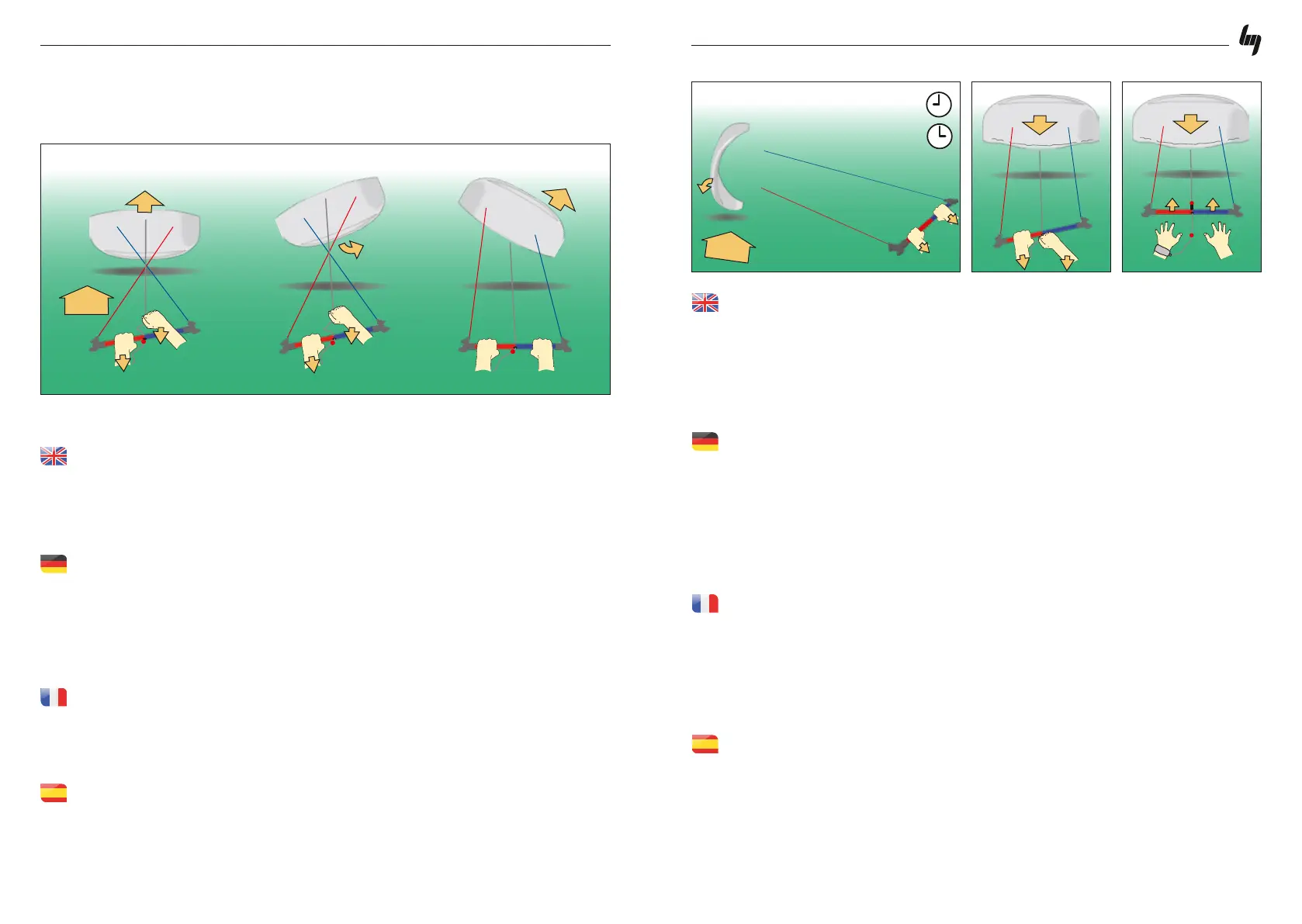
1. All models can be easily landed by flying the kite all the way to the edge of the wind window and steering downwards. Another
person can receive and secure the kite there. If no help is available, one should try to land the kite in an area protected from
wind, e.g. behind a small hill. The kite will initially stay lying down there, but should nonetheless be secured immediately.
2. RUSH PRO can also be landed very easily with the third line by simply pulling it back. If there is a lot of wind, this should also
be done at the edge of the wind window. Hold the kite on the ground with the third line until a helper has secured the kite, or
secure the kite with a ground anchor on the wrist strap.
3. In emergencies, RUSH PRO can also simply be landed by letting go of the bar with both hands. The kite is braked by the drag
edge and goes to the ground. Test this function when there is little wind to overcome fears of letting go. Then you will be able
to react quickly in serious situations. Note that you are still connected to the kite with the wrist strap. Depending on the wind
and on the kites’ position in the wind window, there will be a small yank on the hand when you let go of the bar. If it is neces-
sary to detach from the entire system, simply open the loop on your wrist.
1. Alle Modelle lassen sich einfach landen, indem man den Drachen ganz an den Windfensterrand fliegt und dort nach unten
lenkt. Eine weitere Person kann den Drachen dort annehmen und sichern. Steht keine Hilfe zur Verfügung, sollte man versu-
chen den Drachen in einem windgeschützten Bereich – z.B. hinter einem kleinen Hügel – zu landen. Dort bleibt der Drachen
erstmal liegen, sollte aber dennoch sofort gesichert werden.
2. Die RUSH PRO lässt sich auch sehr leicht über die dritte Leine landen, indem man diese einfach nach hinten zieht. Bei viel
Wind sollte auch das am Windfensterrand geschehen. Halten Sie den Drachen über die dritte Leine am Boden bis ein Helfer
den Drachen gesichert hat, oder sichern Sie den Drachen mit einem Bodenanker an der Handschlaufe..
3. Im Notfall lässt sich die RUSH PRO auch einfach landen, indem man die Bar mit beiden Händen loslässt. Der Drachen wird
über die Schleppkannte angebremst und geht zu Boden. Probieren Sie diese Funktion bei wenig Wind aus, um Hemmungen
vor dem Loslassen zu verlieren. So werden sie im Ernstfall schnell reagieren. Beachten Sie, dass Sie immer noch über
die Handschlaufe mit dem Drachen verbunden sind. Je nach Wind und Position des Drachens im Windfenster gibt es beim
Loslassen der Bar einen kleinen Ruck an der Hand. Ist es erforderlich sich vom ganzen System zu lösen, öffnen Sie einfach
die Schlaufe am Handgelenk.
1. L’atterrissage de tous les modèles est simple : il suffit d’amener l’aile tout au bord de la fenêtre de vol et de la diriger vers le
sol. Un assistant peut alors attraper et sécuriser l’aile. Un pilote sol doit tenter de faire atterrir l’aile dans une zone à l’abri du
vent, par exemple derrière une petite butte. L’aile reste au sol, mais doit immédiatement être sécurisée.
2. Le modèle RUSH PRO peut aussi atterrir très aisément grâce à la troisième ligne en tirant sur celle-ci. Par vent fort, il convient
là aussi d’amener l’aile au bord de la fenêtre de vol. Maintenir l’aile au sol avec la troisième ligne jusqu’à ce qu’un assistant la
sécurise ou fixer l’aile en attachant la sangle à une ancre.
3. En cas d’urgence, l‘RUSH PRO peut aussi atterrir simplement en relâchant la barre. L’aile est alors freinée par le bord de
fuite et tombe au sol. Tester cette fonction par vent léger pour prendre le coup et perdre toute appréhension au moment de
lâcher la barre. Ainsi, vous réagirez plus vite en cas d’urgence concret. Tenir compte que vous êtes toujours relié à l’aile par la
sangle. Selon le vent et la position de l’aile dans la fenêtre de vol, vous pouvez être légèrement tiré par la sangle. Si vous devez
vous libérer du système, il suffit de dégager le poignet de la sangle.
1. Todos los modelos pueden aterrizarse fácilmente haciendo volar totalmente la cometa en el borde de la ventana de viento
y dirigiéndola después hacia abajo. Otra persona puede recibir y asegurar la cometa. Si no se dispone de ayuda, debe inten-
tarse aterrizar la cometa en una zona protegida del viento, por ejemplo, detrás de un pequeño montículo. Allí debe detenerse
la cometa, pero tiene que asegurarse inmediatamente.
2. RUSH PRO pueden aterrizarse también muy fácilmente por medio del tercer hilo, simplemente tirando de éste hacia atrás.
Cuando haya mucho viento, tiene que realizarse también en el borde de la ventana de viento. Sujete la cometa por medio del
tercer hilo en el suelo hasta que un ayudante haya asegurado la cometa o bien asegure la cometa con un ancla de suelo en el
lazo manual.
3. En caso de emergencia, RUSH PRO tienen que aterrizarse también soltando la barra con ambas manos. La cometa se frena
por medio del borde de fuga y se guía hasta el suelo. Pruebe esta función con poco viento para eliminar impedimentos antes
de soltar. De este modo reaccionará rápidamente si hay un problema importante. Tenga en cuenta que debe estar Ud. siempre
unido a la cometa con el lazo manual. Según el viento y la posición de la cometa en la ventana de viento, al soltar la barra se
produce un pequeño tirón en la mano. Si es necesario soltarse de todo el sistema, simplemente abra el lazo de la muñeca.



 To Next Page
 Loading...