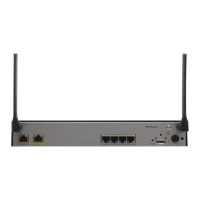
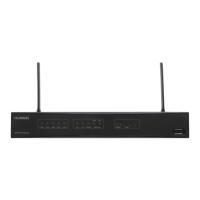
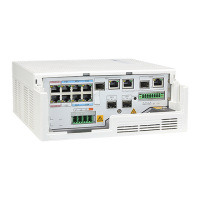
Figure 1-5 Networking diagram of configuring a static route for GRE
RouterA
RouterC
RouterB
Tunnel0/0/1
40.1.1.1/24
Tunnel0/0/1
40.1.1.2/24
10.2.1.1/24
10.1.1.1/24
GE2/0/0
10.1.1.2/24
GE1/0/0
20.1.1.1/24
GE1/0/0
20.1.1.2/24
GE1/0/0
30.1.1.2/24
GE2/0/0
30.1.1.1/24
GE2/0/0
10.2.1.2/24
Tunnel
PC1 PC2
Configuration Roadmap
The configuration roadmap is as follows:
1. Configure a dynamic routing protocol on routers.
2. Create a tunnel interface on Router A and Router C.
3. Specify the source address of the tunnel interface as the IP address of the interface that
sends the packet.
4. Specify the destination address of the tunnel interface as the IP address of the interface that
receives the packet.
5. Assign network addresses to the tunnel interfaces to enable the tunnel to support the
dynamic routing protocol.
6. Configure the static route between Router A and its connected PC, and the static route
between Router C and its connected PC to make the traffic between PC1 and PC2
transmitted through the GRE tunnel.
7. Configure the egress of the static route as the local tunnel interface.
Data Preparation
To complete the configuration, you need the following data:
l Data for running OSPF
l Source address and destination address of the GRE tunnel, and IP addresses of tunnel
interfaces
Procedure
Step 1 Assign an IP address to each interface.
Huawei AR1200 Series Enterprise Routers
Configuration Guide - VPN 1 GRE Configuration
Issue 01 (2012-04-20) Huawei Proprietary and Confidential
Copyright © Huawei Technologies Co., Ltd.
18


 To Next Page
 Loading...