
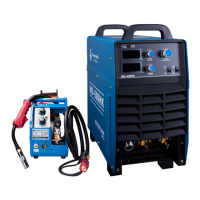

Do you have a question about the Huayuan Electric NB-500HK and is the answer not in the manual?
Fundamental safety guidelines for operating the welding machine.
Key safety points requiring utmost attention before and during use.
Procedures to prevent electrical shock risks.
Methods to shield eyes and skin from arc radiation.
Managing risks from welding fumes and shielding gases.
Measures to prevent fires caused by welding spatter.
Precautions for safe management of gas cylinders.
Safety requirements for power supply and electrical connections.
Specific safety measures for engine-powered welding equipment.
Information on EMF effects and user precautions.
Guidelines for safely moving the welding machine.
Awareness of noise hazards and health impacts.
Overview of the welding machine's model, key features, and applications.
Specifies the conditions under which the welder can operate safely.
Explanation of symbols used in the manual for clarity.
Comprehensive table detailing electrical, mechanical, and performance specifications.
Description of controls, indicators, and meters on the front panel.
Explanation of the functions located on the lower section of the front panel.
Identification and purpose of ports and connectors on the rear panel.
Requirements and steps for connecting the welder to the electrical supply.
Instructions for correctly connecting cables and ensuring proper grounding.
Guide for connecting the wire feeder and welding torch.
Steps for connecting the gas cylinder and regulator assembly.
Essential safety gear and pre-use checks.
How to set and verify the shielding gas flow rate for optimal welding.
Detailed steps for installing and preparing the welding wire spool.
Comprehensive guide to performing welds using the 4-step mode.
Instructions for utilizing the 2-step welding mode for specific applications.
Recommended settings for angle welding based on material thickness and wire size.
Description of the IGBT-based inverter technology and operation.
A visual representation of the internal circuit design.
A table listing key components with their models and codes.
Recommended procedures for cleaning and upkeep.
Instructions for authorized personnel on equipment repair.
A guide to identifying and resolving common operational issues.
A list of all items provided in the product packaging.
The complete electrical schematic diagram for the welding machine.
The NB-500HK is a MIG/MAG/CO2 welding machine designed for various welding applications, particularly in industries utilizing CO2/MAG welding processes. This includes construction, bridge steel structures, and project machinery. The machine's design emphasizes user-friendliness and stable operation, incorporating features that simplify parameter setting and enhance welding performance.
The NB-500HK employs advanced electronic technology, specifically IGBT (Insulated Gate Bipolar Transistor) as its key inverter device. The three-phase AC power input is transformed into a 20KHz high-frequency voltage after bridge rectification. This high-frequency voltage is then converted into the output welding voltage through further transformation, rectification, and filtering stages. This sophisticated power management system ensures a stable and efficient welding process.
The machine offers adjustable arc characteristic functions, allowing users to fine-tune the arc's softness and hardness, control spatter, and influence weld formation. This adaptability makes it suitable for a wide range of welding conditions and material types. Crater current and crater voltage can be set independently, providing precise control over the end of the weld, which is crucial for achieving high-quality finishes and preventing defects.
A gas checking function is integrated, simplifying the process of setting and verifying the shielding gas flow rate before welding. This ensures optimal gas coverage and protection of the weld pool. The machine also includes protection functions against overheating and undervoltage, contributing to more stable and reliable operation by automatically shutting down or adjusting output in adverse conditions.
The NB-500HK is designed for ease of use, with a straightforward control panel that facilitates parameter setup. Before operation, users must ensure proper installation, including power supply connection, welder and wire feeder connection, and gas cylinder and regulator connection. Safety is paramount, requiring the use of personal protective equipment such as fur gloves, safety shoes, and a shield filter glass appropriate for the welding current. Adequate ventilation in the welding area is also essential to prevent the inhalation of harmful gases.
The machine supports both 4-step and 2-step weld operations. The 4-step mode is ideal for welding long seams or medium-thick plates, allowing for arc pit filling at the end of the weld. In this mode, the welding process enters a self-locking state after the arc is successfully initiated, and the torch switch can be released. Adjustments to welding voltage and current can be made during this state to optimize the welding effect. The 2-step mode is primarily used for spot welding, repeated short welding, and thin plate welding, offering a simpler start-and-stop operation.
Wire installation involves confirming the correct wire feeding groove diameter, mounting the wire spool, and threading the welding wire through the correcting wheel and guiding nozzle. The pressing arm and handle are adjusted to apply moderate pressure, ensuring smooth wire feeding. The manual wire feed button on the control box assists in exposing the wire at the torch head, and the screw sleeve of the wire handle is adjusted for appropriate pressing force to prevent slipping.
Regular maintenance is crucial for the longevity and optimal performance of the NB-500HK. Users are advised to open the machine case periodically (at least once a year, or more frequently depending on usage and environmental conditions) to clean internal dust using dry compressed air. This prevents dust accumulation from causing dampness and short circuits, which could lead to malfunctions. Additionally, regular checks of all installation connections are recommended to ensure they remain reliable.
For repairs, it is strictly mandated that only qualified electricians holding the appropriate operation permit should work on the welder. Before any repair work, the power supply must be cut off, and it's important to note that high voltage can persist for up to 10 minutes after power disconnection. Prior to opening the machine, the three-phase voltage of the incoming power should be checked against national standards. If the voltage is normal, internal fuses and welding cable connections should be inspected for any damage or loose connections. The manual provides a comprehensive list of common faults and their eliminating methods, guiding users or technicians in troubleshooting issues such as power problems, wire feeding issues, arc instability, and gas flow irregularities. This systematic approach to fault diagnosis helps in efficiently resolving problems and maintaining the machine's operational integrity.
| Output Current Range | 50-500A |
|---|---|
| Duty Cycle | 60% |
| Efficiency | 85% |
| Protection Grade | IP21S |
| Insulation Grade | F |
| Applicable Wire Diameter | 1.2mm |