EasyManua.ls Logo

Hydroseal KAPLAN - User Manual

Hydroseal KAPLAN
3 pages
Print Icon
To Next Page IconTo Next Page
Loading...
VALVE OPERATION MANUAL
KAPLAN BALL VALVES
Never use pressurized gases with plastic piping systems.
Ensure all testing is done using established and secure hydrostatic equipment.
Certain liquids may be prone to vaporization [o-gassing] which might cause presure uctuation.
Valves may be damaged.
Do not apply excessive weight or mass on top of the valve.
Avoid slurries, this might result in uneven ow.
Avoid crystallized or gelled substrate, this might result in uneven ow.
Always operate valves and piping systems within their designed engineering limits and reccomended conditions.
Ensure adequate space is always kept around the valve for inspections and maintainence.
Ensure the right materials, seats and valve types are used that have adequate chemical resistance to the substrate.
Keep valves from being exposed to direct sunlight for long periods. UV rays might aect the composition.
Ensure routine and periodic maintenance and inspection is done to avoid costly problems.
SECTION 1 - GENERAL OPERATING GUIDELINES
When suspending valves use common sense, ensure adequate support and spacing is maintained.
Thermoplastic may be damged with impacts and sharp objects. Avoid blunt and sharp trauma.
Ensure cartons and packages are stored appropriately, excessive cartons being stacked might collapse.
Avoid contact with paint, tar-sand, insecticides and pesticides, and highly corrosive agents.
During assembly and handling do not carry valves by their handles.
Keep valves from being exposed to direct sunlight for long periods. UV rays might aect the composition.
Prior to assembly ensure a quick and eective visual check is done to ensure items are not defective.
SECTION 2 - TRANSPORTATION AND STORAGE
Perform a visual check prior to installation.
Wear adequate protective equipment when working with tools, solvents, power drills etc.
If using U Clamps or anything similar during assembly make sure not to over-tighten.
During installation of piping systems ensure adequate spacing and hoops are designed in the system.
Ensure no unnecessary stresses are caused on the piping system such as tension, compression, impact etc.
Visually check to determine the direction of ow of valves before installing.
Before hydrostatic testing ensure that union nuts are rmly screwed into position. Take care not to over-tighten.
If connecting to metallic systems ensure that no undue stress is caused to valves.
Never use a pipe wrench on thermoplastic.
For detailed solvent welding, threading and anging connections read Hydroseal Canadas Technical Guide.
SECTION 3 - INSTALLATION
Do not exert excessive force when opening or closing valves.
If sand or other large particles are in the piping system ensure to ush these out before operation of valves.
Ensure that valves are opened and closed only by trained people, never use tools to open/close valves.
If valve provided is lubricant free ensure that water is owing before attempting to operate handles.
SECTION 4 - ASSEMBLY
EN.005
Valve Operation Manual
Page 1 of 3
AUTHORISED SOLE AUSTRALIAN DISTRIBUTOR
UNIVERSAL PIPING PTY LTD - PERTH
sales@universalpiping.com.au

Question and Answer IconNeed help?

Do you have a question about the Hydroseal KAPLAN and is the answer not in the manual?

Summary

General Operating Guidelines

Transportation and Storage

Installation

Assembly

Handle Position

Disassembly

Automation

Maintenance

Troubleshooting

Technical Specifications

Construction

Lists valve parts and their corresponding materials for different components.

Selection Chart

Details valve sizes, connection types, seal materials, and pressure ratings.

CV Factors

Provides flow coefficients (CV) for various valve sizes.

Operating Temperature and Pressure

Graphical data showing operating limits for temperature and pressure.

Overview

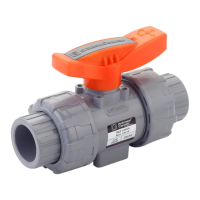
The Kaplan Ball Valve, manufactured by Hydroseal Canada and distributed by Universal Piping Pty Ltd, is a robust valve designed for various industrial applications. This valve is engineered for advanced fluidity control within piping systems.

Function Description:

The Kaplan Ball Valve is primarily used to control the flow of liquids within a piping system. It operates by rotating a spherical ball with a bore through its center. When the bore is aligned with the pipe, flow is permitted (open position). When the ball is rotated 90 degrees, the bore is perpendicular to the pipe, blocking the flow (closed position). The valve is designed for efficient and reliable shut-off and flow regulation.

Important Technical Specifications:

  • Joint Ends: Available with threaded connections (PT, NPT, BSPF) and socket connections (ASTM, DIN, JIS), offering versatility for different piping standards.
  • Working Pressure: Rated for 200 PSI at 70°F (non-shock conditions). This indicates its suitability for moderate pressure applications.
  • Materials of Construction:
    • Handle Cap & Handle: ABS (Acrylonitrile Butadiene Styrene), providing durability and resistance to impact.
    • Stem, Connectors, Insert, Body, Ball: Available in PVC (Polyvinyl Chloride), CPVC (Chlorinated Polyvinyl Chloride), and PP (Polypropylene). These materials offer excellent chemical resistance to a wide range of media and are suitable for various temperature ranges.
    • O-Rings: EPDM (Ethylene Propylene Diene Monomer) and VITON. EPDM is known for its excellent resistance to water, steam, and many chemicals, while VITON offers superior resistance to aggressive chemicals and high temperatures.
    • Seats: PTFE (Polytetrafluoroethylene), known for its low friction, excellent chemical resistance, and wide temperature range, ensuring a tight seal and smooth operation.
  • Sizes: Available in a wide range of nominal sizes from 1/2" (DN 15) up to 4" (DN 100), accommodating various pipe diameters.
  • Dimensions (in mm): Detailed dimensions are provided for different nominal sizes and thread types (ASTM, DIN, JIS), including overall length (L), handle height (H1), and various diameters (D, D1, d, de). For example, a 1/2" (DN 15) valve has an overall length of 116.00 mm (ASTM), a handle height of 49.00 mm, and a body diameter (D) of 46.00 mm.
  • Operating Temperature/Pressure Chart: A graph illustrates the relationship between working pressure (PSI/kPa) and temperature (°C/°F) for PVC, CPVC, and PP materials. This chart is crucial for selecting the appropriate valve material based on the application's operating conditions. For instance, PVC has a lower temperature tolerance compared to CPVC and PP.
  • CV Factors: A table provides flow coefficient (Cv) values for different valve sizes, which are essential for calculating pressure loss in the piping system. For example, a 1/2" valve has a Cv of 8, while a 4" valve has a Cv of 600.
  • Pressure Loss Calculation Formula: The formula ΔP = [Q/Cv]^2 is provided to calculate pressure drop (ΔP) based on flow rate (Q in GPM) and the valve's Cv factor.

Usage Features:

  • General Operating Guidelines:
    • Safety: Emphasizes never using pressurized gases with plastic piping systems and ensuring all testing is done with secure hydrostatic equipment.
    • Media Compatibility: Highlights the importance of using materials, seats, and valve types with adequate chemical resistance to the substrate.
    • Flow Considerations: Advises against using the valve with slurries or crystallized/gelled substrates to prevent uneven flow and potential damage.
    • Environmental Protection: Recommends keeping valves from direct sunlight for long periods as UV rays can affect composition.
    • Installation: Requires adequate spacing around the valve for inspections and maintenance, and avoiding excessive weight or mass on the valve.
  • Transportation and Storage:
    • Handling: Instructs to use common sense when suspending valves, ensuring adequate support and spacing. Avoid carrying valves by their handles.
    • Protection: Warns against impacts, sharp objects, blunt trauma, and contact with paint, tar-sand, insecticides, pesticides, and highly corrosive agents.
    • Storage: Recommends storing cartons and packages appropriately to prevent collapse from excessive stacking.
    • Pre-assembly Check: Advises a quick visual check for defects before assembly.
  • Installation:
    • Pre-installation Check: Perform a visual check before installation.
    • Safety Gear: Wear adequate protective equipment (tools, solvents, power drills).
    • Tightening: Avoid over-tightening U-clamps or similar devices.
    • Piping System Design: Ensure adequate spacing and hoops are designed in the piping system to prevent unnecessary stresses (tension, compression, impact).
    • Flow Direction: Visually check the direction of flow before installing.
    • Connections: Ensure union nuts are firmly screwed into position (without over-tightening) before hydrostatic testing. When connecting to metallic systems, prevent undue stress on valves.
    • Tools: Never use a pipe wrench on thermoplastic valves.
    • Detailed Instructions: Refer to Hydroseal Canada's Technical Guide for solvent welding, threading, and flanging connections.
  • Assembly (Operation):
    • Force: Do not exert excessive force when opening or closing valves.
    • Piping Cleanliness: Flush out sand or large particles from the piping system before operating valves.
    • Operator Training: Valves should only be opened and closed by trained personnel; never use tools for this purpose.
    • Lubrication: If the valve is lubricant-free, ensure water is flowing before attempting to operate handles.
  • Handle Position:
    • Close: Clockwise rotation. The handle should be perpendicular to the pipe.
    • Open: Counter-clockwise rotation. The handle should be parallel to the pipe.
  • Disassembly:
    • Safety First: Perform a visual check, wear protective equipment, and ensure no pressure is in the piping system and all fluid is drained.
    • Tools: Never use a pipe wrench on thermoplastic.
    • Procedure: Loosen union nuts before extracting the valve.
    • Part Replacement: Consult the manufacturer for specific details when replacing parts like seals, seats, or balls.
  • Automation: Refer to Hydroseal Canada's Technical Guide for detailed actuator installation.

Maintenance Features:

  • Routine Maintenance:
    • Regular Checks: Perform regular and scheduled maintenance to address potential leakages and tightness issues that may arise from temperature changes over prolonged periods.
    • Visual Inspection: Check for cracks, deformities on the outside, and fluids on the outside of the valve.
    • Tightness: Check the tightness of union nuts.
    • Handle Operation: Verify that the handle mechanism operates smoothly.
  • Troubleshooting Guide: A comprehensive table helps diagnose and resolve common issues:
    • Leakage when valve is closed:
      • Causes: Loose union nuts, scratched/eroded seats, object within the body, scratched/cracked/eroded ball mechanism.
      • Solutions: Tighten the valve, replace seat or entire valve, clear blockage, replace ball or entire valve.
    • Leakage observed (general):
      • Causes: Loose union nuts, scratched/eroded O-ring(s), object within the body.
      • Solutions: Tighten the valve, replace O-rings or entire valve, clear blockage.
    • Handle not turning smoothly:
      • Causes: Deformity in valve or parts.
      • Solutions: Replace valve.
    • Handle fails to engage:
      • Causes: Broken/cracked stem, broken mechanism between stem and ball.
      • Solutions: Replace stem or entire valve, replace stem and ball, or entire valve.

This detailed manual provides comprehensive guidance for the safe and effective operation, installation, and maintenance of the Kaplan Ball Valve, ensuring its longevity and optimal performance within various industrial applications.

Hydroseal KAPLAN Specifications

General IconGeneral
BrandHydroseal
ModelKAPLAN
CategoryControl Unit
LanguageEnglish