EasyManua.ls Logo

I.C.E Supertester 680 R - Frequency Measurement (Frequency Meter)

I.C.E Supertester 680 R
39 pages
Print Icon
To Next Page IconTo Next Page
To Previous Page IconTo Previous Page
Loading...
To
measure
the capacitance
of I microfarad
up
t0 20,000
pF both
of
paper
and
electrclytic
c-ond-ensers,
proceed
as follows:
lntroduce
the leads
into
the
socket!-O,
Ox
1,
ex'10
Q
x 100
or
f,)
x 1,000
according to the
range required.
Then
connect
ttrii
plugi'td-eethei
-
and
carry
out the zeroing
operation
as
for ohm measurements
in D.c. Then
connjct
ueiween
I
the
plugs
the
condenser
being
lested
and reverse
its
polarity
several times,
only when
the
pointer
is back
steadily_ on
the 0 value.
lf the conden'ser
is-
operating
propbrly,'the
pointer
should move.to
the following.
readings
of the instrument
according toltie
iapatity
an'd then
return
towards
zero
u,F.
lf this
does not
occur, it
means
that the ccndenser'is
not orooerlv"-
insulated
and it
should therefore
be
re,iected, unless
the
condenser
is electroliiic'anlr
working_at
low
v0ltages
and the
polarities
of the
tester
are of opposite
sign
as compared
with
those
of the condenser.
ln
such a
case, the
condenser is
not id
be coniidered
not
efficient
because
the difference
from
the 0
value is
given
by the live
leakage
current
inverted
in
respect $/ith its
normal
w0rklng
voltage.
li sh0uld
however
be borne
in mind
that,
due to
the
above mentjoned
leakage
cu.rrent,
the
condenser
cannot charge
completely
and
condequentiy
the
maximum
displacement
cf the
pointer
will
result lower
ihai
expeited.'The
valid dalistii
measurement
will
be therefore
that
obtained whcn
inverting
the
polarity
0nce
the
pointer
has
come back to
the 0
value.
"v>-
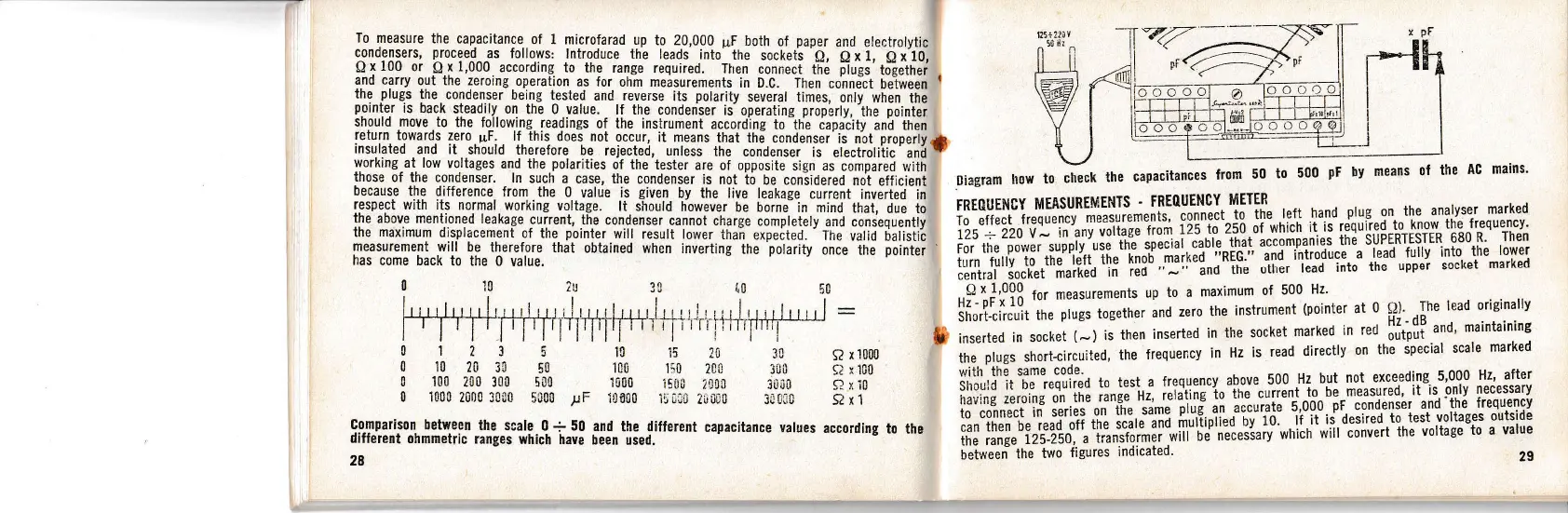
0iagram
how
to
check
the
capacitances
trom
50
to
500
pF
XPF
rlE-r
il
!t
-l
_l
by
means
of
the
Ac
mains
1000
20rt0 30C0
50C0
1tF
i0000
Qo-rypatison
between
the scale
0
;
50
and
the dilterent
capacitance values
according
to
the
different
ohmmetric
ranges
which have
heen
used.
28
FREQUENCY
MEASUREMENIS
.
FREOUENCY
MEIEB
. .
To e{{ect
{requency
*.rrrr.*.nirl-Jinn.it'i.
irrr
left
.hand
Dlus
on
the
analyser
marked
t25-ZZOV-
inanyrortrg.'i'Ji",riii"iJ'Zio,ii*hichitisrdouiredtoknowthefrequencv'
For the Dower
supplv
use
tne'speiiar
iaure
that
accompaniui
tt'd
supfnrfsTER
680
R'
Then
turn fultv
to
the
teft
tne
rrn#"illilio"';nie.;
Jnd
introouce
a
lead
fullv
into
the
lower
centrat
iocket
marked
in
r;;"';*l;'";nd"ih';
oth;t
iiaO-into
the
uppei
socket
marked
..Ox]1099 for
measurements
up
to a
maximum
of
500
Hz'
HZ-0t-xru
Shcri-circuit
the
plugs
together
and
zero
the
instrument
(pointer
at
0
Q).
The
iead
originally
inserted
in
socket
(-)
is then
inserted
in the
socket
marked
in
t'
lirli
and'
maintaining
the
plugs
short-circUited,
the
{requency
in
Hz
is
read
directly
on
the
ipecial
scale
marked
with the
same
code.
SliouIditberequiredtotestafrequencyabove500.Hzbutnotexceeding5,000Hz'after
havinq
zercing
on
the
range
iri
ilii'ti.i-ir-[ne-curren_t^t^o
be measured,
it
is
only
necessary
to connect
in
series
on
tn.'r?ru
i];;;;
;;;t-;i;s'ooo
or condenser
and'the
frequencv
can
then
be
read
off
tne
scare""Jili
fir?ip'iii,o
-rrv
irj.
li
iiii
desired
to
test
voltages
outside
the ranse
tZ5-250,,
trrnrt.r"*El'"*iii"tiii't".".ri'rrii'wtricn
will
c0nvert
the
voltage
to a
value
Uetween-
the
two
figures
indicated'
29
i0
:
Q
x1000
9i
x 100
S"1 x i0
I x'1
L,
1?.35
't0
20
3i
50
100
200 300 5il0
1i0
2fil
iiJ0
i5iii
2'lCil 3iiil0
i5
ii.l
2ii
Ci'J
3u [rC
i0
100
1 [00